
Aluguel de apartamentos no Brasil 🇧🇷
O mercado de aluguel de apartamentos no Brasil parece simples à primeira vista: alguém paga aluguel, alguém entrega as chaves, e todos seguem suas vidas. Mas para muitos estrangeiros — e até para muitos brasileiros — o sistema revela uma combinação peculiar de formalismo jurídico, improviso econômico, desconfiança histórica e sobrevivência financeira cotidiana. O aluguel brasileiro é menos uma transação imobiliária e mais uma negociação permanente sobre risco, inflação, manutenção, dívida e paciência.
No Brasil, a maioria dos contratos residenciais tem duração de 30 meses. Isso surpreende muitos estrangeiros, acostumados a contratos anuais. A razão é parcialmente jurídica: a Lei do Inquilinato cria regras diferentes dependendo do tempo de contrato, e os proprietários historicamente preferiram o modelo de 30 meses porque ele oferece mais previsibilidade para retomada do imóvel. Entretanto, contratos de 12 meses também existem, especialmente em cidades turísticas, apartamentos mobiliados ou imóveis voltados para estudantes e expatriados.
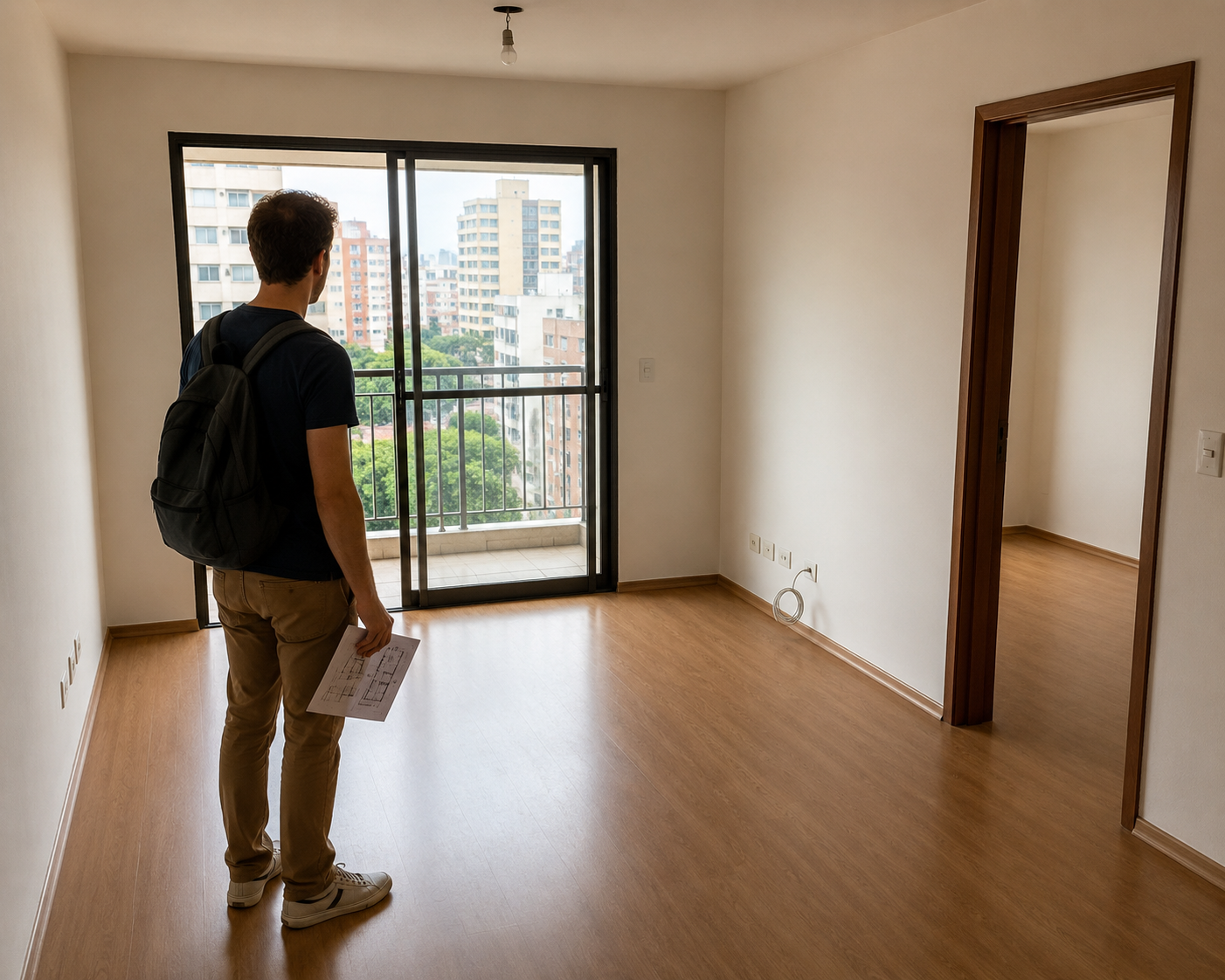
Outra surpresa frequente é o conceito de apartamento “semi-mobiliado”. Em muitos países, um apartamento vazio significa apenas ausência de móveis; no Brasil, às vezes significa ausência até de itens básicos que estrangeiros considerariam permanentes. Há imóveis sem geladeira, sem fogão, sem máquina de lavar e, ocasionalmente, até sem armários de cozinha ou box no banheiro. Em alguns apartamentos antigos, o chuveiro elétrico é instalado pelo próprio inquilino. O estrangeiro recém-chegado imagina que está alugando um “apartamento”; o proprietário imagina que está alugando “o espaço físico entre as paredes”.
Ao mesmo tempo, apartamentos realmente mobiliados podem incluir quase tudo: sofá, televisão, talheres, micro-ondas, ar-condicionado e até roupa de cama. O problema é que a definição de “mobiliado” raramente segue um padrão nacional claro. Um anúncio pode dizer “completo” e ainda assim faltar itens considerados essenciais pelo inquilino. Por isso, vistoria detalhada é quase uma obsessão brasileira. Fotografar cada parede, cada mancha e cada tomada não é paranoia; é estratégia de sobrevivência jurídica.
A relação entre proprietário e inquilino no Brasil é marcada por uma desconfiança mútua profundamente institucionalizada. Proprietários frequentemente acreditam que despejar um inquilino inadimplente pode levar muitos meses ou até anos. Inquilinos, por sua vez, acreditam que proprietários tentarão reter o depósito de garantia por qualquer detalhe microscópico: um risco na parede, uma dobradiça frouxa, uma pintura “fora do padrão”. Ambos os lados têm histórias reais que confirmam seus medos.
Por isso existem mecanismos de garantia relativamente incomuns para estrangeiros. Muitos contratos exigem “fiador” — uma pessoa que aceita responsabilidade legal pela dívida do inquilino e frequentemente precisa possuir imóvel quitado no mesmo estado. Para estrangeiros recém-chegados, isso é quase impossível. Então entram alternativas como caução, seguro-fiança ou títulos de capitalização. O seguro-fiança é particularmente curioso: o inquilino paga mensalmente uma espécie de seguro que protege o proprietário, mas o dinheiro não retorna ao final do contrato. Muitos estrangeiros interpretam isso como injusto; muitos proprietários interpretam como o mínimo necessário para dormir tranquilos.
Outro aspecto importante é a inflação. Durante décadas, o Brasil conviveu com inflação alta ou instável, e isso moldou profundamente os contratos de aluguel. Normalmente existe um reajuste anual indexado a algum índice econômico, como IGP-M ou IPCA. Em certos períodos, o IGP-M disparou dramaticamente, produzindo aumentos de aluguel que pareciam absurdos para os inquilinos. Em resposta, muitos proprietários renegociaram informalmente para evitar vacância. Na prática brasileira, a lei existe, mas a negociação cotidiana frequentemente vale mais do que a teoria contratual.
Já entre contratos, o aumento pode ser praticamente livre, desde que o mercado aceite. Não existe um teto nacional rígido para reajuste em novo contrato residencial. Um proprietário pode tentar aumentar muito o valor após a saída do inquilino anterior, especialmente em cidades com mercado aquecido como São Paulo, Rio de Janeiro ou Florianópolis. Mas o mercado impõe limites concretos: apartamento vazio também custa dinheiro. Condomínio continua vencendo. IPTU continua vencendo. Parcelas do financiamento continuam vencendo. E muitos proprietários brasileiros não são grandes investidores ricos; são aposentados, famílias de classe média ou pessoas extremamente endividadas tentando equilibrar contas.
Esse detalhe surpreende estrangeiros acostumados a imaginar “landlord” como sinônimo de riqueza. No Brasil, o proprietário frequentemente também está financeiramente pressionado. Há quem dependa integralmente do aluguel para complementar aposentadoria. Há quem tenha comprado o imóvel financiado e use o próprio aluguel para pagar o banco. Há quem herde um apartamento antigo cheio de problemas hidráulicos e descubra que o aluguel mal cobre o condomínio. Essa fragilidade econômica ajuda a explicar por que alguns proprietários tentam reduzir custos agressivamente, adiar reformas ou transferir responsabilidades ao inquilino sempre que possível.
E então surge o labirinto das despesas adicionais. O aluguel anunciado muitas vezes não é o valor final pago mensalmente. Em muitos edifícios brasileiros existe a taxa de condomínio, que pode variar enormemente dependendo da estrutura do prédio: portaria 24 horas, piscina, academia, elevadores antigos, segurança privada e funcionários aumentam bastante os custos. Em bairros nobres de grandes cidades, o condomínio pode se aproximar do próprio aluguel.
Além disso existe o IPTU, imposto municipal sobre propriedade urbana. Em alguns contratos o IPTU está incluído; em outros, não. Estrangeiros frequentemente se confundem porque anúncios anunciam apenas o “aluguel”, omitindo condomínio e IPTU em letras pequenas. O valor “real” pode acabar 30%, 40% ou mais acima do anunciado inicialmente.
Também chama atenção a divisão entre manutenção estrutural e manutenção cotidiana. Pela lei, problemas estruturais geralmente são responsabilidade do proprietário. Mas na prática surgem disputas intermináveis: infiltração veio do prédio ou do mau uso? O ar-condicionado já estava velho ou foi mal utilizado? O chuveiro queimou por desgaste natural ou instalação errada? Cada pequeno defeito pode virar uma micro-negociação jurídica informal.
Para muitos estrangeiros, o maior choque cultural talvez seja perceber que o sistema inteiro funciona simultaneamente com muita burocracia e muito improviso. Há contratos extensos, reconhecimento de firma, vistoria fotográfica, cláusulas detalhadas e múltiplas garantias. Mas também há negociações por WhatsApp às onze da noite, acordos verbais, descontos improvisados e soluções “temporárias” que duram anos.
No fim, alugar um apartamento no Brasil exige algo além de dinheiro: exige capacidade de negociação, tolerância à ambiguidade e compreensão de que tanto proprietários quanto inquilinos frequentemente agem defensivamente porque ambos se sentem vulneráveis. O sistema foi moldado não apenas por leis, mas por inflação histórica, lentidão judicial, desigualdade econômica e um mercado onde quase ninguém confia completamente em ninguém — embora todos precisem continuar fazendo negócios juntos.
______________________
Em Florianópolis
Em Florianópolis, o mercado de aluguel possui distorções muito particulares causadas pela mistura de turismo, geografia limitada e crescimento populacional acelerado. A cidade está espalhada entre ilha e continente, e boa parte das áreas desejadas possui oferta física limitada: morros, áreas ambientais protegidas, bairros pequenos e infraestrutura insuficiente impedem expansão rápida. Isso cria uma situação em que apartamentos relativamente simples podem atingir preços extremamente altos durante certas épocas do ano. Além disso, muitos proprietários preferem aluguel de temporada via aplicativos turísticos, especialmente perto das praias, porque conseguem ganhar em três meses de verão o equivalente a muitos meses de aluguel residencial tradicional. Como consequência, moradores permanentes frequentemente enfrentam escassez artificial de imóveis, contratos curtos ou proprietários que exigem que o inquilino saia antes da alta temporada. Não é raro encontrar anúncios “anuais” com cláusulas estranhas ou disponibilidade apenas até dezembro.
Outro problema típico de Florianópolis é a infraestrutura desigual entre bairros. O estrangeiro imagina vida paradisíaca perto da praia, mas descobre rapidamente questões práticas: trânsito severo nas pontes e vias principais, internet instável em certas regiões, umidade intensa, mofo constante e problemas hidráulicos em imóveis próximos ao mar. Muitos apartamentos parecem bonitos nas fotos, mas escondem infiltrações causadas pela maresia e pelo clima úmido da ilha. Há também forte sazonalidade econômica. Durante o verão, restaurantes, comércio e serviços explodem de movimento; no inverno, alguns bairros turísticos ficam quase vazios. Isso influencia o comportamento dos proprietários, que muitas vezes tratam o imóvel menos como residência urbana estável e mais como ativo turístico flexível. Para o inquilino estrangeiro, especialmente aquele vindo de países com mercado mais regulado e previsível, Florianópolis pode parecer simultaneamente maravilhosa e caótica: um lugar onde a vista da varanda é espetacular, mas o contrato talvez mude de lógica assim que chegar dezembro.
— Adam Donaldson Powell
_____________________
O Gringo e o Apartamento 302
Chegou o gringo com mala e contrato,
sorriso europeu, currículo exato,
pensando que aluguel era matemática:
depósito, assinatura, vida automática.
Viu no anúncio: “apartamento completo”.
Imaginou conforto discreto.
Abriu a porta — silêncio profundo.
Não havia geladeira nem fogão no mundo.
“Mas… onde está a cozinha?” perguntou.
“O espaço está aí”, o corretor respondeu.
“Você instala o resto.”
E sorriu honesto, quase modesto,
como quem explica a chuva ou a gravidade.
O gringo aprendeu uma nova verdade:
no Brasil, “semi-mobiliado”
é conceito filosófico avançado.
Vieram depois as taxas escondidas:
condomínio, IPTU, despesas esquecidas.
O aluguel dobrava sem mudar de nome,
como inflação antiga voltando com fome.
Pediu reparo na infiltração da parede.
O proprietário respondeu sem sede:
“Isso aí já estava quando chove forte.”
“Mas pinga na cama.”
“Faz parte da sorte.”
O gringo falava de direitos,
o dono falava de boletos.
Um citava jurisprudência,
o outro mostrava parcelas vencidas.
Porque o senhorio também sofria:
aposentadoria curta, banco cobrando todo dia,
um apartamento herdado da tia,
e um elevador quebrado fazia poesia
de despesas infinitas.
Então cada parafuso virava guerra,
cada pintura, disputa na terra,
porque despejo demora, processo se arrasta,
e advogado no Brasil nunca custa barato.
O gringo não entendia
como tanta burocracia
podia coexistir
com tanta gambiarra.
Mas aos poucos aprendeu a arte rara
de negociar no corredor,
mandar áudio cordial ao fiador,
aceitar desconto em troca de silêncio,
e discutir vazamento com paciência diplomática.
No fim do contrato, já quase brasileiro,
o gringo pintou parede, trocou chuveiro,
tirou foto até do piso do banheiro.
E quando entregou as chaves finalmente,
o proprietário disse calmamente:
“Você foi um bom inquilino.”
O gringo sorriu cansado.
Era talvez o elogio
mais sincero
que já tinha escutado no país.
— Adam Donaldson Powell

Apartment Rentals in Brazil 🇺🇸
The apartment rental market in Brazil appears simple at first glance: someone pays rent, someone hands over the keys, and everyone moves on with their lives. But for many foreigners — and even for many Brazilians — the system reveals a peculiar combination of legal formalism, economic improvisation, historical distrust, and everyday financial survival. Renting in Brazil is less a real estate transaction and more a permanent negotiation about risk, inflation, maintenance, debt, and patience.
In Brazil, most residential lease agreements last 30 months. This surprises many foreigners who are accustomed to one-year contracts. The reason is partly legal: Brazil’s Tenancy Law creates different rules depending on the contract length, and landlords historically preferred the 30-month model because it offers greater predictability for reclaiming the property. However, 12-month contracts also exist, especially in tourist cities, furnished apartments, or properties aimed at students and expatriates.
Another frequent surprise is the concept of a “semi-furnished” apartment. In many countries, an empty apartment simply means a lack of furniture; in Brazil, it can sometimes mean the absence of even basic items that foreigners would consider permanent fixtures. Some properties come without a refrigerator, stove, washing machine, or occasionally even kitchen cabinets or a shower enclosure. In some older apartments, the electric showerhead is installed by the tenant themselves. The newly arrived foreigner imagines they are renting “an apartment”; the landlord imagines they are renting out “the physical space between the walls.”
At the same time, truly furnished apartments may include almost everything: sofa, television, cutlery, microwave, air conditioning, and even bed linens. The problem is that the definition of “furnished” rarely follows any clear national standard. A listing may say “fully equipped” and still lack items the tenant considers essential. For that reason, detailed inspection reports are almost an obsession in Brazil. Photographing every wall, every stain, and every electrical outlet is not paranoia; it is a strategy for legal survival.
The relationship between landlord and tenant in Brazil is marked by deeply institutionalized mutual distrust. Landlords frequently believe that evicting a tenant who stops paying rent may take many months or even years. Tenants, meanwhile, believe landlords will try to keep the security deposit over any microscopic detail: a scratch on the wall, a loose hinge, paint “outside the standard.” Both sides have real stories that confirm their fears.
This is why there are guarantee mechanisms that seem relatively unusual to foreigners. Many contracts require a fiador — a person who accepts legal responsibility for the tenant’s debt and who often must own fully paid-off property in the same state. For newly arrived foreigners, this is almost impossible. Alternatives therefore include security deposits, rental insurance, or capitalization bonds. Rental insurance is particularly curious: the tenant pays a monthly fee for a kind of insurance that protects the landlord, but the money does not come back at the end of the contract. Many foreigners interpret this as unfair; many landlords see it as the bare minimum necessary to sleep peacefully at night.
Another important aspect is inflation. For decades, Brazil lived with high or unstable inflation, and this profoundly shaped rental contracts. There is usually an annual adjustment tied to some economic index such as the IGP-M or IPCA. In certain periods, the IGP-M rose dramatically, producing rent increases that seemed absurd to tenants. In response, many landlords renegotiated informally to avoid vacancies. In Brazilian practice, the law exists, but everyday negotiation often matters more than contractual theory.
Between contracts, however, rent increases can be practically unrestricted, as long as the market accepts them. There is no rigid national cap for increases in new residential contracts. A landlord may try to raise the rent sharply after the previous tenant leaves, especially in hot markets such as São Paulo, Rio de Janeiro, or Florianópolis. But the market imposes concrete limits: an empty apartment also costs money. Condominium fees still come due. Property taxes still come due. Mortgage installments still come due. And many Brazilian landlords are not wealthy real estate investors; they are retirees, middle-class families, or heavily indebted individuals trying to balance their finances.
This detail surprises foreigners accustomed to imagining “landlord” as synonymous with wealth. In Brazil, landlords are often financially pressured themselves. Some depend entirely on rent to supplement retirement income. Some bought the property with financing and use the rent itself to pay the bank. Some inherit an old apartment full of plumbing problems and discover that the rent barely covers the condominium fees. This economic fragility helps explain why some landlords aggressively try to reduce costs, postpone renovations, or transfer responsibilities to tenants whenever possible.
Then comes the maze of additional expenses. The advertised rent is often not the final amount paid monthly. Many Brazilian buildings have condominium fees, which can vary enormously depending on the building’s structure: 24-hour concierge service, swimming pools, gyms, old elevators, private security, and staff significantly increase costs. In upscale neighborhoods of large cities, condominium fees can approach the rent itself.
In addition, there is the IPTU, a municipal urban property tax. In some contracts the IPTU is included; in others, it is not. Foreigners are often confused because listings advertise only the “rent,” omitting condominium fees and IPTU in small print. The “real” price can end up being 30%, 40%, or more above the amount initially advertised.
Another striking feature is the division between structural maintenance and everyday maintenance. By law, structural problems are generally the landlord’s responsibility. But in practice, endless disputes emerge: did the leak come from the building or from misuse? Was the air conditioner already old, or was it poorly used? Did the shower burn out from natural wear or improper installation? Every small defect can become an informal legal micro-negotiation.
For many foreigners, perhaps the greatest cultural shock is realizing that the entire system operates simultaneously with enormous bureaucracy and enormous improvisation. There are lengthy contracts, notarized signatures, photographic inspections, detailed clauses, and multiple guarantees. But there are also WhatsApp negotiations at eleven at night, verbal agreements, improvised discounts, and “temporary” solutions that last for years.
In the end, renting an apartment in Brazil requires something beyond money: it requires negotiation skills, tolerance for ambiguity, and the understanding that both landlords and tenants often behave defensively because both feel vulnerable. The system was shaped not only by laws, but also by historical inflation, judicial slowness, economic inequality, and a market where almost nobody completely trusts anybody else — although everyone still needs to continue doing business together.
In Florianópolis
In Florianópolis, the rental market has particularly unusual distortions caused by the combination of tourism, limited geography, and rapid population growth. The city is spread between island and mainland, and much of the desirable area has physically limited supply: hills, protected environmental areas, small neighborhoods, and insufficient infrastructure prevent rapid expansion. This creates a situation in which relatively simple apartments can reach extremely high prices during certain times of the year.
In addition, many landlords prefer short-term rentals through tourism apps, especially near the beaches, because they can earn in three summer months the equivalent of many months of traditional residential rent. As a result, permanent residents frequently face artificial housing shortages, short contracts, or landlords who require tenants to leave before peak tourist season. It is not uncommon to find “yearly” listings with strange clauses or availability only until December.
Another typical problem in Florianópolis is the uneven infrastructure between neighborhoods. The foreigner imagines a paradise lifestyle near the beach, but quickly discovers practical issues: severe traffic on bridges and main roads, unstable internet in certain regions, intense humidity, constant mold, and plumbing problems in properties close to the sea. Many apartments look beautiful in photographs but hide leaks caused by sea air and the island’s humid climate.
There is also strong economic seasonality. During the summer, restaurants, commerce, and services explode with activity; in winter, some tourist neighborhoods become almost empty. This influences landlord behavior, as many treat the property less as stable urban housing and more as a flexible tourism asset. For the foreign tenant, especially one coming from countries with more regulated and predictable markets, Florianópolis can seem simultaneously wonderful and chaotic: a place where the balcony view is spectacular, but the contract may change its logic the moment December arrives.
— Adam Donaldson Powell
The Gringo and Apartment 302
The gringo arrived with suitcase and contract,
European smile, impeccable résumé,
thinking rent was mathematics:
deposit, signature, automatic life.
He saw the listing: “fully equipped apartment.”
He imagined discreet comfort.
He opened the door — profound silence.
There was no refrigerator or stove in sight.
“But… where is the kitchen?” he asked.
“The space is there,” the realtor replied.
“You install the rest.”
And he smiled honestly, almost modestly,
like someone explaining rain or gravity.
The gringo learned a new truth:
in Brazil, “semi-furnished”
is an advanced philosophical concept.
Then came the hidden fees:
condominium charges, IPTU, forgotten expenses.
The rent doubled without changing its name,
like old inflation returning hungry.
He requested repairs for the leak in the wall.
The landlord replied without concern:
“That already happens when it rains hard.”
“But it drips onto the bed.”
“That’s part of luck.”
The gringo spoke of rights,
the owner spoke of bills.
One cited legal precedent,
the other showed overdue installments.
Because the landlord suffered too:
a small retirement,
the bank demanding payment every day,
an apartment inherited from an aunt,
and a broken elevator turning
infinite expenses into poetry.
So every screw became a war,
every paint job a territorial dispute,
because eviction takes time,
lawsuits drag on,
and lawyers in Brazil are never cheap.
The gringo could not understand
how so much bureaucracy
could coexist
with so much improvisation.
But little by little he learned the rare art
of negotiating in the hallway,
sending polite voice messages to the guarantor,
accepting discounts in exchange for silence,
and discussing leaks with diplomatic patience.
By the end of the contract, already almost Brazilian,
the gringo painted walls, replaced the showerhead,
and photographed even the bathroom floor.
And when he finally handed over the keys,
the landlord calmly said:
“You were a good tenant.”
The gringo smiled tiredly.
It was perhaps the most sincere compliment
he had ever heard
in the country.
— Adam Donaldson Powell
Leave a Reply