Interview in three parts, by Adam Donaldson Powell
INTERVIEW: ALBERT RUSSO (Part Three)
Autumn 2012
Powell:
In this third and concluding segment of the interview, I would ask you to tell our readers how you see your transition from being a heterosexual family man (married father of two children) to a gay/bisexual family man, and how that has influenced your literature.
Did you begin to publish your books before, during or after this transition; and how long did it take from your first published book until you were to write, and then to publish, books that included gay or bisexual characters and themes?
Russo:
This transition came about quite late in my life, about the time I was getting my second divorce. I did not divorce because of it but because of an incompatibility of characters. Here again I escape any stereotype. In sexual matters I was a late comer, actually I can now say that I belonged to the tiny minority of asexual men. I was neither interested in men nor in women, and homosexuality for me was just a curiosity, like for instance the study of dinosaurs, until the age of 20 when I was ‘raped’ by a French woman. I then got married at first time and was in love with my wife. The second marriage was not one I had planned. I have two wonderful children who know all about me.
I started writing when I was about 20, in English, while I was studying at NYU. I continued writing in Italy, in both French and English and started publishing in US and French magazines in these two languages. It is much later, after my second divorce, that I began to write gay novels.
Powell:
Can you tell us a bit about how your “coming out” affected your writing and your need to write; and also how your writing affected your own gay identity in transition? Has writing about gay characters and gay themes enabled you to “break through” with other genres that you work with, or has your gay writing mostly benefited from your novels and short stories with heterosexual characters and themes?
Russo:
As I have mentioned before, my transition was so smooth I almost didn’t see it coming. This probably has much to do with the fact that It all happened in a big city, Paris, where anonymity allows you a certain freedom. And again, I found no difficulty in writing about gay sex, since I was already writing about heterosexual sex in the past.
Powell:
You have a rather impressive list of literary friends and acquaintances who are public concerning their gay status. Which of these are (in your experience) the most important or most influential in your case?
Russo:
Among the gay writers I like are: EM Foster, Proust, Tennessee Williams, James Baldwin, André Gide, Julien Green (an American who wrote in French), Bukowsky, and the list goes on.
The one I have been closest to is… Adam Powell, a wonderful poet and artist who is as daring in his writings – he has ‘the nerve’ to create in 4 different languages ( hat! as we say in French) – as he is endearing.
Powell:
How difficult has it been for you to find mainstream publishers for your gay-themed works? Do you see this as having gotten easier now that recognition of gay rights, gay marriage and gay partnership has come about in many European countries? Is there a better “market” for gay-themed books in France than in the USA? Is it easier to publish and sell gay-themed print books or gay-themed e-books, in your opinion?
Russo:
I was very lucky to have known a small French publisher who happens to be bisexual. He published my poetry and my first gay novel ‘L’amant de mon Père’ which sold very well, in spite of little promotion. And then Editions Hors Commerce came about, which published all my other books, including African stories, gay novels and poetry.
Powell:
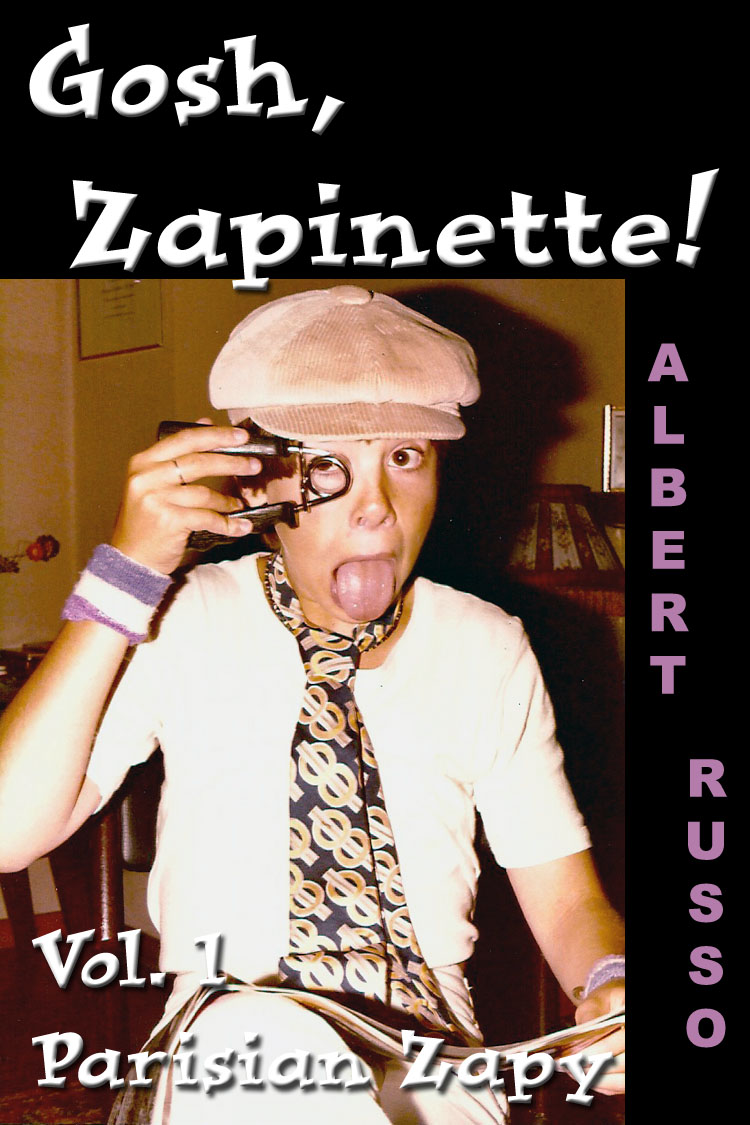
Your Zapinette series is rather cinematographic in style. Do you envision the stories that unfold as a film?
Russo:
Yes I do, but that is a dream many writers have. It would be a ‘miracle’ if a TV producer got interested in my Zapinette series. Ginkgo, my other French publisher, also sees my African novels in films. But I have no illusion about it ever happening, since I have no connection whatsoever with the movie industry.
Powell:
You are also renowned for your numerous art photography books. How has this discipline influenced your novel-writing?
Russo:
I like them to interact. Critics have often said that my writing was visual, so photography is a natural with me.
Powell:
And finally, Mr. Russo: Will your readers ever experience Zapinette as a mature young woman, or will she forever embody the refreshing childish wisdom in us all?
Russo:
I don’t think so. She is so cheeky and rambunctious, I want her to remain that way, and moreover she allows me to write the most outrageous things that come through my mind, things that I could not write in a different context.
Thank you for your empathy and your kind patience, Adam (Mr. Powell).
Powell:
And thank you Albert Russo! I would like to end this interview with a reprint from your latest book, “Crystals in a shock wave — The works of / Albert Russo / et son oeuvre”:
Albert Russo’s Essay on Writing,
Identity, and the Meaning of Life
(presented at the ‘Colors of Africa’ event in Saint-Hilaire-la-Côte, France, 2012)
I’m sometimes asked why I write. So I answer this: to continue my quest for the meaning of life, because I still constantly need to discover new horizons, I still need to meet people like me and people different from me, otherwise I feel, in a way, orphaned from humanity. I need to know these people who live on the other side of the divide, whether they reside in the country where I live or beyond our borders.
This is where the question of identity, or identities, arises. To illustrate my point, I would say that I must overcome a series of barriers—an exercise that is constantly renewed, as long as I cannot communicate with the Other, this Other who faces me and who does not know me, and who remains for me an enigma or simply a cliché. Utopian, you might cry! Well, yes, and that is why I write. Another image comes to mind: we are all trapped in a labyrinthine prison; some realize it, others don’t, or perhaps they choose to ignore it for their own comfort.
These barriers I mentioned earlier—to simplify, I’ll limit myself to six or seven at most. I always try to overcome them—and I do mean overcome, not destroy—because I’m convinced that a slow approach, even imperfect communication, is a thousand times more valuable than violence. It’s about taking the time to be present instead of imposing oneself, offering a smile to the stranger instead of giving them a cold stare or ignoring them with indifference.
Here, I’ll use ‘barriers’ and ‘borders’ interchangeably.
1) First, there are the barriers erected within the language one has spoken since birth. In my case, I would mention French and English, my two ‘mother tongues’. Let’s take the example of French, a universal language spoken on all 5 continents – this can also apply to English, Portuguese, or Spanish, which are also spoken in all four corners of the earth.
Let me digress for a moment: when I hear people claim that a particular language, in this case French, is the most beautiful in the world, I bristle. Because that’s a barrier erected between one’s own language and that of others. Does that mean that Chinese, Turkish, Swahili, or Hebrew are less beautiful, less ‘refined,’ in other words, ‘inferior’? Minimizing the quality of another language is not the best way to defend one’s own. Of course, one can have preferences, whether rooted in tradition or emotion, but ultimately, that choice remains personal.
Returning to French, which I find superb, both when I hear it resonate in the mouth of someone for whom it is much more than a simple means of communication—a treasure reflecting a millennia-old culture, treated with both respect and pleasure—and when I make it my own for writing, it is further enriched, even embellished, by the contributions of the French dialects that have spread to other continents. For elsewhere than in France, there are expressions as flavorful as they are exotic, untranslatable into ‘classical’ French. There is also a logic to some of these dialects that is sometimes lacking in standard French. I will only cite a few examples, taken at random, such as the ‘septante’ of the Belgians and the Swiss and the ‘huitante’ of the latter, instead of the seventy and ninety, really far-fetched, or the ‘courriel’, a Quebec neologism, so much prettier than ‘mél’, not to mention all those Creole expressions or French from Africa and Oceania that make your mouth water.
That said, I firmly believe that the French that should be taught worldwide is what, for lack of a better term, I would call classical French—yes, the beautiful language of Molière—so that all French speakers can both understand each other and better communicate with one another. What I also cherish are the different accents that give so much color and ‘personality’ to the diverse dialects of French. Remove the Marseilles accent, or the accent of the Southwest, or even the rolling ‘r’s of other speakers, and you deprive French of its most flavorful ingredients.
I would like to add a remark concerning the country of my birth, Congo/Zaire (the former Belgian Congo), as large as Western Europe, and which will soon become the second largest French-speaking country after France—when schooling becomes compulsory and free for children aged 6 to 18—with its forty-five million inhabitants. The government of this immense territory, which encompasses hundreds of ethnic groups and has almost as many languages, of which Lingala, Kiswahili, and Tshiluba are the most widely spoken, has chosen French as its official language because, to communicate with their peers in Lubumbashi, located in the far south of the country, or with those in Kasai, the provinces of Equateur, or Kivu, a resident of Kinshasa must speak French.
To return to the question of identity, I also believe it is imperative, again using the case of Congo, that future French speakers not abandon their mother tongue and that they be as proud of it as of the French they learned at school. This applies equally to Corsicans, Bretons, or Haitians, because by taking away their mother tongue, we amputate a part of their identity.
2) I now come to the language barrier, and I will summarize my thoughts in a few words. Utopian, yes, that adjective again: if I could live 1,000 years like certain figures in the Bible, I would learn the 6,000 or so languages of our planet—alas, more and more are disappearing due to the homogenization of our cultures—both for the sake of knowledge and for the pleasure of being able to communicate with Others, those Others who would then be more and more like me. Wouldn’t I thus have the opportunity to overcome the most significant barriers that separate me from those we call foreigners—a word I deeply dislike?
3) Doesn’t this lead us straight to the barrier of time, that time which seems to shrink as we ‘cross’ continents and ‘skim’ cultures by flying over them, without understanding their essence? But it’s already a step! Let’s turn inward, within the family, an average family in our Western countries, neither poor nor rich, and which, with the economic crisis of this second decade, has to tighten its belt.
We gather in the living room after dinner, in front of the television. Little is said. The teenage son is starting to get bored and goes to his computer in his room. The youngest finds the program—a documentary on climate change—too serious; she too goes to her room and distracts herself with video games. Time is held hostage here, and sometimes communication in this family is reduced to shouting. We no longer connect, we drift apart, and this is happening more and more, due to the fatigue of the day and the stress of the parents, both of whom work.
4) There is the visual barrier: two people who do not know each other stand in front of the same so-called ‘classical’ painting. One finds this painting dark and depressing, the other, on the contrary, that it gives off a strong atmosphere and that the chiaroscuro brings the characters to life.
The same people find themselves in a room of abstract art. The first one murmurs: “It’s pathetic, and we pay a fortune for it!” The other exclaims to himself: “What strokes of genius!”
But this barrier, if we can call it that, does not necessarily separate people whose tastes differ.
5) The culinary frontier, the one we cross most easily. We can know nothing about people from other countries and still appreciate their cuisine, whether it’s Congolese chicken mwambe, Moroccan tagine, Peking duck, or tortellini al pesto. Here’s a pleasant introduction to the countries whose specialties we’ve tasted.
6) Finally, there is the racial and/or ethnic barrier—a misnomer, since scientifically, it has been proven that the human race is one and only one. In fact, this is the first barrier we notice. A Black person, a blond person, a person with brown skin, a café-au-lait person, cannot go unnoticed. But once the first three barriers have been overcome, the racial barrier should fall on its own. I am simplifying, of course; too many centuries have passed with atavistic prejudices and stereotypes that persist even in the subconscious. How many generations will it take to eliminate the cruel caste system in India, antisemitism in Europe and Muslim countries, despite the Holocaust, ethnic conflicts in Africa and Asia, after the genocides in Rwanda and Cambodia, and the religious wars, reignited today, between Muslims, Christians, and Jews?
But if you already learn the language of your ‘opponent’, there may be a start of dialogue, unless you persist in believing that religion remains the major obstacle that divides you, as between Protestants and Catholics in the past, or Shiites and Sunnis today, even though these people sometimes speak the same language.
And in conclusion, I’ll repeat myself: a smile, even if you don’t understand the other person’s language, is so much more accommodating, so much more pleasant than a punch. For this to happen, of course, you have to want to get closer to the other person.
After all, aren’t Others our Mirror? We can make this mirror faithful or distorting.
(reprinted with permission of Albert Russo.)
The following biography of Albert Russo is reprinted from his website: www.albertrusso.eu
BIOGRAPHY
A bilingual author, Albert Russo writes in both English and French, his two “mother tongues”; he also speaks five languages fluently and has lived in Africa, the United States and Europe. He is the recipient of many awards, such as The American Society of Writers Fiction Award, The British Diversity Short Story Award, several New York Poetry Forum Awards, Amelia Prose and Poetry Awards and the Prix Colette, among others. He has also been nominated for the WB Yeats and Robert Penn Warren poetry awards. His fiction, which has been praised by James Baldwin, Pierre Emmanuel, Paul Willems, Gilles Perault and Edmund White, has appeared worldwide in a dozen languages.
Some of the journals and magazines that have published his work:
The literary Review, Confrontation, The International Herald Tribune (published with The New York Times and The Washington Post), Playboy magazine (French edition), Cosmopolitan (Dutch Edition), the Midatlantic Review, Books in Canada, impulse, Short Story International, Ambit, The Edinburgh Review, Chapman, Indian Literature, The Taj Mahal Review, Africa Prize, New Hope International, Passport, World Wide Writers, The European Journal of Psychology, Prospice, Envoi, Poets for Africa, The Body Politic, The Auschwitz Foundation Bulletin, Fremde Verse, Los Muestros, Plurilingual Europe, etc. The BBC World Service has broadcast his story “The Discovery”.
His African novels have been favorably compared to VS Naipaul’s work, which was honored with the Nobel Prize for Literature in 2001.
He is a member of the jury for the Prix Européen (with Ionesco, until his death) and sat in 1996 on the panel of the prestigious Neustadt International Prize for Literature which often leads to the Nobel Prize.
WHERE TO BUY THE BOOKS OF ALBERT RUSSO

Leave a Reply