— Adam Donaldson Powell 🎨✍🏻📖

AI, the Internet, and the Changing Fate of Artists: A More Complex Story Than “Technology Ruined Art”
The claim that artificial intelligence has “ruined the art market” reflects a real anxiety among artists, but it also oversimplifies a much longer transformation that began decades before generative AI appeared. The disruption facing artists today is not only the result of AI-generated images. It is the consequence of a fundamental shift in how culture is produced, distributed, discovered, and valued in the digital age.
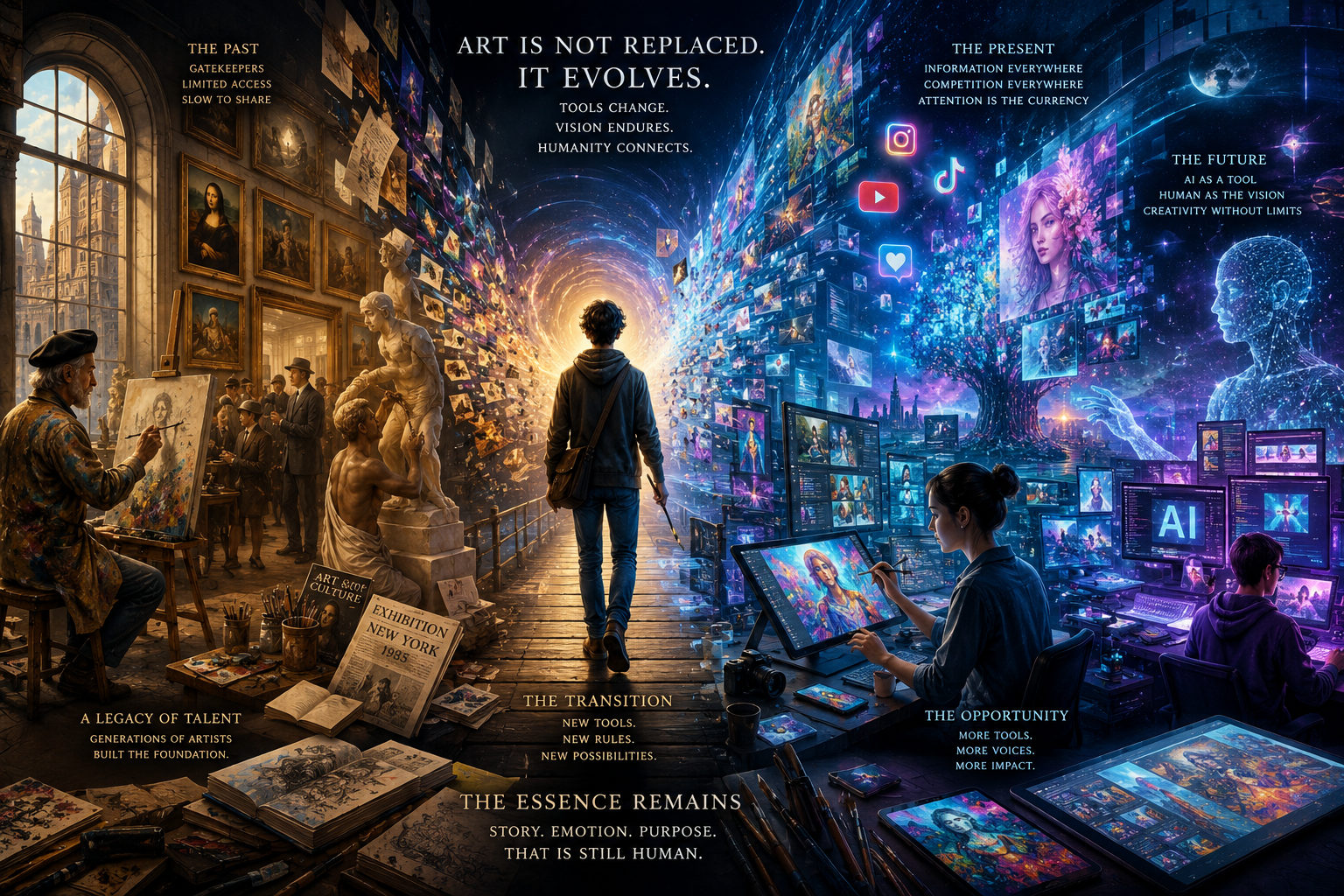
AI arrived at a moment when the traditional art economy had already been weakened by the internet, globalization, changing consumer behavior, and the decline of older cultural gatekeepers. While AI has introduced new challenges, it is better understood as the latest tool in a much larger historical transition.
For much of the twentieth century, artists could build careers through systems that no longer operate in the same way. Galleries, critics, magazines, exhibitions, and cultural institutions acted as filters that helped determine which artists gained visibility. The rise of famous artists from the 1980s and 1990s occurred within a different environment: one where physical exhibitions, art schools, collectors, and gallery relationships played a much larger role in shaping public reputation.
Many talented artists from that era created remarkable work but struggled when the internet transformed the rules. The new environment rewarded not only artistic ability but also visibility, branding, networking, consistency, and the ability to communicate directly with audiences. An artist could no longer rely only on the quality of the work itself. The internet became a crowded global marketplace where millions of creators competed for attention.
However, it would be inaccurate to say that earlier artists simply “failed to adapt.” Many came from a professional culture that trained them to create art, not to operate as media personalities, entrepreneurs, or online brands. The skills needed to succeed on social media — constant self-promotion, audience engagement, content production, and personal storytelling — were not traditionally considered part of an artist’s craft. The transition from “artist” to “artist as a public-facing brand” changed the profession.
At the same time, cultural attention moved toward new forms of influence. Social media platforms rewarded popularity, emotional reaction, and shareability. Influencers, online personalities, and algorithm-driven trends increasingly shaped what people saw and valued. The public often responded less to artistic history or technical mastery and more to visibility, personality, aesthetics, and social proof. Events, international exhibitions, luxury branding, and celebrity association became powerful signals of prestige.
This does not mean audiences became less intelligent or that all popular art lacks value. Rather, the mechanisms of attention changed. Every era has had its own forms of hype: royal commissions, newspaper critics, museum exhibitions, celebrity collectors, and auction houses all influenced artistic reputation in earlier periods. Social media simply created a faster and more democratic — but also more chaotic — version of cultural competition.
AI enters this environment as both a disruption and an opportunity. Critics are correct that AI-generated images can threaten certain areas of commercial illustration, stock imagery, advertising, and design work. Companies that previously hired artists for simple visual production may choose cheaper automated alternatives. For artists whose income depended on producing large volumes of predictable work, this represents a serious challenge.
However, AI is not the first technology to transform creative labor. Photography changed painting. Digital editing changed traditional production methods. Desktop publishing changed graphic design. The camera did not eliminate artists; it forced artists to reconsider what painting could achieve. Similarly, AI may reduce demand for some types of production while increasing demand for artists who use new tools creatively.
The idea that AI gives “everyone access to art” is partly true. AI tools allow individuals and businesses to quickly generate images, experiment with ideas, and communicate visually without needing years of technical training. This expands access to creativity. But access to tools does not automatically create artistic meaning. A generated image may be visually impressive, yet audiences still value human intention, storytelling, originality, cultural perspective, and emotional connection.
In fact, AI may create new opportunities for artists who learn how to use it strategically. An artist can now combine traditional skills with artificial intelligence to create customized designs, personalized products, interactive experiences, and visual solutions for clients. Instead of only selling finished artworks, artists can become creative problem-solvers who help individuals and companies communicate ideas.
The deeper issue is not that AI replaced artists. It is that the definition of an artist’s role is changing. The artists who succeed in the future may not simply be those who can produce images, because machines can increasingly assist with image production. They may be those who develop a unique vision, build communities, understand technology, and create experiences that cannot be reduced to a single generated picture.
Many gifted artists from previous generations deserve recognition because history should remember that talent and fame are not the same thing. Countless skilled creators existed outside the spotlight because the systems that produced fame were limited, selective, and often dependent on timing and connections. The internet did not remove this problem; it changed the rules for how it happens. Today’s overlooked artists may need to be understood not as failures, but as creators who belonged to a transitional period between two cultural economies.
The story of AI and art is therefore not simply one of destruction. It is a story of technological change, economic pressure, and cultural evolution. AI has created legitimate concerns, especially around income, originality, and ownership, but the decline of the traditional art market began long before AI. The internet transformed how artists are discovered, social media transformed how attention is earned, and artificial intelligence is now transforming how images are made.
The artists who adapt will not necessarily be the ones who abandon tradition or blindly embrace technology. They will be the ones who understand history: that every major artistic era has been shaped by new tools, new audiences, and new definitions of value.
Leave a Reply