— Adam Donaldson Powell

From Bookshelves to Smartphones: How Technology Is Transforming Reading and Reshaping the Writer’s Craft
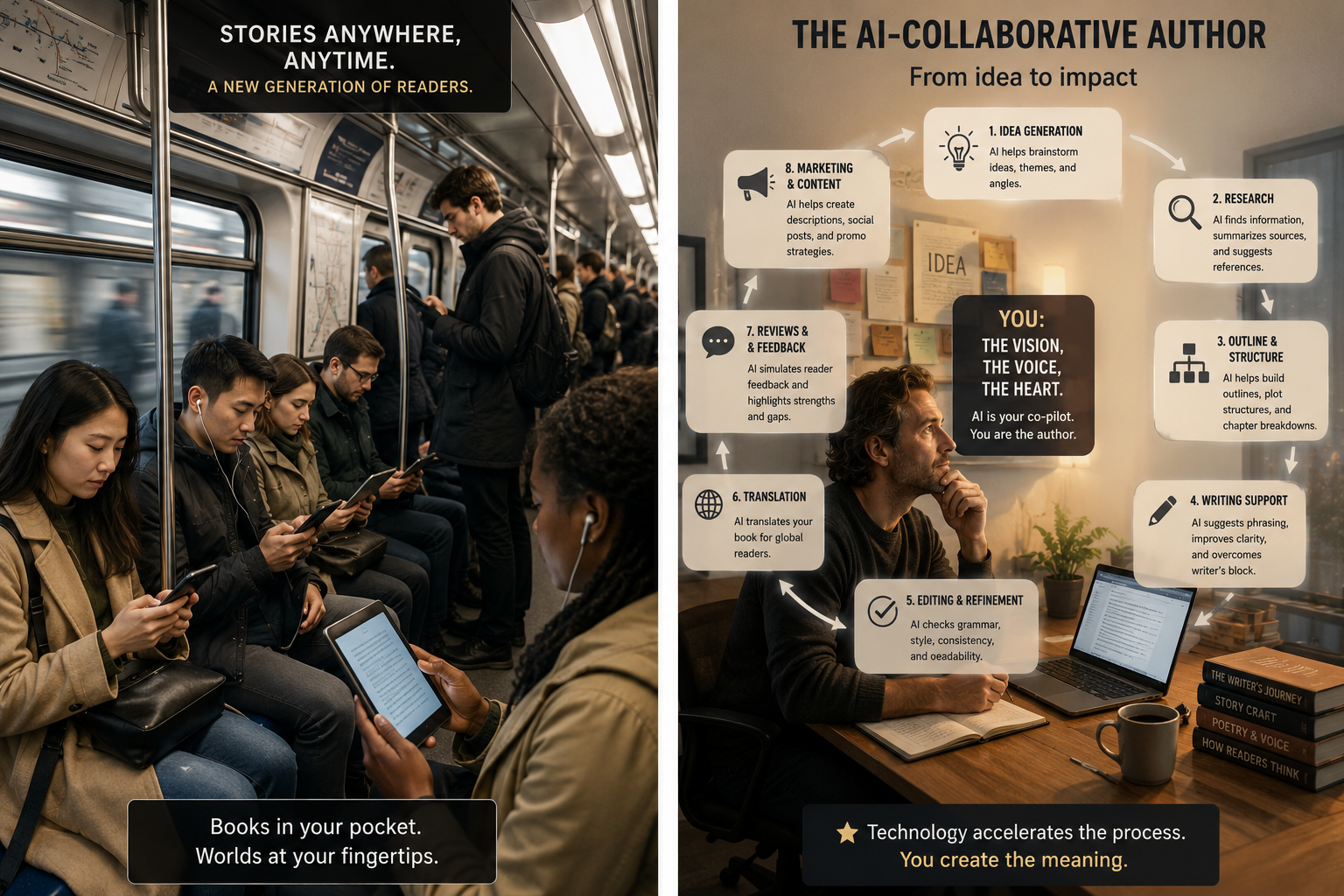
For centuries, the physical book defined the relationship between writers and readers. A writer created a manuscript, a publisher selected and edited it, printers produced copies, bookstores distributed them, and readers made time to sit down with a book. Technology has disrupted almost every part of this chain. Today, reading is no longer tied to a chair, a lamp, or a bookshelf. A novel, essay, or biography can travel in a pocket, appear instantly on a phone screen, or be heard through headphones while a reader is commuting, exercising, or doing household tasks.
This transformation has expanded access to literature—but it has also changed expectations. The same technologies that make reading easier are influencing what readers choose, how they consume stories, and how writers create them.
Reading Without the Weight of a Book
One of the biggest changes brought by digital reading is convenience. Many people enjoy books but struggle to find uninterrupted time for traditional reading. A large physical book requires a certain commitment: it must be carried, opened, and read in a suitable environment. For commuters, travelers, and people with busy schedules, this can be a barrier.
E-books remove many of these obstacles. A reader can carry an entire library on a smartphone or tablet and continue reading whenever a few spare minutes appear. Waiting for a train, sitting on a bus, or standing in a queue can become opportunities to read.
Audiobooks have pushed this even further. They have transformed “dead time” into reading time. A person who might never sit down for an hour with a novel can experience the same story while commuting or performing routine tasks. The growth of audio has expanded the definition of reading itself: consuming a book is no longer necessarily a visual activity.
The result is a larger potential audience. People who previously felt excluded from reading because of time constraints, physical limitations, or lifestyle demands now have easier access to literature.
The Rise of the Independent Writer
Technology has also transformed publishing. In the past, writers depended heavily on traditional publishers to bring their work to readers. Publishers controlled printing, distribution, marketing, and often the decision of which books deserved to exist in the marketplace.
Digital publishing has changed that relationship. A writer can now create an e-book, upload it to online platforms, and sell it directly to readers. In effect, many writers can become their own publishing companies.
This creates enormous freedom. Authors no longer need permission from a publishing gatekeeper to release a book. Niche topics, experimental works, and books aimed at smaller audiences can find readers without requiring large print runs or bookstore space.
However, independence also brings responsibility. The writer who becomes a publisher must also become a marketer, editor, brand manager, and businessperson. Writing the book is only part of the process. Visibility has become a major challenge because digital platforms contain millions of competing titles. A great book can disappear without effective promotion.
How Technology Influences Literary Choices
The changing relationship between readers and books inevitably affects the choices writers make. Literature has always adapted to new technologies. The rise of newspapers influenced the development of shorter forms. The arrival of radio and film changed storytelling techniques. Digital reading and audio consumption are now creating new pressures and opportunities.
Shorter and Faster-Paced Writing
Many readers today consume content in smaller fragments of time. This does not mean readers have lost interest in long books—major novels and epic stories continue to succeed—but it does mean that writers often need to capture attention quickly.
Digital environments encourage stronger openings. The first pages of a book must immediately create curiosity because readers have countless alternatives available. A slow introduction that might have worked in the past may struggle in an environment where a reader can download another book within seconds.
This may encourage tighter prose, faster pacing, and shorter chapters. Some writers increasingly structure books around smaller reading sessions, creating natural stopping points that fit modern habits.
The Changing Length of Books
Book length is becoming more flexible. Traditional publishing often favored certain formats because printing and distribution costs mattered. Digital publishing removes many of those limitations.
A writer can publish a 25-page novella, a 300-page novel, or a multi-volume series without worrying about physical production in the same way. This opens opportunities for forms that previously struggled commercially.
However, digital convenience can also create pressure toward shorter works. Some readers may prefer books that provide a complete experience without requiring a major time investment. This may lead to growth in shorter fiction, essays, serialized stories, and specialized non-fiction.
Genre Changes and Market Demand
Technology has made it easier for writers to reach specific audiences. Instead of trying to appeal to everyone, authors can write for highly focused communities.
This benefits genres with dedicated readers, such as romance, science fiction, fantasy, mystery, and personal development. Online platforms allow writers to find audiences that traditional bookstores might never have reached.
At the same time, algorithms influence visibility. Digital bookstores and reading platforms often recommend books based on previous purchases and reading patterns. This can help readers discover similar works, but it may also encourage writers to follow successful formulas.
A writer may feel pressure to produce books that match popular trends: familiar themes, recognizable structures, and predictable reader expectations. The risk is that literature becomes optimized for market performance rather than artistic exploration.
Writing for the Ear as Well as the Eye
The growth of audiobooks is creating another important change: writers increasingly have to consider how their words sound.
A sentence that looks elegant on a page may not work when spoken aloud. Long descriptions, complex sentence structures, and subtle visual formatting may become less effective in audio form. Dialogue, rhythm, and clarity become more important.
This could influence writing styles. Future writers may increasingly create stories designed to function across multiple formats: text, audio, and even interactive digital experiences.
The Paradox of Digital Freedom
Technology has created a fascinating paradox for writers. On one hand, it has removed barriers. More people can publish, more readers can access books, and more unusual voices can find audiences.
On the other hand, the abundance of content makes attention more difficult to earn. The challenge is no longer simply getting published—it is being discovered.
The modern writer must balance two competing demands: creating meaningful literature while understanding the realities of a digital marketplace. A successful writer today may need the imagination of an artist and the strategic thinking of an entrepreneur.
The Future of Writing
Technology is unlikely to replace traditional literature, but it will continue to reshape its forms. The novel will not disappear, just as physical books did not disappear after the arrival of e-books. Instead, different forms of storytelling will coexist.
The writers who adapt best may be those who understand both sides of the transformation. They will recognize that technology changes the way people consume stories, but it does not change the fundamental human desire for ideas, emotions, imagination, and connection.
The future of writing will not simply belong to those who write the longest books or the shortest books. It will belong to those who understand how to tell compelling stories in a world where readers can access millions of voices instantly—and where every moment, from a subway ride to a quiet evening at home, can become an opportunity to enter another world.
AI and the New Literary Ecosystem: Translation, Editing, Reviews, and the Democratization of Writing
The digital revolution did not stop with e-books and self-publishing. Artificial intelligence is now transforming the supporting services that surround literature: translation, editing, marketing, criticism, and even the creation of audio content. For writers, this represents another major shift in power. Tasks that once required expensive professional networks can now be accessed instantly and at relatively low cost.
From Local Writer to Global Author: AI Translation
For much of literary history, reaching international readers required publishers, translators, and distribution networks. A writer in one language often depended on a chain of professionals before their work could reach another culture.
AI translation tools are changing this equation. A writer can now translate a manuscript into multiple languages within minutes or hours rather than waiting months for a human translation process. This creates new possibilities for independent authors who want to reach global audiences.
A French novelist, for example, no longer necessarily needs a major publishing house in another country to introduce their work to foreign readers. A self-published author can produce translated editions and distribute them internationally through digital platforms.
However, translation is more than replacing words from one language with words from another. Literature contains cultural references, humor, rhythm, symbolism, and emotional nuance. A machine can produce a highly accurate translation while still missing the artistic qualities that make a poem, novel, or essay unique.
The future may therefore not be a choice between human translators and AI, but a collaboration: AI providing speed and accessibility, while human expertise refines voice, style, and cultural meaning.
AI as the Writer’s Editor
Editing has traditionally been one of the biggest barriers for independent writers. Professional editors provide valuable feedback on structure, grammar, pacing, character development, and clarity—but their services can be expensive.
AI writing assistants now offer many writers immediate editorial support. A writer can ask for feedback on a chapter, identify unclear passages, improve language, test different styles, or analyze whether a story maintains reader interest.
This changes the writing process itself. In the past, writers often completed a manuscript and then sought external feedback. Today, they can receive continuous assistance while creating the work.
For new writers especially, this lowers the barrier to entry. More people can improve their writing before publishing. At the same time, easy access to editing tools may create a new challenge: if everyone can produce technically polished text, originality, personality, and emotional depth become even more important.
Good editing has never been only about correcting mistakes. It is about understanding intention. AI can identify patterns and suggest improvements, but the writer remains responsible for artistic decisions.
The Automation of Literary Discussion and Reviews
Literary criticism and book discussion are also being transformed. AI can now summarize novels, analyze themes, compare writing styles, and generate discussions about poetry, essays, and fiction.
For readers, this creates new ways of engaging with books. Someone who finishes a novel can immediately explore interpretations, historical context, philosophical themes, or comparisons with other writers.
For authors, AI-generated reviews and discussions create new opportunities for visibility. A self-published writer can use AI to help produce podcasts, discussion guides, promotional materials, or analytical content connected to their work.
This may help smaller authors compete in a crowded marketplace. A book no longer needs a traditional newspaper review or literary magazine feature to generate conversation. Writers can create their own ecosystem around their work.
However, this also raises questions about authenticity. Literature has always depended on human conversation: readers sharing emotional reactions, critics offering personal interpretations, and communities forming around books. If reviews become increasingly automated, there is a risk that literary culture becomes more analytical but less personal.
AI-Generated Podcasts and New Forms of Literary Promotion
Audio is already one of the fastest-growing ways people consume books. AI is expanding this trend by making it easier to create podcasts, author interviews, reading discussions, and literary commentary.
A writer can transform a written essay into an audio program, create a discussion about their novel, or produce promotional content without a studio, production team, or broadcaster.
This changes the role of the writer. The modern author is no longer only someone who produces text. They may also become a creator of an entire media presence: writing books, recording discussions, engaging audiences, and building communities.
The boundary between author, publisher, and media producer is becoming increasingly blurred.
The New Question for Writers: What Should Humans Do Best?
As AI takes over more mechanical and technical tasks, writers may need to focus more strongly on what technology cannot easily replicate: unique perspectives, lived experiences, emotional truth, imagination, and cultural insight.
The advantage of a writer in the AI age may not be the ability to produce words quickly. Machines can already produce enormous amounts of text. The advantage will be knowing which ideas matter, which stories deserve to be told, and how to create a connection with readers.
Technology is therefore creating both a challenge and an opportunity. It allows more people than ever to write, translate, edit, publish, and promote books. But because production has become easier, meaning and originality may become the qualities that distinguish truly memorable literature.
The future writer may not simply be an author with a manuscript. They may be an independent creative organization: a writer, publisher, translator, editor, and communicator supported by artificial intelligence.
Leave a Reply