Pip: Welcome to osoparavos.com, where the questions are big, the stakes are real, and apparently 1998 never fully left the building.
Mara: Adam Donaldson Powell has been writing about what happens when football history meets a once-in-a-generation matchup — specifically, what Norway versus Brazil in 2026 actually means, beyond the ninety minutes.
Pip: Let’s start with the collision itself — tradition, renewal, and why this fixture carries weight that most group-stage games simply don’t.
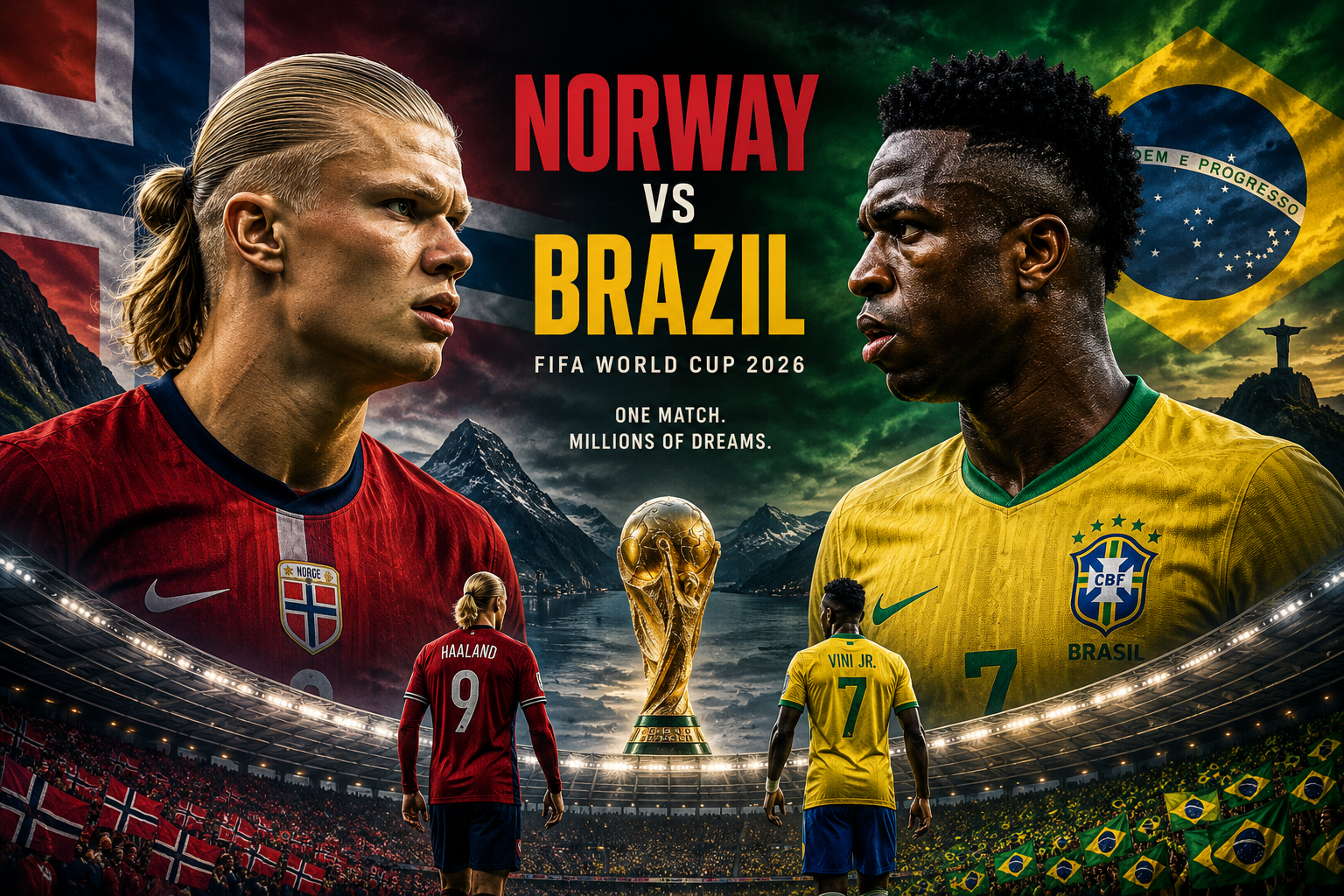
Norway vs. Brazil: History, Stakes, and 2026
Mara: The post frames this matchup as something beyond a single result — the question it’s really asking is what it means when football’s most decorated nation meets a country returning to the World Cup stage after nearly three decades away.
Pip: And the post answers that directly. The setup is that Brazil’s identity is inseparable from its history: “Desde os tempos de Pelé, passando por Garrincha, Zico, Romário, Ronaldo e Ronaldinho, até a geração moderna, o Brasil construiu uma identidade baseada no talento ofensivo e na paixão nacional pelo futebol.”
Mara: What that means in practice is that every Brazil match at a World Cup arrives pre-loaded with expectation — not just to win, but to win a particular way. That’s the inheritance Vinicius Junior and Rodrygo are stepping into, and the post is clear that 2026 is specifically framed as a moment of reclamation after disappointing recent tournaments.
Pip: Norway’s side of the ledger is just as loaded. Twenty-eight years off the main stage is a long time, and Haaland’s emergence is what changed the calculus entirely — the post describes him as the principal symbol of a new era, one that’s shifted how the rest of the world reads Norwegian football.
Mara: The post also names Martin Ødegaard as the creative and leadership anchor in midfield, alongside younger players like Antonio Nusa and Oscar Bobb — a generation that has moved Norway from “organized and physical” to genuinely threatening on the attack.
Pip: Which is where 1998 comes back in. Norway beat Brazil two-one in the group stage that year, and the post treats that result not as a footnote but as the narrative spine of the whole fixture — proof that reputation doesn’t decide outcomes.
Mara: Exactly. The post puts it plainly: for Brazilians, 2026 is a chance to reassert historical superiority; for Norwegians, it’s a chance to prove the new generation belongs at the top table. Two different football philosophies — improvisation and creative freedom on one side, structure and physical intensity on the other — meeting on the biggest stage in the sport.
Pip: And that philosophical contrast is what makes the match matter even if you have no stake in either country’s result.
Mara: The post closes on that note — that what makes a World Cup fixture historic isn’t the scoreline, it’s the capacity to become collective memory for millions of people on both sides.
Pip: History as pressure, renewal as ambition — that tension doesn’t resolve cleanly, which is probably why the fixture is worth writing about before a ball is kicked.
Mara: Back here next time with whatever osoparavos.com puts on the table next.
Leave a Reply