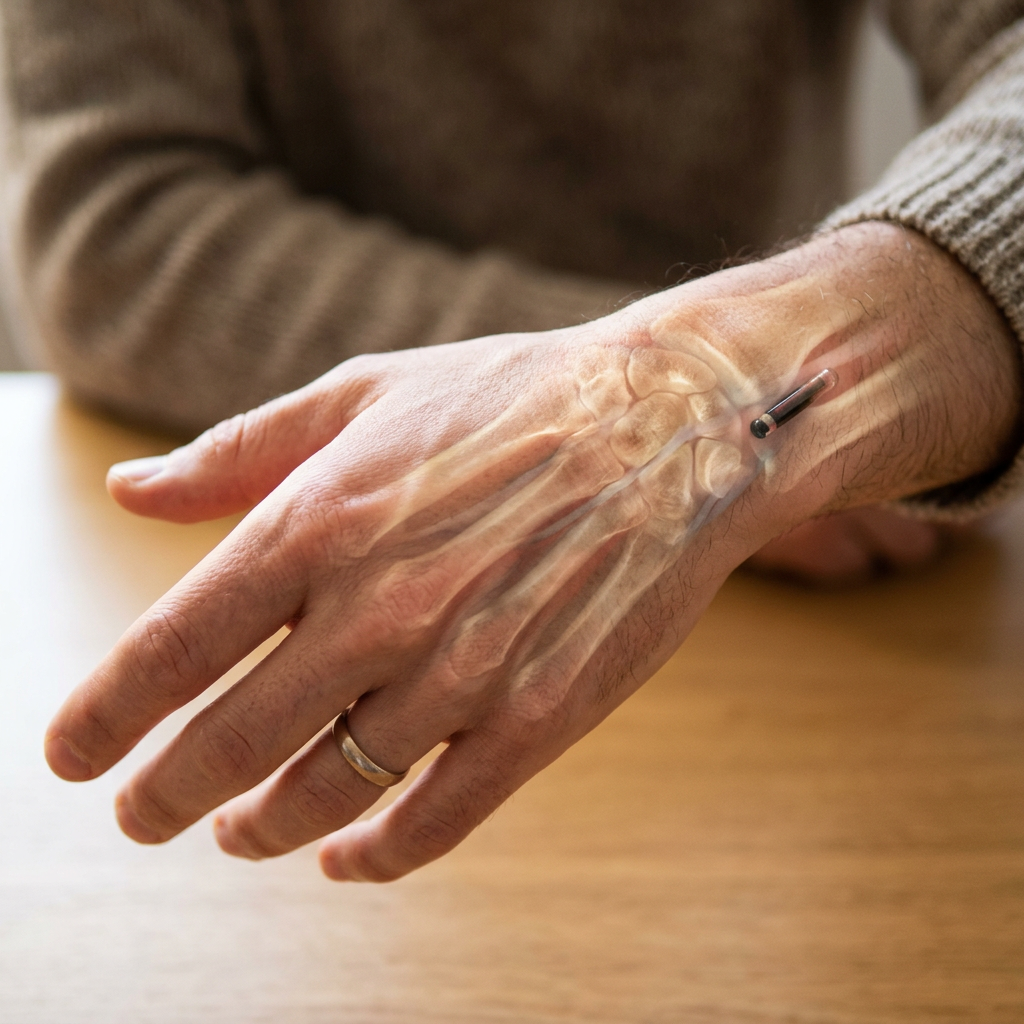
Voluntary human microchipping typically involves inserting sub-dermal RFID or NFC transponders—usually the size of a grain of rice—into the webbing between the thumb and index finger.
Notable Real-World Examples
- Sweden’s Biohacking Movement: Thousands of Swedes voluntarily receive implants to store emergency contact info, access gyms, log into office systems, and replace train tickets via national rail operators.CSIS
- Three Square Market (Wisconsin, USA): In 2017, the tech company offered voluntary microchip implants to employees. Over 50 workers agreed to use them for keyless building entry, logging into computers, and buying snacks at breakroom kiosks.EBSCO+ 1
- Walletmor Payment Implants: A commercial firm that produced bio-compatible NFC payment chips, enabling users to pay at standard contactless terminals directly with a wave of their hand.
- VeriChip / HealthLink: An early FDA-approved (2004) medical ID chip designed to give emergency medical technicians instant access to patient medical records.Loyola University Chicago
Successes
- Seamless Frictionless Access: Users successfully bypass physical keys, keycards, and passwords for home locks, office doors, and personal devices.CSIS
- Impossible to Forget or Lose: Unlike cards, phones, or key fobs, implanted RFID tags cannot be misplaced or stolen off a table.
- High Biocompatibility: Enclosed in bioglass or medical-grade polymer coatings, passive RFID chips require no internal batteries and generally trigger minimal immune rejection when inserted properly.
Failures & Technical Limitations
- Rapid Obsolescence & Deprecation: Crypto standards and reader frequencies update faster than human tissue. For instance, early payment chip providers faced bank partnership dropouts, leaving implanted chips dead and functionally useless inside hands.
- Medical & Surgical Risks: Sub-dermal insertion done outside clinical environments (often by piercing or tattoo artists) carries risks of localized bacterial infection, biofilm formation (e.g., Staphylococcus aureus), and chip migration deeper into hand tissues.PMC – NIH
- Short Signal Range: Passive chips lack an internal power source and require precise alignment against an active reader, often resulting in awkward hand-positioning to register a scan.
- Security & Hijacking: Unencrypted RFID credentials can be cloned wirelessly by an attacker standing nearby with a hidden reader, enabling unauthorized building access or credential cloning.www.hbs.net
_____________________________
How do passive sub-dermal RFID chips compare to active brain-computer interfaces like Neuralink?
Passive sub-dermal RFID chips and active brain-computer interfaces (BCIs) like Neuralink sit at opposite ends of the bio-implant spectrum, differing fundamentally in complexity, surgical invasiveness, power delivery, and data bandwidth.
| Feature | Passive Sub-Dermal RFID Chips | Active BCIs (e.g., Neuralink Telepathy) |
|---|---|---|
| Implantation Site | Sub-dermal tissue (typically hand webbing) | Cerebral cortex (brain tissue) through the skull |
| Surgical Complexity | Minor outpatient piercer/needle injection (seconds) | Invasive neurosurgery using custom automated surgical robots |
| Power Source | Passive: Powered externally via electromagnetic induction from a nearby reader | Active: Onboard lithium battery charged wirelessly via inductive external charger |
| Data Bandwidth | Static, tiny storage (kilobytes); single identity strings or keys | High-bandwidth real-time streams (1,000+ to 3,000+ electrode channels recording microvolts) |
| Directionality | 1-way passive responder (transmit fixed ID upon scan) | 2-way dynamic link (decode intent into output; potential sensory/neural feedback) |
| Primary Function | Keyless entry, contactless payment, basic identification | Controlling devices via thought, motor restoration, speech decoding, vision restoration |
| Risk Profile | Local infection, minor migration, static data spoofing | Glial scarring, tissue damage, surgical bleeding, device degradation |
Core Technological Differences
- Static Credentials vs. Live Neural Decoding: RFID tags function as wireless “tags” that respond with pre-written data when excited by an RF field (like a digital key fob). Neuralink processes thousands of firing neurons in real time using custom ASICs to translate neural activity into cursor movements, speech, or motor commands.Neuralink
- Complexity of Integration: An RFID implant is a self-contained bioglass capsule containing a microchip and antenna. A BCI requires ultra-flexible microscopic threads inserted directly into brain tissue, communicating wirelessly with external compute devices to run signal-processing algorithms.Neuralink
- Medical Purpose vs. Convenience: Sub-dermal RFID is primarily a lifestyle convenience tool (eliminating keys or cards). Invasive BCIs are medical devices designed to treat severe motor paralysis, speech loss, and neurological impairment.Cerebralink
_____________________________
What are the cybersecurity risks and vulnerabilities associated with human RFID implants, and how does credential cloning work?
Human RFID/NFC implants carry distinct cybersecurity risks primarily because they rely on radio frequencies that emit data unencrypted or over predictable wireless protocols. Unlike smartphones or smart cards, implanted chips cannot be easily removed, turned off, or put in a Faraday shielding sleeve when walking through public spaces.
Cybersecurity Risks & Vulnerabilities
- Clandestine Skimming & Eavesdropping: Passive implants activate whenever they enter an electromagnetic field emitted by a reader. An attacker equipped with a high-gain antenna or handheld device (such as a Flipper Zero or Proxmark3) can read the chip’s static identifier (UID) or stored data from a short distance without the host’s knowledge—such as during a handshake, riding crowded transit, or standing in line.
- Relay Attacks: In a relay attack, two adversaries collaborate. Attacker A stands near the implanted person with an NFC bridge device, while Attacker B stands at the target door reader. The signal from the door reader is relayed over Wi-Fi/cellular to Attacker A’s device, which excites the implant and passes the response back to open the door—bypassing proximity assumptions entirely without needing to clone the tag.
- Lack of Cryptographic Upgradability: Standard implants (e.g., EM4100, MIFARE Classic) use legacy, broken encryption or unencrypted static strings. Once implanted, upgrading the chip’s crypto stack is impossible; when the protocol is broken, the implant becomes permanently vulnerable unless surgically removed.
- Physical Target Tracking: Because the implant repeatedly broadcasts a unique, static identifier when queried by any compatible reader, third-party rogue readers placed in public areas can track an individual’s physical movements.
How Credential Cloning Works
Credential cloning turns an attacker’s blank card or secondary device into an exact functional duplicate of the target’s human implant.
- Interrogation & Capture: An attacker places a wireless sniffing device near the host’s hand. The device emits a 125 kHz (Low Frequency) or 13.56 MHz (High Frequency) field that powers the passive chip via magnetic induction, prompting it to broadcast its credentials.
- UID extraction or Key Cracking:
- For unencrypted Low Frequency tags (e.g., EM4100): The device reads the raw 32-bit or 40-bit Unique Identifier (UID) string in plaintext.
- For encrypted High Frequency tags (e.g., MIFARE Classic): Attackers use cryptographic exploits (like Nested or Hardnested attacks) to recover secret sector keys within seconds using tools like Proxmark3.
- Data Emulation or Writing: The attacker writes the captured data onto a re-writable “magic” tag (a chip configured to bypass UID write-lock restrictions) or loads it into a software emulator.
- Replay & Unauthorized Access: The cloned card or emulator now responds to building readers with the exact same binary payload as the implant, granting the attacker access.
______________________________
What are the regulatory hurdles and FDA approval processes required for human brain-computer interface trials?
Human brain-computer interfaces (BCIs)—especially implantable systems—are classified by the U.S. Food and Drug Administration (FDA) as Class III (high-risk) medical devices. Before a BCI can be tested in human clinical trials or brought to market, developers must navigate a multi-stage approval process and overcome severe technical and ethical hurdles.
U.S. Food and Drug Administration (.gov)+ 1
FDA Approval Roadmap for Human Clinical Trials
- FDA Q-Submission Program (Pre-Sub): Developers engage with the FDA’s Center for Devices and Radiological Health (CDRH) early to discuss study protocols, risk mitigation strategies, and testing requirements.U.S. Food and Drug Administration (.gov)
- Non-Clinical & Pre-Clinical Testing: Prior to human implantation, sponsors must submit comprehensive bench-testing and animal-model data proving:
- Biocompatibility: Materials (e.g., micro-threads, housing polymers) will not trigger toxic immune responses.
- Electrical & Thermal Safety: Wireless power transfer and active electronics will not overheat brain tissue or leak electrical current.
- Software & Cybersecurity: Onboard firmware is protected against software corruption, unauthorized access, and telemetry hacking.
- Investigational Device Exemption (IDE) Application: To conduct human trials, sponsors must receive formal IDE approval from the FDA. The IDE waives standard commercial distribution regulations specifically to allow human clinical testing for safety and feasibility.U.S. Food and Drug Administration (.gov)
- Institutional Review Board (IRB) Approval: An independent IRB at each clinical trial site (e.g., hospitals or research universities) must approve the trial protocol, patient selection criteria, and informed consent disclosures before participant recruitment.U.S. Food and Drug Administration (.gov)
- Premarket Approval (PMA): After successful feasibility and pivotal clinical trials, sponsors submit a PMA application—the FDA’s most stringent review process—to obtain commercial clearance.PMC – NIH
Key Regulatory & Technical Hurdles
- Biocompatibility & Chronic Foreign-Body Response: Implanted electrodes degrade over time due to glial scar formation (the brain encapsulating foreign objects), which reduces signal quality and raises questions about multi-year device longevity.
- Explantation & Re-operation Risks: The FDA requires explicit risk protocols for device failure, wire breakage, infection, or necessary removal, as brain re-surgery carries serious medical risks.PMC – NIH
- Cybersecurity & Data Privacy: Wireless BCI links transmit sensitive neural data; regulators require robust end-to-end encryption to prevent unauthorized interception or malicious firmware tampering.
- Long-Term Participant Support & Device Abandonment: If a neurotech start-up fails financially, regulators and ethicists face the problem of “device abandonment”—ensuring trial participants retain medical and technical support for implanted hardware.
____________________________
How can security administrators mitigate RFID cloning and relay attacks on physical access control systems?
To mitigate RFID cloning and relay attacks on physical access control systems (PACS), security administrators must upgrade underlying credential architecture, enforce strict round-trip timing parameters, and secure backend reader communications.
1. Eliminating Credential Cloning
- Upgrade Legacy Low-Frequency (125 kHz) to Secure High-Frequency (13.56 MHz): Phase out legacy protocols like HID Prox, EM4100, or Indala, which broadcast static unencrypted IDs in plaintext.
- Deploy Modern Smart Cards with Mutual Authentication: Transition to credentials using AES-128/256 encryption, such as MIFARE DESFire EV2/EV3 or HID Seos. These require readers and cards to perform a secure cryptographic handshake, rendering simple UID copying useless.
- Transition to PKI/Mobile Credentials: Use mobile-based access credentials (BLE/NFC via Apple Wallet or Android) that leverage public-key cryptography and device-level biometrics (Face ID/Fingerprint), making badge duplication impossible without compromising the smartphone hardware.
2. Defeating Relay Attacks
- Enforce Strict Timeout Thresholds (Frame Waiting Time): Relay attacks introduce latency because signals must be digitized and forwarded across a network bridge. Set access controllers to enforce tight round-trip response windows—reducing allowed challenge-response delays down to 5 ms or less will fail any relayed connection attempt.Genetec+ 1
- Enable Proximity Checks / Distance Bounding: Utilize smart card protocols (such as DESFire EV2/EV3 Proximity Check) that perform ultra-fast single-bit exchange challenges to measure the exact time-of-flight between the reader and the card, detecting whether the credential is physically present or being relayed over a distance.Nedap Security
- Leverage Ultra-Wideband (UWB) Technology: Transition high-security access points to UWB credentials. UWB measures exact physical distance using nanosecond radio pulses, rendering traditional RF signal extenders completely ineffective.
3. Securing Reader-to-Controller Wiring
| Weakness | Upgrade Path | Security Benefit |
|---|---|---|
| Legacy Wiegand Wiring | OSDP (Open Supervised Device Protocol) | Wiegand sends unencrypted card data in cleartext over wires. OSDP v2 (using Secure Channel AES-128) encrypts all data between reader and controller, preventing inline hardware wiretapping. |
| Physical Tampering | Optical Anti-Tamper Sensors | Configures controllers to shut down reader lines and raise real-time alerts if an attacker attempts to unscrew or pull a reader off the wall to attach a tap. |
4. Implementing Multi-Factor & Behavioral Controls
- Mandate Multi-Factor Authentication (MFA): For sensitive exterior or high-security interior doors, enforce a secondary factor (Card + PIN keypad or Card + Biometrics). Even if a credential or relay connection is cloned, the attacker cannot bypass the PIN or biometric check.
- Configure Anti-Passback (APB) & Anomaly Detection: Enable hard anti-passback rules so a credential cannot be used to enter a zone twice without an intervening exit event. Trigger administrative alerts for impossible travel scenarios (e.g., a badge used at two geographically distant doors within seconds).
- Physical Isolation via Shielding: Provide employees working in high-risk environments with Faraday/RFID-blocking sleeves or badge holders to prevent passive skimming in public spaces.
Leave a Reply