Pip: Welcome to osoparavos.com, where today we’re asking what happens when the brain breaks open and something unexpected climbs out.
Mara: Adam Donaldson Powell takes us into acquired savant syndrome — the neurological territory where serious injury or illness can, paradoxically, unlock artistic abilities that were never there before.
Pip: Let’s start with what that actually looks like in practice.
—
When Illness Unlocks the Artist Within
Mara: The central question here is whether neurological damage is purely subtractive — taking things away — or whether it can also reveal capacities that were buried all along.
Pip: The post frames it precisely. The setup is Anne Adams, a cell biologist who abandoned her lab in her fifties to paint, and the quote that anchors the whole piece reads: “questa esplosione di creatività coincideva con le prime fasi della demenza frontotemporale, una patologia che attacca selettivamente i lobi frontali e temporali.”
Mara: So the upshot is that the creative surge wasn’t separate from the disease — it was part of the same neurological event. The illness and the art were running in parallel from the start.
Pip: And the Adams case has an almost eerie mirror built into it. Her masterwork, Unraveling Bolero, translates Ravel’s composition note by note onto canvas with near-mathematical precision — and Ravel himself showed similar symptoms before dying of a progressive neurological illness. The post calls it a “misteriosa simmetria biologica” between composer and painter, which is the kind of detail that stops you mid-sentence.
Mara: The second case the post develops is Tommy McHugh, a British laborer who survived two burst brain aneurysms in 2001 and woke from his coma compelled to paint and write poetry. He described his mind as flooded by a continuous river of images and words. His house walls became entirely covered in faces, geometric patterns, and verse.
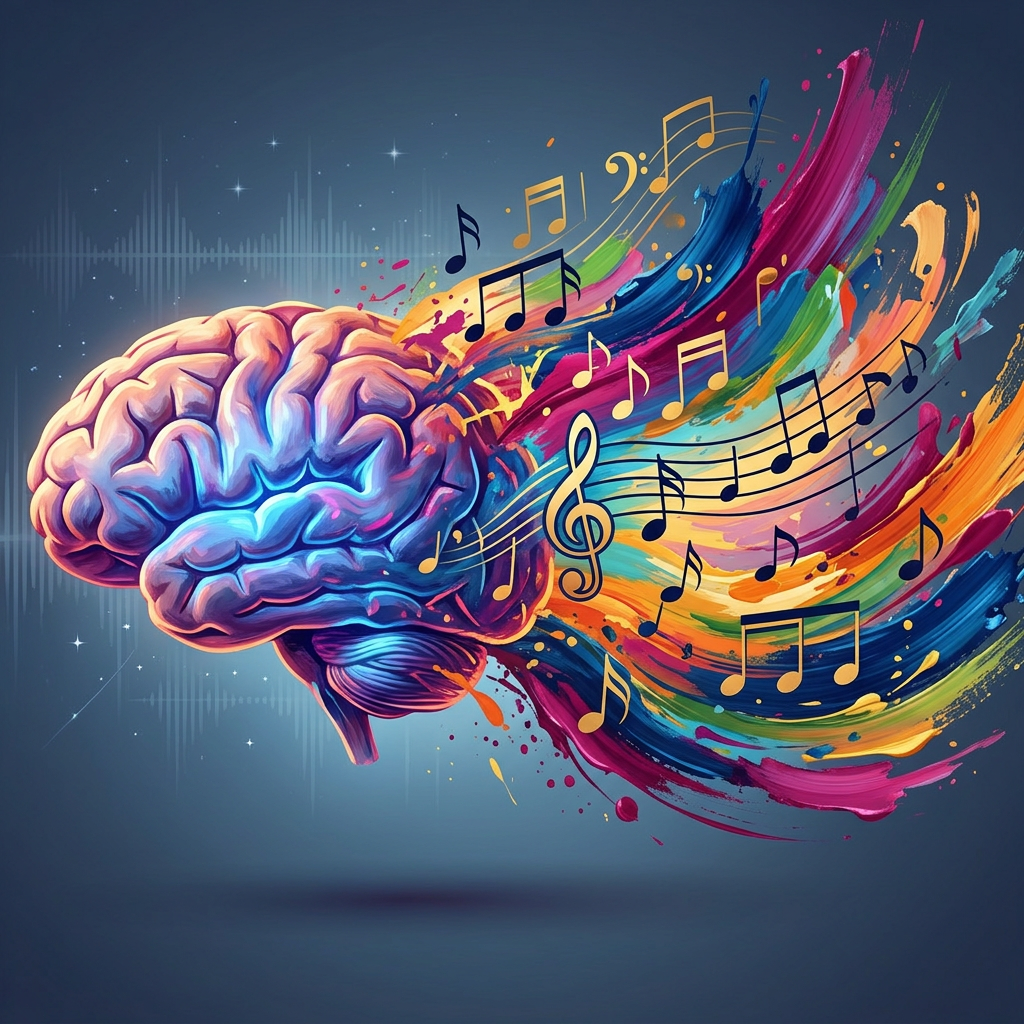
Pip: The neurological explanation the post offers is what it calls paradoxical inhibition — damage to the left hemisphere removes the rational controls that normally suppress the right hemisphere’s perceptual and spatial capacities. The brain rewires, and raw sensory detail surfaces.
Mara: Which leads to the post’s sharpest claim: “questa forma di creatività non nasce dal nulla, ma rappresenta la liberazione di un potenziale latente.” The art isn’t invented by the illness. It was already there, held down.
Pip: That reframes the whole story. The diagnosis isn’t only taking — it’s also, in these rare cases, opening a door.
Mara: And what emerges through that door becomes, as the post puts it, a survival channel — an alternative language through which the mind rebuilds its identity against physical decline.
—
Pip: Latent potential, paradoxical liberation — the brain contains territory it never shows you until something forces the map to change.
Mara: Next time, more from osoparavos.com on what the mind does when the ordinary rules stop applying.
_______________________________
Leave a Reply