Why proust presents himself as an only child in «swann’s way»
In real life, Marcel Proust had a younger brother, Robert Proust (who became a distinguished surgeon). However, in Swann’s Way (Du côté de chez Swann) and the broader sequence In Search of Lost Time, the Narrator is presented as an only child.
Reddit+ 1
Proust made this deliberate creative choice for several psychological, narrative, and aesthetic reasons:
- Intensity of the Mother-Child Bond: The emotional core of Combray—most famously illustrated in the drama of the bedtime kiss—depends on an exclusive, hyper-sensitive attachment to the mother. Introducing a sibling would dilute this singular Oedipal focus and the child’s desperate need for his mother’s undivided affection.
- Themes of Solitude and Subjectivity: A major theme of the novel is existential solitude—the idea that every individual is fundamentally trapped within their own subjective experience. Portraying the Narrator as an only child heightens his sense of isolation, fragility, and deep interiority. Reddit+ 1
- Proust’s Theory of Art (Contre Sainte-Beuve): Proust strongly opposed the critic Charles Augustin Sainte-Beuve, who believed a writer’s work should be understood through their biography. Proust argued that a literary work comes from “a different self” (un autre moi) than the person who lives in everyday society. The Narrator is an artistic creation designed to explore memory and consciousness, not a literal autobiographical record.
- Narrative Economy: Eliminating a sibling streamlined the family dynamic down to its essential archetypes: the indulgent Grandmother, the stern Father, the loving Mother, and the eccentric Aunt Léonie. Adding Robert, whose life followed a conventional medical career path similar to their father’s, would have added unnecessary narrative noise without serving the book’s thematic goals. Reddit
By removing his brother from the fictional canvas, Proust created a domestic vacuum that forces the Narrator inward, laying the psychological foundation for the entire novel’s meditation on memory, art, and time.
___________________________
The Fascination with Noblewomen
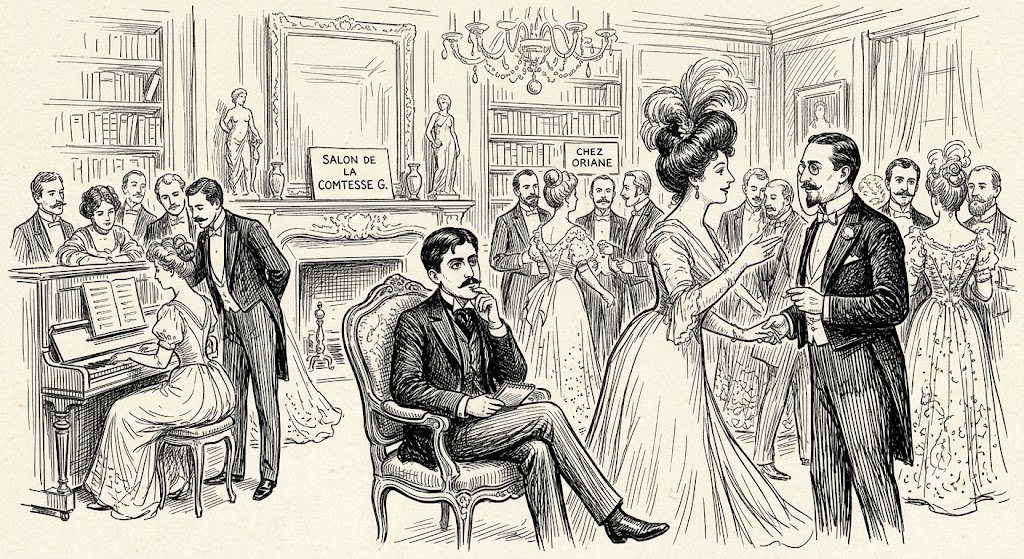
Proust’s fixated literary and social focus on noblewomen—such as the fictional Duchess de Guermantes and her real-world inspirations, the Comtesse Greffulhe and Laure de Sade, Comtesse de Chevigné—was rooted in aesthetic idealization rather than simple social climbing.
- Living Works of Art: Proust viewed high-born women as historical artifacts. To his imagination, a duchess’s features, gestures, and spoken phrasing carried centuries of French history, architectural style, and linguistic lineage. They were not merely attractive individuals, but living tapestries merging poetry, aristocracy, and myth.
- The Illusion of Distance: Proust’s romantic desire was inherently bound to unattainable ideals. Because these women occupied an elevated social sphere, they functioned as distant projections. Once the Narrator in In Search of Lost Time gains entry to their salons, the illusion shatters, exposing their conversational superficiality—a core Proustian theme regarding the gap between expectation and reality. Manchester Review of Books – WordPress.com
- Sublimation and Screen Identities: In several instances, Proust’s depictions of intense heterosexual infatuation in his writing served as artistic transpositions. Scholars widely recognize that the character of Albertine—the Narrator’s great, obsessive female love interest—was largely modeled on Proust’s real-life male chauffeur and secretary, Alfred Agostinelli. High-society women provided a socially acceptable, glamorous canvas upon which he could project complex emotional, possessive, and romantic dynamics.
Attraction to Younger Men and Adolescent Fantasies
Proust’s attraction to younger men was not merely a residual adolescent fantasy, though his early experiences laid the groundwork for his adult psychology. It was a complex interplay of emotional arrest, social dynamics, and dynamic desire:
- Early Formative Relationships: In his youth, Proust formed intense, idealized attachments to male peers, such as his schoolmate Marie-Alphonse Robert de Billy and the composer Reynaldo Hahn. Early unpublished short stories from his twenties demonstrate that he experienced his same-sex attraction with a sense of tragic, melancholic intensity from an early age. The Guardian
- Fixation on Youth and Lost Time: For Proust, youth represented vitality, beauty, and uncorrupted potential. As a chronic invalid plagued by severe asthma and early aging, pursuing younger men (such as drivers, waiters, and working-class youths) was an attempt to capture the vitality he felt he lacked. His sexual preferences mirrored his broader artistic obsession with retrieving lost time and preserving fleeting beauty.
- Power Dynamics and Independence: In his adult life, Proust often sought relationships with men who were lower in social standing or significantly younger. Biographers suggest this gave him a degree of control and protection. Because open homosexuality carried immense social stigma in Third Republic France—prompting Proust to keep his sexuality out of the public eye—relationships with dependent or younger men allowed him to act as a benefactor while maintaining privacy. The Guardian
- Psychological Immaturity and Maternal Dependency: Proust’s emotional life remained anchored in his childhood. His inability to fully detach from the hyper-sensitive dynamic he shared with his mother left his romantic life marked by an adolescent longing for devotion, reassurance, and control. His attraction to younger men was less about relive-a-fantasy and more about a persistent emotional structure that never fully transitioned into conventional adult intimacy.
_____________________________
In In Search of Lost Time, Transposition (la transposition) refers to Proust’s technique of taking real-life figures, experiences, and same-sex romantic attachments and recasting them into heterosexual relationships on the page.
The most prominent example of this is Albertine Simonet, the Narrator’s deeply adored, endlessly elusive, and fiercely guarded mistress, who was primarily modeled on Proust’s chauffeur and secretary, Alfred Agostinelli.
The Real-Life Model: Alfred Agostinelli
Alfred Agostinelli was hired as Proust’s chauffeur in 1907. Over time, Proust fell obsessively in love with him. In 1913, Agostinelli moved into Proust’s Paris apartment with his partner, acting as Proust’s personal secretary.
The relationship mirrored the toxic, hyper-possessive dynamic later depicted between the Narrator and Albertine:
- Confinement and Control: Proust tried to keep Agostinelli captive in his home through lavish gifts and financial dependence to prevent him from leaving.
- Flight and Tragic Death: Fleeing Proust’s suffocating affection, Agostinelli secretly ran away to Monaco under an assumed name (Marcel Swann) to learn to fly airplanes. In May 1914, his plane crashed into the sea, and he drowned at age 26.
- Literary Grief: Agostinelli’s sudden death devastated Proust, who channelled his immense grief and guilt directly into the tragic trajectory of Albertine (who also flees the Narrator and dies abruptly in an accident).
How Proust Executed the Transposition
To convert Agostinelli (and other real-life male loves, such as his publisher Gaston de Caillavet) into Albertine, Proust used specific literary mechanisms:
- Name and Phonetic Clues: The name Albertine is a feminine derivative of Alfred. Throughout the novel, the Narrator is attracted to a cluster of young women whose names echo those of men Proust knew: Albertine, Andrée, Gilberte, and Rosemonde.
- Inverting the Power Dynamics: By turning Agostinelli into a young, unmarried woman of slightly lower social standing, Proust made the Narrator’s obsessively protective and jealous behavior read as a familiar, albeit dark, heterosexual courtship dynamic to 1920s readers.
- Subtextual Clues and Jealousy of Women: A central plot point in The Captive (La Prisonnière) is the Narrator’s agonizing suspicion that Albertine is attracted to other women (lesbian or “Gomorrah” relationships). Literary critics note that this fear was Proust’s clever transposition of his real-world anxiety: fear that his male partners were secretly attracted to women, leaving him utterly excluded from their true desires.
Why Transpose? Social Prudence vs. Universal Art
Proust had two primary reasons for using transposition rather than depicting open male-male romantic relationships:
- Social and Legal Self-Preservation: In early 20th-century Europe, writing explicitly about a gentleman’s passionate, tragic love affair with his male chauffeur would have triggered public scandal, social ostracization, and potential legal fallout.
- Thematic Universality: Proust believed that the fundamental nature of obsessive love, jealousy, and the desire to possess another person’s freedom was universal. By converting the relationship into a heterosexual framework, he ensured his psychological insights on love and loss would resonate with a broader contemporary audience without being dismissed as an anomaly.
Interestingly, Proust did not conceal homosexuality entirely; characters like Baron de Charlus and Robert de Saint-Loup represent explicit depictions of same-sex desire. However, for his central, tragic meditation on romantic devotion—the narrative heart of the novel—he chose the veil of Albertine.
_____________________________
Marcel Proust was exceptionally witty, sardonic, and at times ruthlessly funny in real life.
Because modern pop culture often paints him as a melancholy recluse shivering in a cork-lined bedroom, people are frequently surprised by how sharp, hilarious, and socially devastating he could be.
Literary Hub
His wit operated across a few distinct dimensions:
1. The Master Mimic and Salon Satirist
Long before he wrote In Search of Lost Time, Proust was famous in Belle Époque Paris salons for his brilliant impersonations. He had an uncanny ear for voice, posture, and social hypocrisy.
- He could mimic high-society hostesses, pompous academics, and aristocratic snobs down to their exact stutters, nasal tones, and fake laughs. Literary Hub
- Contemporaries noted that his parodies were so precise that he could leave an entire dinner party in hysterics. This skill became the bedrock for the sharp, satirical portraits of characters like Madame Verdurin and Baron de Charlus in his novels.
2. Sardonic Politeness (Weaponized Courtesy)
Proust was notoriously over-polite—so polite that it became a subtle form of ironical warfare.
- He showered people with excessive compliments, elaborate apologies, and dramatic expressions of devotion, which allowed him to mock or manipulate them without breaking the rules of etiquette.
- When dealing with difficult people (or noisy neighbors), he would write letters of such baroque, groveling courtesy that the recipient could never quite tell if they were being praised or brutally insulted.
3. Biting, Cynical Humor
Proust possessed a deeply sardonic view of human nature, romantic love, and social climbing.
Yale University
- On Love: He famously viewed romantic passion as a self-inflicted mental illness or illusion. He once dryly remarked that “To say that one will love someone until death is to imagine that one will go on living for ever.” Yale University
- On High Society: Though he loved high society, he harbored no illusions about it. He viewed aristocrats as exquisite, empty shells—comparing salon hostesses to birds or rare insects pinned under glass.
4. Self-Deprecating Wit
Despite his severe illnesses (he suffered from debilitating asthma and hypersensitivity to noise), Proust regularly used black humor to poke fun at his own hypochondria and unusual lifestyle.
WordPress Websites – University of Michigan
- He often referred to himself as a living corpse, joking about his nocturnal existence, his dozens of layers of winter clothes in summer, and his total inability to function like a normal adult.
Summary
Proust’s real-life persona was not that of a solemn, humorless tragic figure. He was a brilliant social observer whose charm, razor-sharp observation, and sardonic humor allowed him to dissect the ridiculousness of human behavior—a quality that directly powers the comedy and satire throughout his masterwork.
Leave a Reply