— Adam Donaldson Powell

Thinking Between Languages
Toward a Poïetics of Re-Creation
Thought is translated; language is recreated.
I. The Illusion of Translation
Translation is commonly understood as the transfer of words from one language into another. Dictionaries, grammars, and increasingly sophisticated computational tools all reinforce this assumption by presenting language as a system of lexical correspondences governed by syntactical rules. At first sight, the process appears almost mechanical. One identifies the appropriate equivalent, adjusts the grammar to conform to the conventions of the target language, and in doing so preserves the meaning of the original. The translator is thus imagined as a careful intermediary whose task is to transport a finished work across linguistic boundaries while disturbing it as little as possible.
Yet every serious reader, writer, musician, or translator eventually discovers that something essential escapes this description. The greatest difficulty is seldom the absence of an equivalent word. More often it is the realization that languages do not simply name the same world in different ways. They organize experience differently. They establish different hierarchies of importance. They cultivate distinct rhythms of thought and invite different habits of perception. A sentence that is entirely natural in one language may become awkward, overly explicit, or strangely lifeless when transferred directly into another.
This observation suggests that the true object of translation has never been words alone.
Words are the visible surface of thought, not thought itself.
If language were merely a code, translation would consist of replacing one set of symbols with another. Yet literature has always resisted such reduction. Poetry, philosophy, music criticism, memoir, and the novel continually remind us that meaning does not reside exclusively in vocabulary. It emerges from relationships: between ideas, memories, images, rhythms, silences, and expectations. These relationships are themselves shaped by culture, history, and imagination. They cannot simply be transferred intact by lexical substitution.
The inadequacy of direct translation becomes particularly apparent whenever one attempts to render works whose power lies less in what they say than in the manner in which thought unfolds. Philosophical argument, poetic metaphor, musical criticism, and reflective prose derive much of their force from conceptual movement rather than verbal ornament. To reproduce only the words is often to lose the living architecture that gave birth to them.
It is therefore worth asking whether translation has been defined too narrowly.
This essay proposes that the highest form of translation is not translation in the conventional sense but re-creation.
By disquisition I understand a sustained philosophical inquiry—an attempt to explore first principles rather than merely summarize established opinion. By creation I mean the bringing into existence of something genuinely new: an intellectual, artistic, or literary act through which experience assumes form. Finally, I adopt René Passeron’s conception of poïetics as the philosophy and science of creation itself: the study of the relationship between creator and work while the work is still coming into being.
This final qualification is of particular importance.
Poïetics concerns neither the finished object nor its subsequent interpretation. Its concern is the act of becoming.
Passeron observes that once the creative act has been consummated, three conditions prevail. The finished work constitutes a unique entity. It acquires a personality of its own. And it continues to implicate its creator, who remains responsible for it because he has brought it into existence.
These observations are usually applied to original works of art.
I propose that they apply equally to the finest acts of translation.
For if the translated work possesses its own literary identity; if it speaks naturally within its adopted language rather than merely echoing another; and if the translator assumes responsibility for the innumerable interpretive decisions embodied in the finished work, then something more profound than linguistic transfer has occurred.
Another act of creation has taken place.
The translator has become, in part, an author.
This proposition does not diminish fidelity to the original. On the contrary, it relocates fidelity.
Instead of asking whether the words have been preserved, we begin to ask whether the thought has survived.
The distinction is subtle, yet decisive.
Words belong to languages.
Thought belongs to consciousness.
Languages differ.
Thought precedes them.
The translator’s first responsibility is therefore not to words but to understanding.
Only after understanding has become complete does the genuinely creative task begin.
This distinction also explains a familiar paradox experienced by multilingual writers. One may possess an extensive vocabulary and command grammatical structures with confidence while nevertheless producing prose that feels foreign. Such writing is frequently accurate without being alive. It remains governed by the conceptual habits of another language. The difficulty is not lexical deficiency but cognitive dependence.
The problem, then, is not how to translate words.
The problem is how to allow thought itself to assume a new linguistic existence.
Between these two activities lies a creative interval that has received remarkably little attention.
It is this interval that I shall call re-creation.
The purpose of the present inquiry is therefore neither to reject translation nor to advocate unnecessary freedom. Rather, it seeks to describe a process that many writers, artists, and multilingual thinkers have practiced intuitively without always possessing a language in which to describe it.
Translation, I shall argue, reaches its highest form precisely at the point where it ceases to think of itself as translation.
It becomes creation once more.
__________________________
II. Marcel Proust and the Re-Creation of Thought
Among the many examples that illuminate the distinction between translation and re-creation, few are as revealing as the work of Marcel Proust.
At first glance, Proust’s translations of John Ruskin present a curious paradox. The translator of Ruskin was not a scholar of English in the conventional sense. He did not possess the effortless linguistic command that one might expect from someone undertaking the translation of a major literary figure. He relied upon assistance, particularly from his mother, Jeanne Proust, whose knowledge of English enabled her to clarify difficult passages, explain expressions, and resolve uncertainties of meaning.
This fact has sometimes encouraged an overly simple interpretation: that Proust’s achievement depended upon linguistic assistance and therefore belonged primarily to others. Such a conclusion, however, misunderstands the nature of translation itself.
The assistance Proust received belonged to the necessary but preliminary stage of comprehension.
It helped him understand what Ruskin had written.
It did not determine what Proust would create.
There is a profound distinction between understanding a text and recreating it.
The first requires access to meaning.
The second requires the transformation of meaning into another form of existence.
The dictionary, the grammar book, and the bilingual collaborator all serve the first task. They illuminate the surface, clarify references, and establish the semantic boundaries within which interpretation can occur. But no dictionary can tell a writer what a sentence must become in another language. No grammar book can reveal the precise rhythm through which an idea should be reborn.
That decision belongs to the creator.
Proust’s true work began after the English text had become intelligible.
At that moment, he faced the question that confronts every serious translator:
What is it that must survive?
The words?
The syntax?
The imagery?
The argument?
Or something deeper that generated all of these?
Proust appears to have intuitively understood that the visible language of Ruskin was not the final object of his attention. Beneath the English sentences existed another reality: a movement of thought, a structure of perception, a particular relationship between beauty, memory, morality, and artistic experience.
This was the living substance of the work.
The English language was the form through which that substance had first appeared. But form and substance, though inseparable in the original creation, could be distinguished during the act of re-creation.
The translator must therefore perform a delicate operation.
The original language must become transparent.
Not forgotten, but transcended.
The translator must enter the work deeply enough that the words cease to be obstacles and become instead windows through which the underlying thought may be perceived.
Only then can another language receive the work.
This is the moment where translation becomes poïesis.
Proust did not simply ask:
“How would Ruskin’s sentence be expressed in French?”
He asked a more fundamental question:
“If this thought were born in French, what form would it naturally assume?”
The difference between these questions is the difference between imitation and creation.
A translated sentence may reproduce the external appearance of an original while failing to preserve its internal necessity. Conversely, a recreated sentence may depart from the surface structure of the source while remaining profoundly faithful to its intellectual and emotional foundation.
The latter is not betrayal.
It is fidelity at a deeper level.
The significance of Proust’s translations becomes even clearer when considered alongside another aspect of his development: his use of pastiche.
Before becoming the author of À la recherche du temps perdu, Proust spent years writing in the voices of other writers. He produced imitations, experiments, and literary exercises in which he temporarily inhabited different styles and sensibilities.
These exercises were not merely demonstrations of literary skill. They were experiments in perception.
To write in the manner of another author is to ask:
What does this writer notice?
How does this writer organize experience?
What rhythms of thought determine this voice?
What assumptions about reality are embedded in this manner of expression?
Pastiche, when practiced seriously, is not copying.
It is analysis performed through creation.
The writer does not stand outside another voice and describe it.
The writer temporarily enters that voice and discovers its internal mechanisms.
This is remarkably similar to the process of translation.
In translation, one enters another writer’s thought across the boundary of language.
In pastiche, one enters another writer’s thought across the boundary of style.
In both cases, the essential movement is the same:
temporary inhabitation leading toward transformation.
This reveals a deeper truth about originality.
Originality is not the absence of influence.
It is the successful transformation of influence.
The artist becomes original not by having no predecessors, but by absorbing them so completely that what remains is a new voice.
Proust became Proust through encounters with other minds.
He discovered himself by entering elsewhere.
Creation, therefore, is not the rejection of inheritance.
It is inheritance made alive.
__________________________
III. Reformulation: The Invisible Stage
Between understanding a text and creating a new version of it lies a moment that is rarely examined. It is neither reading nor writing, neither interpretation nor expression. It is the silent interval in which meaning is detached from its original form and prepared to enter another.
This interval is the hidden center of re-creation.
Without it, translation remains bound to substitution. One language replaces another, sentence by sentence, phrase by phrase, word by word. The result may be accurate, yet it often retains the unmistakable presence of its origin. It carries the architecture of the first language into the second, as though the new language were merely a surface upon which the old structure has been placed.
Re-creation begins when that structure is allowed to dissolve.
The translator must first permit the original text to disappear.
Not vanish.
Not be forgotten.
But become transparent.
This may appear paradoxical. How can fidelity be achieved by temporarily letting go of the very thing one wishes to preserve?
Yet this paradox exists throughout the creative arts.
The musician does not perform the printed score while consciously thinking of every individual note. The painter does not create by constantly analyzing each brushstroke. The actor does not bring a character to life by repeating the script mechanically.
In every art, mastery requires a movement from external form toward internal understanding.
The form must be absorbed before it can be recreated.
The same is true of language.
Every text possesses at least two forms.
The first is its linguistic form: the words, syntax, grammar, rhythm, and conventions through which it appears.
The second is its conceptual form: the underlying organization of perception, emotion, argument, memory, and imagination that gave rise to those words.
Translation traditionally operates upon the first.
Re-creation seeks the second.
This does not mean that linguistic form is unimportant. Great writers know that form and meaning are inseparable within the finished work. A poem is not merely an idea expressed through words; the words themselves participate in the creation of the idea.
Yet when a work crosses into another language, transformation becomes unavoidable.
The original linguistic form cannot be preserved completely.
Something must change.
The question is therefore not whether change will occur.
The question is whether the change will be superficial or creative.
A mechanical translation attempts to preserve what cannot remain unchanged.
A re-creative translation identifies what must survive and allows everything else to be reborn.
The process may be understood as four movements.
First: suspension.
The translator suspends the impulse to search immediately for equivalents and instead asks:
What is happening here?
What thought is being constructed?
What experience is being communicated?
Second: comprehension.
The translator enters the internal world of the work. Historical references are clarified. Cultural assumptions are examined. The text becomes understood not merely as language but as consciousness communicating with consciousness.
Third: reformulation.
This is the invisible stage.
The original sentence is no longer the object being transferred. The thought that generated the sentence becomes the object.
The translator asks:
“If this idea had originated within my own linguistic world, what form would it naturally have taken?”
Fourth: rewriting.
Only now does the new language fully enter.
The writer creates the expression that the original thought requires in its new environment.
At this point, translation completes its transformation into creation.
This explains why direct translation often fails most dramatically with the works that matter most.
Literary and philosophical works derive their power from movement.
A metaphor carries a history of perception.
A sentence carries a rhythm of consciousness.
An argument carries a particular organization of reality.
To translate only the visible structure is to risk losing the living process that produced it.
The translator becomes like a musician who reproduces every note correctly but fails to hear the phrase.
The performance is accurate.
The music is absent.
Reformulation is therefore not a compromise between translation and originality.
It is the foundation of both.
Creation itself is a continual process of re-creation.
The mystery is not that something changes.
The mystery is that something essential survives the change.
That survival is the true object of translation.
__________________________
IV. Apprenticeship Through Re-Creation: Proust, Pastiche, and the Discovery of Voice
The development of an original voice is often misunderstood as a sudden emergence of individuality.
Yet the history of creation suggests something different.
A voice is not discovered fully formed.
A voice is cultivated.
It develops through attention, imitation, discipline, and repeated encounters with forms that already exist.
Apprenticeship is not opposed to originality.
It is the condition through which originality becomes possible.
For centuries, painters learned through the works of masters. Musicians learned through existing compositions. Writers learned through entering other writers’ worlds.
Proust’s path reveals this universal principle.
His translations of Ruskin and his literary pastiches were not separate exercises. They were laboratories of perception.
To write in another author’s style is to ask:
What does this writer see?
How does this writer organize reality?
What hidden assumptions determine this voice?
Pastiche is not copying.
It is analysis performed through creation.
This principle changes our understanding of originality.
The original artist is not someone untouched by influence.
The original artist is someone who transforms influence.
The borrowed material disappears because it has become internal.
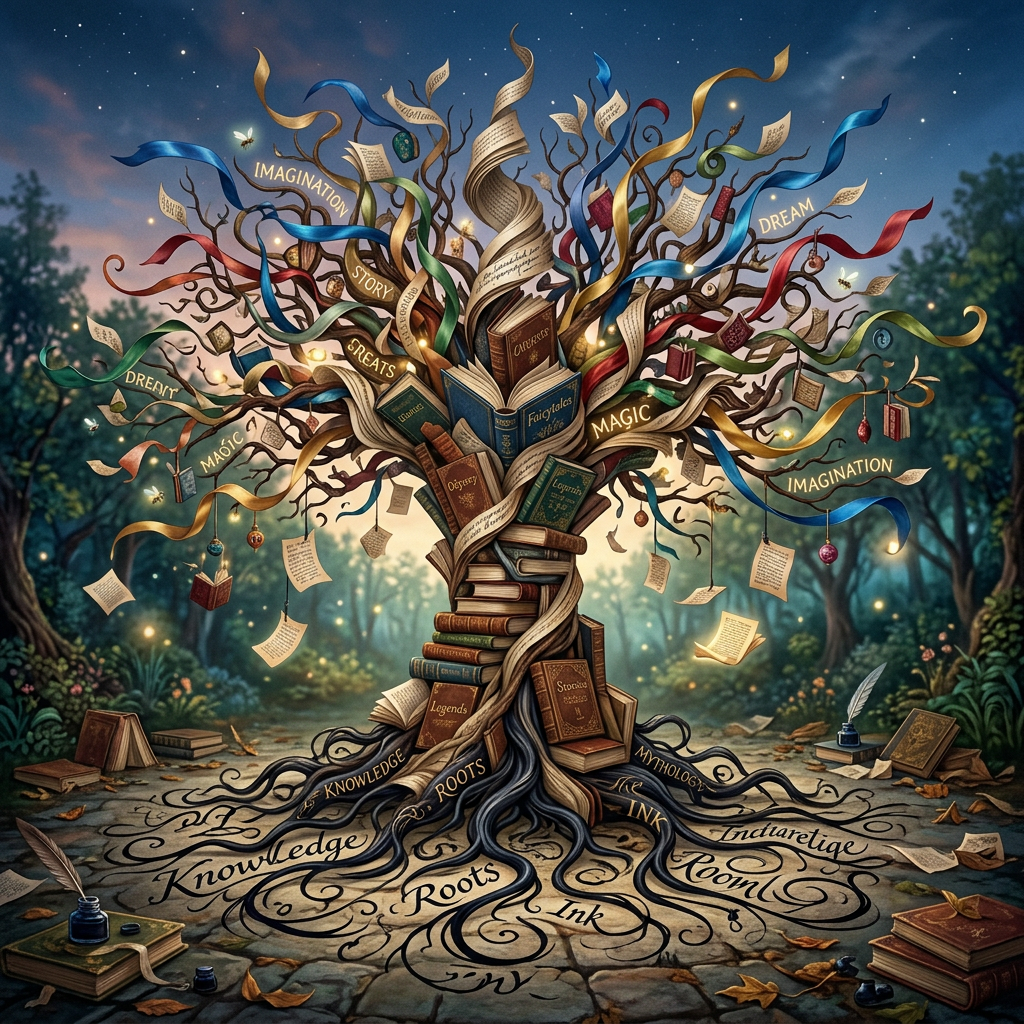
A tree does not remain a collection of soil and water.
It transforms them.
Likewise, the mature artist transforms what has been received.
Proust’s journey from translation to pastiche to the novel represents one continuous poïetic movement.
Translation.
Imitation.
Assimilation.
Transformation.
Each stage moved him beyond external form toward internal necessity.
He learned not merely how writers wrote.
He learned how writers perceived.
This is the true purpose of apprenticeship.
The beginner imitates surfaces.
The apprentice studies methods.
The artist discovers principles.
The same sequence governs language learning.
One begins by translating.
One progresses by reformulating.
One arrives by creating.
A new language begins as an external system. Through practice, it becomes internal. Eventually, it becomes capable of generating thought.
This is the linguistic equivalent of discovering one’s artistic voice.
The goal is not to imitate forever.
The goal is to absorb deeply enough that something new can emerge.
Every original voice is born through a history of re-creations.
Creation is not the opposite of inheritance.
Creation is inheritance transformed.
_________________________
V. Thinking Between Languages: The Emergence of a Multilingual Self
Learning another language is often described as acquiring another system of communication.
One studies vocabulary, grammar, pronunciation, and cultural conventions.
Yet this describes only the outer dimension of language.
The deeper transformation begins when one discovers that another language is not merely another way of saying things.
It is another way in which things may become sayable.
Every language carries within it a history of attention. It reflects particular experiences, metaphors, relationships, and patterns of thought.
To enter a language deeply is therefore to encounter another organization of human experience.
This explains why serious language learners often experience frustration.
A person may understand grammar.
A person may possess vocabulary.
A person may communicate effectively.
Yet creative expression remains distant.
The language functions, but it does not yet breathe.
The reason is often not lack of knowledge.
It is that the learner is still translating rather than thinking.
Translation is the beginning.
It is not the destination.
The bridge between languages must eventually become a landscape in which thought can move freely.
Creative fluency is different from technical fluency.
Technical fluency allows communication.
Creative fluency allows creation.
The final threshold occurs when the language ceases to be merely something one studies and becomes something through which one perceives.
The multilingual writer does not possess several identical instruments.
The multilingual writer possesses several distinct ways of seeing.
Each language reveals possibilities unavailable through others.
The goal is not to make languages identical.
The goal is to allow each language to become capable of independent creation.
To think between languages does not mean to remain permanently suspended between them.
It means discovering a larger intellectual space where multiple forms of thought coexist.
The multilingual person does not live between worlds.
The multilingual person discovers that the worlds were never truly separate.
_________________________
VI. Toward a Poïetics of Multilingual Creation
Creation begins before the finished work exists.
It begins in uncertainty.
In exploration.
In the invisible movement between intention and expression.
This is the domain of poïetics.
The finished work may appear complete, but behind it remains the history of becoming: the choices, transformations, doubts, discoveries, and acts of imagination through which it came into existence.
Translation belongs within this same creative domain.
The translator does not merely transfer a completed object.
The translator participates in the continuation of the work’s life.
A great translation is not a copy of an original.
It is a new realization of the same creative impulse.
This understanding brings together everything explored throughout this essay.
Proust’s translations of Ruskin.
His pastiches.
His discovery of literary voice.
The multilingual writer’s search for independent expression.
The artist’s movement from apprenticeship toward originality.
All reveal the same fundamental process:
Creation is re-creation.
The human act of creating is never an isolated beginning from nothing. Every work emerges from previous experiences, previous forms, previous encounters.
The creator transforms what has been received.
The translator therefore occupies a unique position.
The translator is both reader and writer.
Interpreter and creator.
Witness and participant.
The responsibility is immense because the translator does not merely preserve a work’s existence.
The translator contributes to its future existence.
A work that enters another language does not simply travel.
It is reborn.
Perhaps the deepest lesson of multilingual creation is that language itself is an artistic medium.
To learn another language is to acquire another instrument.
To create within that language is to discover another voice.
The musician does not ask whether the cello should become a piano.
The painter does not ask whether oil should become watercolor.
Each medium possesses its own possibilities.
So do languages.
The mature multilingual creator does not seek sameness.
The goal is harmony.
Several voices.
One consciousness.
Thinking between languages is therefore not a condition of incompleteness.
It is an expanded form of awareness.
The space between languages is not empty.
It is creative.
It is the place where comparison becomes insight, where difference becomes possibility, and where thought discovers new forms.
The highest achievement of translation is not that one language successfully replaces another.
It is that, through the encounter of languages, something new comes into existence.
A new text.
A new voice.
A new way of seeing.
That is the essence of re-creation.
That is the work of poïetics.
And that is what it means to think between languages.
________________________
Leave a Reply