Pip: Welcome to osoparavos.com, where the literary salons of Belle Époque Paris are apparently still open for business and the guest list keeps expanding.
Mara: Today we’re covering work by Adam Donaldson Powell — pieces that map Proust’s intellectual formation, from the foreign thinkers who shaped his method to the writers and public figures who surrounded him in Paris. Let’s start with the philosophical roots: Ruskin and Emerson.
Proust’s Intellectual Roots: Ruskin and Emerson
Mara: The question here is how a writer in creative crisis finds his footing — and what it looks like when the answer comes from outside your own language and tradition entirely.
Pip: The piece on Proust, Ruskin, and Emerson captures the devotional intensity of that influence directly. Proust himself declared: “Je ne prétends pas savoir l’anglais ; je prétends connaître Ruskin.”
Mara: Which is to say he translated two of Ruskin’s major works without fully mastering English — with help from his mother and friends. The upshot is that the influence was filtered, intimate, and almost willful.
Pip: Ruskin gave Proust a discipline of observation and, crucially, an architectural model — the cathedral as a unified organic whole — that Proust transposed directly onto the structure of the Recherche. Emerson’s contribution was different: the philosophical permission to trust his own inner experience as the legitimate subject of literature.
Mara: And yet Proust eventually broke with both. In his preface to the Ruskin translation, he accused his master of a kind of idolatry — valuing the monument over the interior work it should provoke in the reader.
Pip: So the student absorbed the method and then quietly fired the teacher.
Mara: That’s where involuntary memory enters — the madeleine scene being the clearest illustration of a theory neither Ruskin nor Emerson could have supplied. On to the question of who Proust was actually navigating in Paris itself.
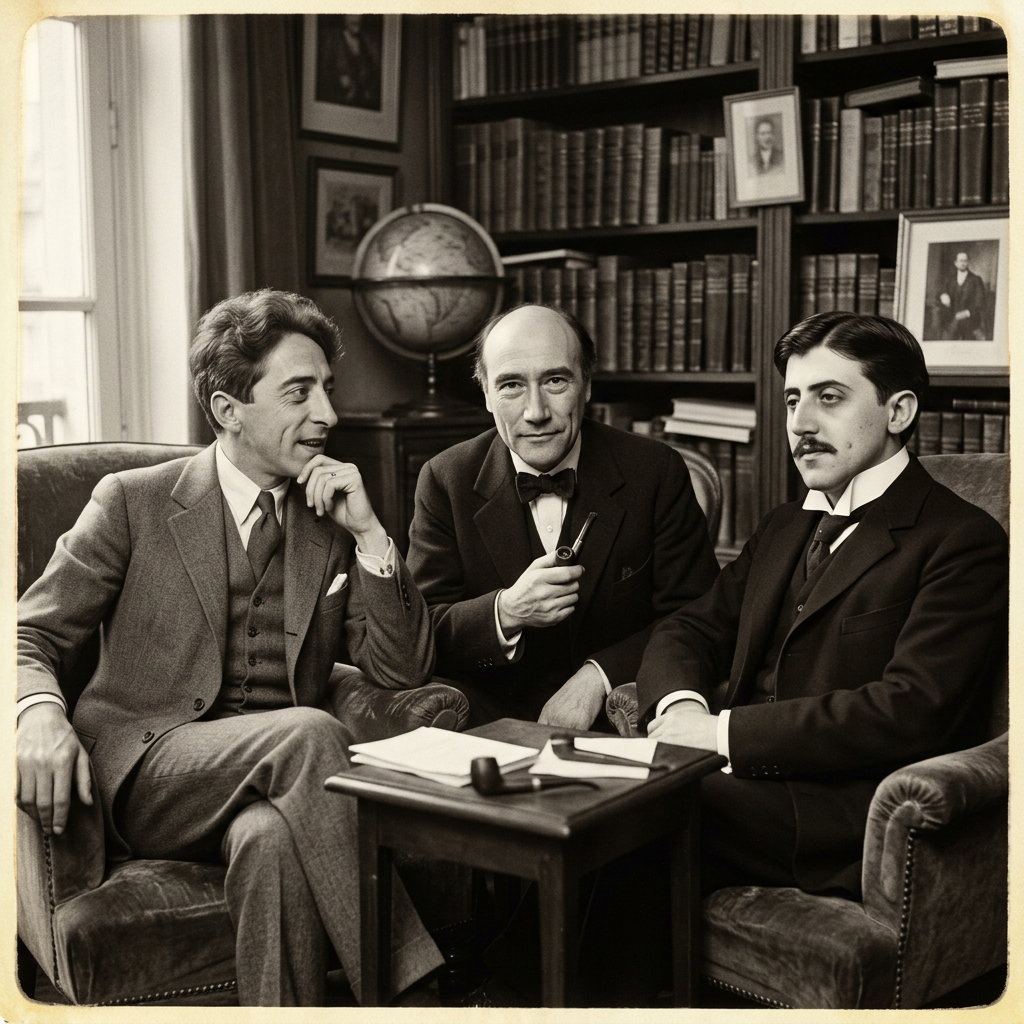
Proust Among Montesquiou, Zola, Gide, and Cocteau
Mara: The posts here examine Proust in relation to four very different figures — and what each relationship reveals about how he moved between the social, the political, and the literary.
Pip: The post on Montesquiou and Zola frames the contrast sharply from the start. Proust’s relationship with Montesquiou was personal, spanning nearly twenty years, while with Zola it was essentially political — their bond forged almost entirely through the Dreyfus Affair.
Mara: On Montesquiou, the post is precise: he didn’t simply open aristocratic doors for Proust. The piece notes that Proust already had access through family connections and figures like Madeleine Lemaire. What Montesquiou supplied was something subtler — “les codes les plus subtils,” the symbolic hierarchies and ceremonial grammar of that world.
Pip: A laboratory of observation, the post calls it. Which makes Montesquiou sound less like a friend and more like an extremely high-maintenance field site.
Mara: The relationship was genuinely complicated. Montesquiou required near-constant diplomatic management, and Proust delivered years of carefully calibrated letters. The tension sharpened when readers recognized Montesquiou in the Baron de Charlus — though the post is careful to say Charlus is a synthesis, drawing on multiple real figures, not a straight portrait.
Pip: Zola’s influence runs in a completely different direction. When Zola published “J’Accuse…!” in January 1898, Proust — despite moving in largely anti-Dreyfusard aristocratic circles — took an early public stand. He helped gather signatures for the petition supporting Zola and attended the trial.
Mara: Aesthetically, the two were far apart. Zola’s naturalism sought to explain behavior through social and hereditary determinism; Proust built inward, around memory and subjectivity. But the post argues that Zola’s deepest influence on the Recherche was historical — the Dreyfus Affair runs through Le Côté de Guermantes and Sodome et Gomorrhe as a stress test for every social loyalty and personal conviction.
Pip: Then there’s the post on Gide and Cocteau, which adds two more very different registers. Gide’s connection to Proust is anchored by one of literary history’s most famous editorial blunders.
Mara: In 1912, Gide helped turn down the manuscript of Du côté de chez Swann at the Nouvelle Revue Française. Once he read the full work, he described the rejection as the “plus grave remords” of his entire editorial career. The post frames that admission as a mark of genuine intellectual honesty — rare enough to be worth noting.
Pip: Cocteau’s relationship with Proust was warmer and more straightforward: he was simply an admirer. He credited Proust with an almost miraculous ability to transform the smallest social details into novelistic material.
Mara: What the post draws out is that despite real aesthetic differences — Proust’s slow interior excavation versus Cocteau’s instinct for the sudden poetic image — both shared the conviction that art reaches truths ordinary observation cannot.
Pip: Four very different people, and Proust was navigating all of them at once — the dandy, the public moralist, the rival editor, the younger admirer.
Mara: Which says something about the range of attention the Recherche actually required to build.
Pip: What these posts keep returning to is the same question from different angles — how a writer assembles the conditions for an original vision out of influences he has to partially dismantle.
Mara: Ruskin, Emerson, Montesquiou, Zola, Gide, Cocteau — next time, we’ll see what other constellations the site has been mapping.
Leave a Reply