— Adam Donaldson Powell & AI
What Marcel Proust thought about Oscar Wilde
The relationship between Marcel Proust and Oscar Wilde represents one of the most intriguing intersections in turn-of-the-century European literature. Though separated by nationality, temperament, and aesthetic strategy, both writers stood as monumental figures in capturing the psychological nuances of high society, art, and forbidden desire.
Proust’s perspective on Wilde was complex and deeply ambivalent. He viewed Wilde through three distinct lenses: as an ostentatious social figure, as an aesthetically brilliant yet theatrical writer, and as the ultimate cautionary symbol of societal persecution following his catastrophic legal downfall.
1. As a Person: Fascinated Disdain and the Mask of the Dandy
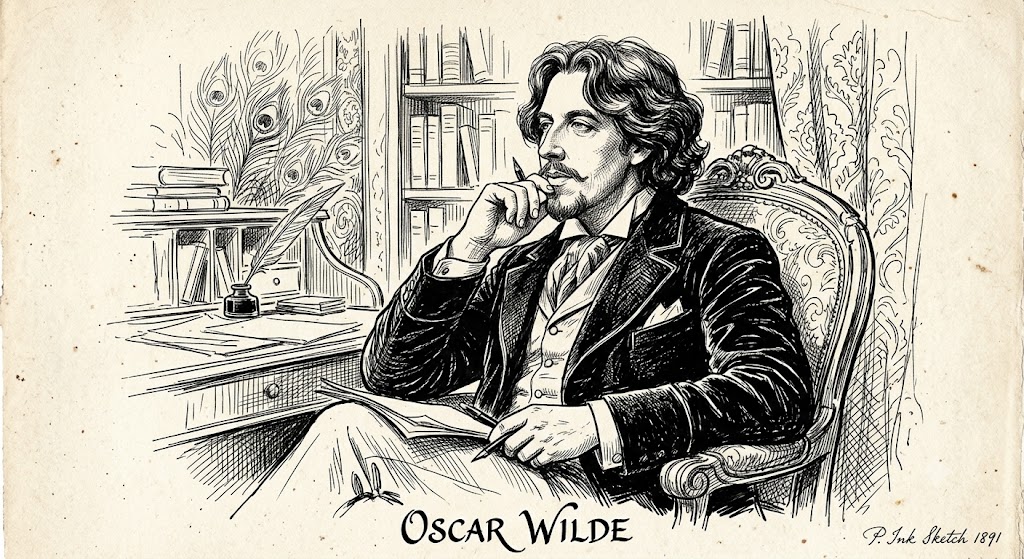
Proust and Wilde met briefly in Paris around 1891, when the young Proust was an aspiring 20-year-old man-about-town and Wilde was at the height of his international celebrity. According to contemporary memoirs and literary anecdotes, Proust invited Wilde to dinner at his parents’ bourgeois home on the Boulevard Malesherbes. Wilde arrived fashionably late, surveyed the family apartment, and allegedly delivered a characteristically cutting remark before departing: “Comme c’est laid chez vous” (“How ugly your house is”).
Whether apocryphal or exact, the story highlights the fundamental clash of personalities between the two men. Where Wilde performed his dandyism publicly—wearing his persona as an outrageous, theatrical armor—Proust operated through hyper-sensitivity, social diplomacy, and protective concealment.
Proust later summarized his conflicted feelings toward Wilde in a famous letter to Jean Cocteau:
“Je déteste Wilde (ou plutôt je ne le connais pas).”
(“I hate Wilde [or rather, I do not know him].”)
Proust distrusted Wilde’s theatrical self-dramatization. To Proust, Wilde was guilty of prioritizing the performance of art over the arduous, inward labor of artistic creation. While Wilde famously remarked that he put his genius into his life and only his talent into his works, Proust believed precisely the opposite: true genius belonged strictly to the written work, while the social persona was a superficial mask.
2. As a Writer: Aesthetic Kinship vs. Surface Brilliance
Despite his personal reservations, Proust recognized Wilde as a fellow traveler in literary aesthetics. Both shared a deep intellectual inheritance, particularly their reverence for Honoré de Balzac.
In his critical essays, Proust cited Wilde’s famous observation from The Decay of Lying that one of the greatest tragedies of Wilde’s life was the death of Lucien de Rubempré in Balzac’s Splendeurs et misères des courtisanes. Proust appreciated Wilde’s keen understanding of how art reshapes human perception—that life imitates art far more than art imitates life.
┌─────────────────────────────────────────────────────────────────────────┐│ Aesthetic Approaches │├───────────────────────────────────┬─────────────────────────────────────┤│ Oscar Wilde │ Marcel Proust │├───────────────────────────────────┼─────────────────────────────────────┤│ • Art as exterior performance │ • Art as internal memory ││ • Epigrammatic, witty surface │ • Voluminous, psychological depth ││ • Public provocation │ • Private, coded analysis ││ • Life converted into art │ • Life mined for the artwork │└───────────────────────────────────┴─────────────────────────────────────┘
However, Proust ultimately viewed Wilde’s literary output with some reservation. He found Wilde’s epigrammatic style too decorative and light, lacking the dense, involuntary memory and temporal depth that Proust considered essential for lasting literature. Nevertheless, Proust implicitly acknowledged Wilde as a pioneer in attempting to bring the subject of male-male desire into modern European literature.
3. The Legal Case: The Shadow of Le Jour du Scandale
The 1895 trials and subsequent imprisonment of Oscar Wilde for “gross indecency” sent shockwaves through European intellectual circles, profoundly shaping Proust’s world. For Proust, who was himself homosexual, Wilde’s downfall was not merely a foreign news story—it was a terrifying demonstration of societal cruelty and the suddenness with which high society could turn on an outsider.
In Sodome et Gomorrhe (the fourth volume of À la recherche du temps perdu), Proust directly addresses the psychological weight of this tragedy. He describes homosexuals as an outcast race constantly haunted by the fear of “le jour du scandale”—the catastrophic day when private secrets are exposed to public ruin.
Proust explicitly refers to Wilde (without naming him directly) in one of the longest, most syntactically complex sentences of the entire novel:
- He frames Wilde as the tragic archetype of the persecuted invert—a man stripped of his status, exiled by a hypocritical aristocracy that had previously applauded him, and forced into disgrace.
- He critiques the legal system and moral posturing of society, seeing Wilde’s trial as a modern witch hunt where hypocrisy used the law to punish artistic and personal transgression.
Where Wilde’s legal tragedy stemmed from aggressive public confrontation—bringing a libel suit against the Marquess of Queensberry—Proust drew the opposite lesson. Wilde’s trial reinforced Proust’s conviction that discretion, double meanings, and artistic coding were necessary survival mechanisms in a hostile world.
Conclusion
To Marcel Proust, Oscar Wilde was simultaneously an object of irritation, an intellectual peer, and a tragic martyr. As a person, Wilde represented a dangerous, theatrical flamboyance that Proust rejected in favor of quiet observation. As a writer, Wilde offered brilliant aesthetic insights that Proust admired, even while finding his literary form too lightweight.
Above all, Wilde’s ruinous legal case left an indelible mark on Proust’s imagination. In the shadow of Reading Gaol, Proust crafted his own masterwork with equal parts artistic daring and protective camouflage, ensuring that the subterranean truths Wilde died for were preserved safely within the pages of À la recherche du temps perdu.
Leave a Reply