— Adam Donaldson Powell
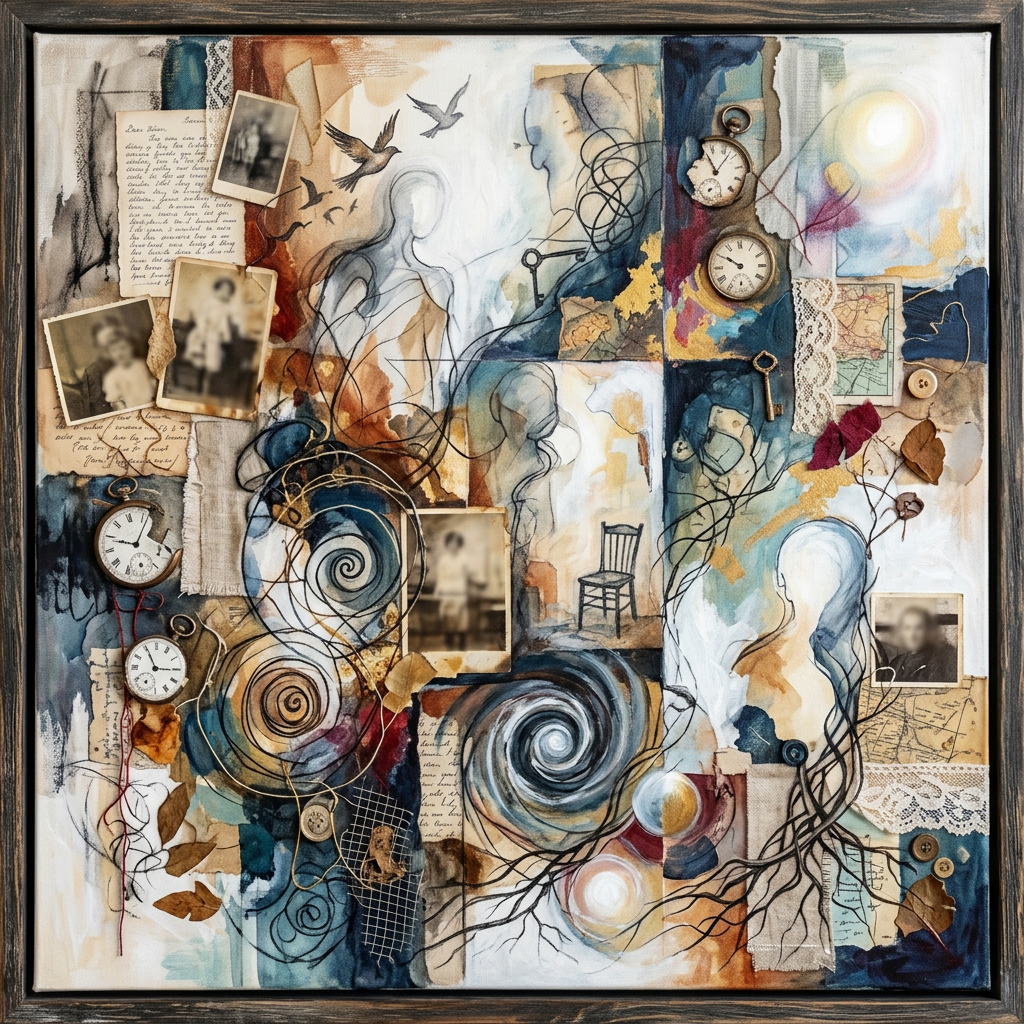
storytelling: of memory, monsters, mortality… proust
Humans cannot live by facts alone. We require memory to know where we came from, dreams to imagine where we might go, heroes to embody our ideals, anti-heroes to expose our contradictions, monsters to give form to our fears, and mythological beings to explore realities beyond ordinary experience.
At first glance, memories, dreams, heroes, monsters, and mythological beings seem like disparate subjects. But they can all be understood as different ways humans make the invisible visible. They are cognitive and existential tools that help us inhabit time. Together they make storytelling possible—and storytelling is how we learn to live within time.
- Memory anchors identity. Without memory there is no continuous self, only isolated moments. Philosophy from Locke onward treats memory as central to personhood.
- Dreams point beyond the present. They represent hope, fear, unconscious desire, and the imagination’s refusal to be limited by reality.
- Heroes embody aspiration. They are less about perfection than about giving us a direction.
- Anti-heroes acknowledge that goodness is rarely simple. They invite moral reflection instead of moral certainty.
- Monsters externalize what threatens us—death, chaos, disease, violence, the unknown. Dragons, vampires, and cosmic horrors change shape across cultures, but they consistently dramatize existential anxieties.
- Mythological creatures and beings inhabit the borderlands between nature and spirit, reason and mystery. They allow cultures to ask questions that ordinary language cannot answer.
Perhaps the deepest reason these figures endure is that humans are temporal creatures. We know we are finite. Unlike most animals, we anticipate our own death, remember our past, and imagine futures that may never come. Storytelling is one of our responses to this predicament.
Stories stretch a human life beyond the immediate present. They let us rehearse choices before making them, preserve the dead in memory, imagine descendants we will never meet, and contemplate worlds that never existed. They are, in a sense, experiments in living.
Philosophy asks what it means to live a good life. Storytelling asks us to experience possible lives.
Together they form complementary ways of confronting time. One argues; the other imagines. Both attempt to answer the same question: what should we do with the brief interval between birth and death?
Humans are constantly “coming to terms with time/life left.” That wording hints at something more universal than simply fearing death. Humans don’t merely want to survive; we want our limited time to mean something. Stories provide structure where life often feels chaotic. They transform the passage of time into a narrative, and a narrative into meaning.
Every culture invents these figures because they answer the same enduring human needs: identity, morality, imagination, fear, hope, and, ultimately, reconciliation with our own finitude.
Memory, dreams, heroes, monsters, myths, anti-heroes—these are not merely recurring literary motifs. They are recurring structures of consciousness.
Humans do not simply perceive reality.
We remember.
We anticipate.
We imagine.
We mythologize.
We personify abstractions.
We invent monsters for dangers we cannot define.
We invent heroes for virtues we struggle to embody.
We dream futures that never happen.
We revisit pasts that never quite existed.
Storytelling is not an artistic luxury built on top of consciousness.
It is one of the principal ways consciousness organizes itself.
Homer, Shakespeare, Proust, Cervantes, Dostoevsky, Kafka, Borges, Tolkien, Woolf, Márquez…
Very different writers.
Yet all depend upon memory, imagination, symbolic figures, archetypes and imagined worlds because these are the furniture of the human mind.
Even science relies on thought experiments.
Even philosophy relies on myths.
Plato has the Cave.
Nietzsche has Zarathustra.
Descartes has the Evil Demon.
Hobbes has the Leviathan.
These aren’t decorative. They’re cognitive tools.
Proust isn’t simply sequencing memories.
He is demonstrating that memory itself is creative rather than archival.
We do not retrieve the past.
We recreate it.
Dreams do something similar with the future.
Myths do something similar with cultures.
Novels do something similar with lives.
All of them transform raw experience into meaningful narrative.
Memory gives us a past. Dreams give us a future. Heroes tell us who we might become. Monsters reveal what we fear becoming. Myths bind individual lives into a history larger than ourselves. Stories weave these together so that a finite life may be experienced as something more than a sequence of passing moments. We tell stories because time otherwise remains unintelligible.
That’s a philosophical claim, not a literary one.
And that’s why Proust becomes relevant rather than central.
He is not important because he wrote about memory.
He is important because he discovered one of literature’s deepest capacities: to make the reader witness the formation of their own consciousness.
____________________________
Conclusion:
Human beings do not tell stories because life is interesting. We tell stories because time is finite.
Everything else—memory, dreams, myth, heroes, monsters, even stream of consciousness—is subordinate to that.
Memory rescues what time would otherwise erase.
Dreams anticipate what time has not yet brought.
Heroes compress lifetimes into exemplary actions.
Anti-heroes remind us that our time is spent amid moral ambiguity.
Monsters embody the threats that accompany mortality.
Myths extend an individual life into cultural time.
Stories make the passage of time intelligible.
Proust’s genius was to reveal that consciousness itself unfolds through time rather than merely existing within it.
That is why we continue to tell stories, create myths, remember the dead, imagine impossible worlds, and return to books long after their plots have faded. We are not merely passing time with stories; we are using stories to understand what the passage of time means.
This candid essay is blunt, but at the same time it is aiming at something subtler than memento mori: We do not become aware of time because clocks exist. We invented clocks because we had already become aware that our lives unfold irreversibly. The first measure of time was not the sundial but memory. Before we counted hours, we counted generations. Before we recorded dates, we told stories. Storytelling is one of humanity’s oldest clocks. It measures not seconds but significance. And with that, this bold little essay becomes something larger than a reflection on literature. It becomes a reflection on why literature exists at all.
Leave a Reply