A history of «Gay banter» in early literature
Defining “gay banter” as witty, teasing, sexually charged exchanges between characters of the same sex—not simply literary depictions of homosexuality—then the history goes surprisingly far back. There isn’t a single “first,” because surviving literature is only a tiny fraction of what was written, but some of the earliest surviving examples are quite recognizable.
1. Aristophanes — 5th century BCE
The strongest early candidate is Aristophanic comedy. In plays such as The Clouds, The Acharnians, The Knights, The Birds, Lysistrata, and The Frogs, jokes about male sexual behavior, effeminacy, pederasty, and men’s attraction to other men are woven into ordinary comic dialogue.
What’s interesting is the social mechanism of the humor. Aristophanes frequently assumes that the audience already knows who is sexually “available,” who is effeminate, who has slept with whom, etc. A real person such as Cleisthenes could repeatedly be used as a comic target because his supposed sexual reputation was common knowledge.
So you get something quite close to modern campy teasing: everyone knows what we’re talking about, nobody needs to spell it out, and the joke is partly in the insinuation.
2. Plato — 4th century BCE
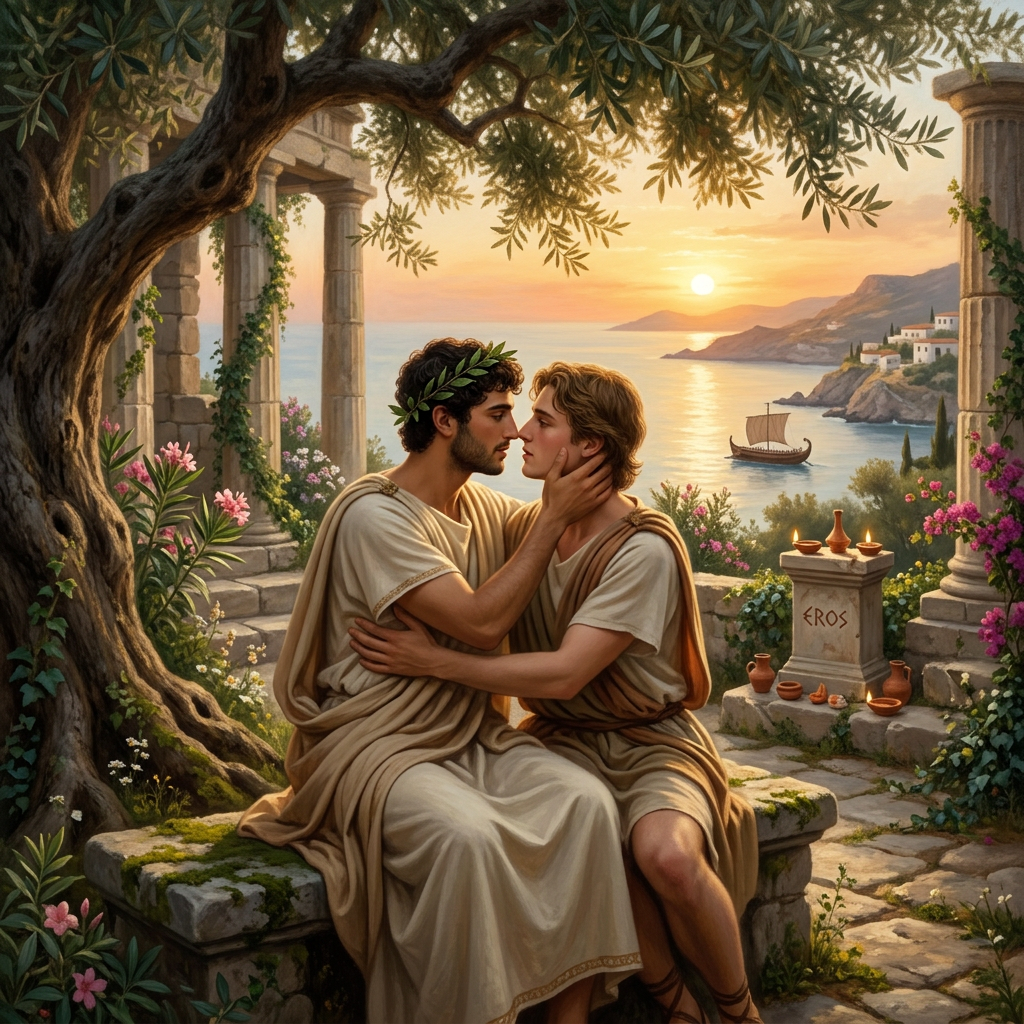
Plato’s Symposium is a very different sort of example. The men are discussing love between men with extraordinary seriousness, but there is also playful male-on-male teasing throughout the framing narrative.
The opening is almost sitcom-like: Apollodorus recounts a dinner party he has heard about, Aristodemus turns up unexpectedly, Agathon’s servants fuss around the guests, Socrates arrives late, and the men joke and flirt around the edges of an extremely serious philosophical discussion of erotic love.
It isn’t “gay banter” in the modern identity-based sense—the Greeks didn’t organize sexuality around our category of “gay”—but it demonstrates something important: male homoeroticism could be simultaneously erotic, affectionate, intellectual and comic.
3. Petronius — 1st century CE
If you’re looking for something that feels much more recognizably like modern gay banter, jump forward to Petronius’ Satyricon.
The relationship between Encolpius, Ascyltos and Giton produces an extraordinary amount of sexual jealousy, insults, flirtation and double-entendre. Encolpius and Ascyltos are lovers/rivals who compete for Giton, and their arguments have the rhythm of two men who know each other’s sexual history intimately.
What’s particularly striking is that Petronius doesn’t merely make homosexuality the butt of the joke. The sexual relationships themselves generate the comedy. One scholar describes Petronius as treating the material with a considerably more subtle humor than Aristophanes.
That’s probably the closest ancient analogue to what someone today might call “gay banter.”
4. Roman satire and epigram
The Romans then give us a huge amount of sexually explicit joking in Catullus, Martial, Juvenal, and others. Here the banter can become vicious: sexual roles, masculinity, penetration, impotence, effeminacy and male lovers are all material for insults.
But there’s an important distinction: much of this is homophobic or status-based humor by modern standards, rather than “gay humor.” Roman sexuality was strongly structured around active/passive status and social rank. A joke about a man having sex with another man isn’t necessarily a joke about being homosexual.
That’s one reason I wouldn’t simply label all ancient homosexual jokes “gay banter.”
The really interesting progression
One could roughly sketch the surviving tradition like this:
Aristophanes (5th c. BCE)
→ sexual insinuation and public teasing
→ Plato (4th c. BCE)
→ male eroticism becomes playful/intellectual conversation
→ Petronius (1st c. CE)
→ sexual relationships themselves become the engine of comic banter
→ Martial (1st–2nd c. CE)
→ extremely compressed sexual jokes and insults
→ medieval/early-modern literature
→ homoerotic joking becomes more coded because of Christian sexual norms
→ Shakespeare and Renaissance comedy
→ elaborate homoerotic double entendre, especially in male friendships and cross-dressing plots
→ Wilde, Firbank, Coward, Isherwood, etc.
→ recognizably modern gay wit and camp.
So if asking “What is the earliest surviving literature where two men interact in a way that feels like gay banter rather than simply a depiction of homosexual sex?”, the answer might be:
Aristophanes gives us the earliest surviving comic vocabulary for it; Petronius gives us perhaps the earliest surviving relationship-driven gay banter.
And Satyricon is especially worth reading if you’re interested in the genealogy of camp, bitchiness, sexual jealousy and knowingly homoerotic male comedy.
Oscar Wilde and Marcel Proust both excelled at gay banter, but in different ways:
- Oscar Wilde excelled at overt, quotable, performative gay banter. His dialogue is built around double meanings, flirtation, epigrams, camp, and the pleasure of saying something scandalous while pretending to be innocent. In The Importance of Being Earnest, Lady Windermere’s Fan, and The Picture of Dorian Gray, his wit frequently operates through a kind of coded homoerotic knowingness. Wilde’s own conversational style was famously similar: he could turn an exchange into a performance.
- Marcel Proust excelled at something more psychological and socially intricate. In In Search of Lost Time, especially around the Baron de Charlus, Jupien, Saint-Loup, Albertine, and the Verdurins, homosexuality produces elaborate networks of insinuation, jealousy, coded recognition, flirtation, mockery and social maneuvering. Proust is less “one-liner” and more theatrical social intelligence: characters constantly try to work out who desires whom, who knows what, and who is pretending not to know.
There’s a fascinating distinction:
Wilde:
I know we’re both pretending not to say what we’re saying.
Proust:
I know that you know that I know what you’re pretending not to say—and I’m going to spend 40 pages analyzing the implications.
And there’s an important historical wrinkle. Wilde’s banter is often deliberately camp, whereas Proust’s is frequently about the social code surrounding homosexuality. Proust was extraordinarily interested in the peculiar conversational world of homosexual men in Belle Époque Paris: coded language, recognition between strangers, euphemism, gossip, cruising, jealousy, and the contrast between public heterosexual identity and private desire.
So if by “gay banter” you mean effeminate/campy, witty, sexually coded repartee, Wilde is probably the greater master.
If you mean the intricate, coded, psychologically perceptive conversation of gay social life, Proust may be unmatched.
And interestingly, Wilde is much funnier per sentence, while Proust is much funnier once you understand what everyone in the room is actually doing.
Leave a Reply