Pip: Welcome to osoparavos.com, where today the question is whether a man can be simultaneously the smartest person in the room and the least equipped to survive it.
Mara: Adam Donaldson Powell takes on that exact tension in a long-form essay on Oscar Wilde — the wit, the trials, the imprisonment, and what De Profundis reveals about what was left when the applause stopped.
Pip: Let’s start with the man who turned every courtroom question into a performance review.
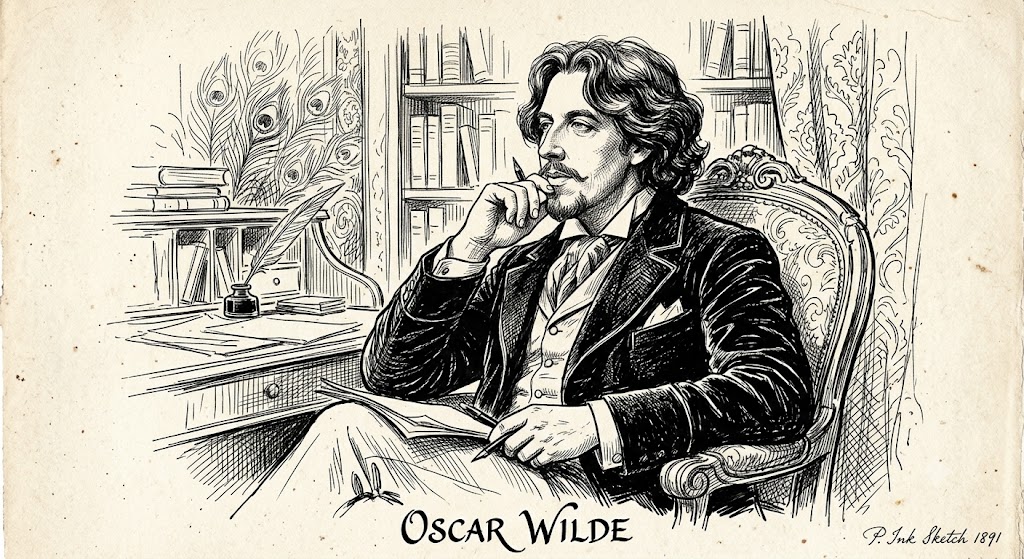
Oscar Wilde: The Martyr of Wit
Mara: The essay opens by holding two claims at once: Wilde was the victim of a genuinely unjust society, and he was also someone whose temperament made survival harder than it needed to be. That’s the tension the whole piece lives inside.
Pip: And the essay names that tension precisely. The piece sets up Wilde’s wit not as vanity but as philosophy — his way of attacking Victorian moral certainty through paradox rather than argument.
Mara: The preface to The Picture of Dorian Gray gets cited directly: “There is no such thing as a moral or an immoral book. Books are well written, or badly written.” That wasn’t a defense of artistic freedom so much as an attack on the assumption that literature existed to serve social morality.
Pip: So the epigrams weren’t just jokes. They were the delivery mechanism for ideas that a sermon would have gotten people’s backs up about.
Mara: Exactly — the essay puts it as a small intellectual explosion wrapped in entertainment. The theater worked the same way. In The Importance of Being Earnest, cucumber sandwiches get the gravity reserved for moral crises, while baptisms and inheritances become absurd devices. The comedy was surgical.
Pip: Which is fine until the audience stops laughing and starts subpoenaing.
Mara: That’s precisely where the essay goes. When Queensberry left his card at Wilde’s club in 1895, friends urged retreat. Wilde prosecuted instead, believing eloquence would prevail. The essay frames his opponent Edward Carson as disciplined intelligence — patient and methodical — against Wilde’s creative intelligence, spontaneous and unpredictable.
Mara: The breaking point arrives when Carson asks whether Wilde kissed a young servant named Walter Grainger. Wilde denied it, then added the man was “a particularly plain boy” and “unfortunately extremely ugly.” The essay calls this devastating — not as confession, but because his first impulse was an aesthetic judgment, not a denial of desire.
Pip: He answered like an artist when the room needed a defendant. That’s the whole essay in one exchange.
Mara: After conviction and two years of hard labor, something shifts. Before prison, the essay says, wit was a sword. After, it became something closer to a lantern. De Profundis is the evidence — Wilde writing to Lord Alfred Douglas, wounded and reflective. He writes, “I must say to myself that I ruined myself, and that nobody great or small can be ruined except by his own hand.”
Pip: That’s a remarkable sentence to write from inside a Victorian prison. No self-pity, no full absolution of the system either.
Mara: The essay holds both. Victorian persecution was real and brutal — the piece is unambiguous about that. But Wilde also refuses the consolation of pure victimhood. The closing image is him in a Paris hotel, dying in poverty, reportedly looking at the wallpaper and saying one of them had to go. A joke, a confession, and a tragedy dressed as elegance, all at once.
Pip: The society that sentenced him is now a footnote. He is not.
Mara: The essay’s final argument is that Wilde wasn’t destroyed by his enemies or entirely by himself — he was destroyed by the same force that made him extraordinary.
Pip: Brilliance that refuses silence always carries a price. That one stays with you.
___________________________
Leave a Reply