Pip: Welcome to osoparavos.com, where the madeleine has been waiting in the tea long enough that it’s gone a bit soggy — but the memory it triggers is, apparently, a whole neurosurgical event.
Mara: Adam Donaldson Powell takes us into the place where philosophy, literature, and clinical brain science meet — specifically, what Bergson and Proust got right about memory, and how the operating theater eventually proved it.
Pip: Let’s start with the scalpel, the philosopher, and the novelist who never met but somehow wrote the same book.
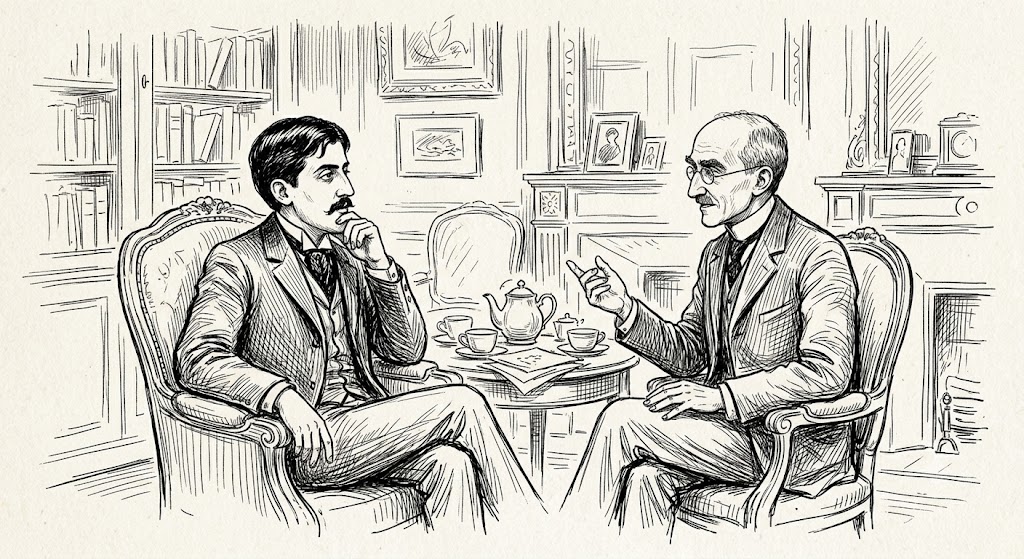
Bergson, Proust, and the Neuroscience of Memory
Mara: The central question here is whether two early twentieth-century French thinkers — one a philosopher, one a novelist — were doing neuroscience before neuroscience had the tools to catch up. The post argues the answer is yes, and the evidence comes from the operating room.
Pip: The verbatim case for that starts with Proust. The post quotes directly from Swann’s Way — the madeleine moment: “No sooner had the warm liquid mixed with the crumbs touched my palate than a shudder ran through me and I stopped, intent upon the extraordinary thing that was happening to me. An exquisite pleasure had invaded my senses… And at once the vicissitudes of life had become indifferent to me, its disasters harmless, its brevity illusory…”
Mara: What that passage describes, in neuroanatomical terms, is the olfactory and gustatory system bypassing the thalamic relay entirely — routing directly to the amygdala and hippocampus before the prefrontal cortex can apply any executive filter. Proust experienced it as literature. Neurosurgeons now map it as circuitry.
Pip: And Bergson had the structural framework first. He divided memory into habit memory — procedural, embodied, forward-looking — and pure memory, the unrepeatable episodic record of lived experience. The post traces how that dichotomy was confirmed by Wilder Penfield’s awake brain surgeries at the Montreal Neurological Institute.
Mara: Penfield stimulated the temporal cortex of conscious patients and found they relived specific vivid scenes — a childhood melody, a neighborhood smell. Not motor responses. Experiential ones. The post also points to the bilateral medial temporal resection of patient H.M., who lost new episodic memory entirely but retained the capacity to learn motor tasks, confirming Bergson’s structural split along exactly the lines he proposed.
Pip: So the philosopher’s diagram and the novelist’s prose both turned out to be functional neuroanatomy in disguise.
Mara: The post extends this into a third area — Bergson’s warning against “spatializing” time, treating it as discrete measurable points rather than continuous lived flow. Recent neuroscience identified hippocampal “time cells” that fire at sequential intervals, which looks at first like exactly what Bergson feared. But the post argues these cells encode experiential trajectories, not abstract clock ticks — each moment carrying residual activity from the last and priming for the next.
Pip: Bergson’s durée, rendered in population-level firing patterns. That’s either a vindication or a very elegant coincidence.
Mara: The post closes on memory reconsolidation — the finding that every time a memory is retrieved, it becomes biochemically labile and open to rewriting before it restabilizes. It connects this directly to Proust’s observation that “the memory of a particular image is but regret for a particular moment; and houses, roads, avenues are as fugitive, alas, as the years.” Memory isn’t playback. It’s reconstruction, every time.
Pip: Which means the past isn’t stored. It’s continuously authored.
Mara: What stays with me is the convergence — philosophy, literature, and surgery arriving at the same model of memory through entirely different methods.
Pip: Three disciplines, one brain. More from osoparavos.com next time.
_____________________________
Leave a Reply