Pip: Cork-lined walls, caffeinated milk, and a literary masterpiece that runs to several thousand pages — osoparavos.com is asking the obvious question: how does that happen?
Mara: This episode draws on work by Adam Donaldson Powell, and the territory is Proust — specifically the women who made his writing life possible, and what their devotion looked like in practice.
Pip: Let’s start with the architecture holding the whole thing up.
The Women Who Built Proust’s World
Mara: The central claim here is that Proust’s famous fragility and his monumental literary output are not a contradiction — they’re connected. The women around him provided what the post calls the structural, intellectual, and emotional scaffolding that kept his fragile psyche grounded.
Pip: The post traces that scaffolding across three figures: his grandmother Adèle Weil, his mother Jeanne, and his housekeeper Céleste Albaret — each one picking up where the last left off.
Mara: Adèle Weil comes first. She ran a household where, as the post puts it, “culture was not an ornament worn for social status; it was a living, ethical practice.” She steered the young Proust away from cheap fiction and toward Madame de Sévigné and Saint-Simon — the writers whose moral gravity and prose clarity would shape his own.
Pip: So the grandmother installs the operating system, and then Jeanne keeps it running under pressure.
Mara: Jeanne Weil Proust is where the post gets genuinely specific. She didn’t just comfort Marcel — she translated Ruskin’s English into French word for word so that Marcel could polish the drafts into Proustian prose. She cross-referenced citations, edited manuscripts, and managed his correspondence. The post calls her his primary literary collaborator during his formative years.
Pip: That’s a significant reframe. The enabling mother turns out to be the co-author.
Mara: And when Jeanne died in 1905, Proust wrote to a friend: “My life has now lost its only purpose, its only direction, its only consolation, its only warmth.” The post reads her death as the catalyst — her absence forced him to confront time and loss directly, which is what In Search of Lost Time is actually about.
Pip: Grief as the engine. That tracks.
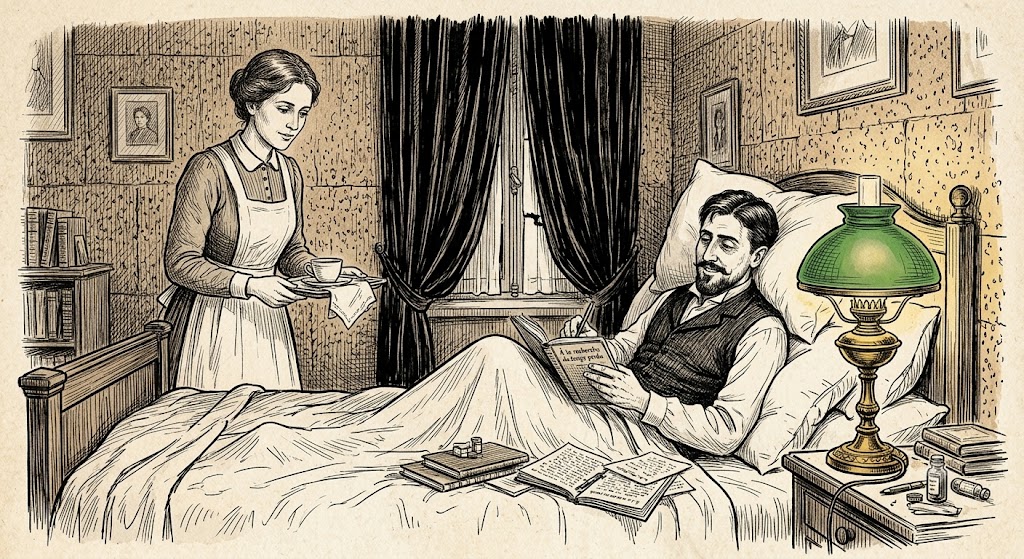
Mara: Céleste Albaret steps into that gap from 1913 onward. She maintained his cork-lined bedroom, served meals at three in the morning, and pasted extension strips onto his handwritten notebooks as his sentences grew. Proust once told her: “Ah, Céleste, if I had had you when I was young, I wouldn’t have needed my mother!” The post treats that line as more than flattery — it marks the continuity of care he required to finish the novel before his death in 1922.
Pip: Three women, one unbroken line of devotion — and at the end of it, one of the longest novels ever written.
Mara: The post’s conclusion is that the “mama’s boy” label misreads the dynamic entirely. Proust’s dependency wasn’t a failure of development — it was the condition that made the art possible.
Mara: What stays with me is the Ruskin collaboration — the idea that the novel’s intellectual foundation was genuinely shared work.
Pip: Memory, time, and the people who hold the space while you figure out what to say about them. More from osoparavos.com next time.
_____________________________
Leave a Reply