Pip: Welcome to osoparavos.com, where the literary feuds are centuries old and the pistols are loaded with footnotes.
Mara: Today we’re in the territory of Adam Donaldson Powell’s work on intra-community rivalry, salon power, and the surprisingly physical world of Belle Époque literary competition. Let’s start with the combats de coqs themselves.
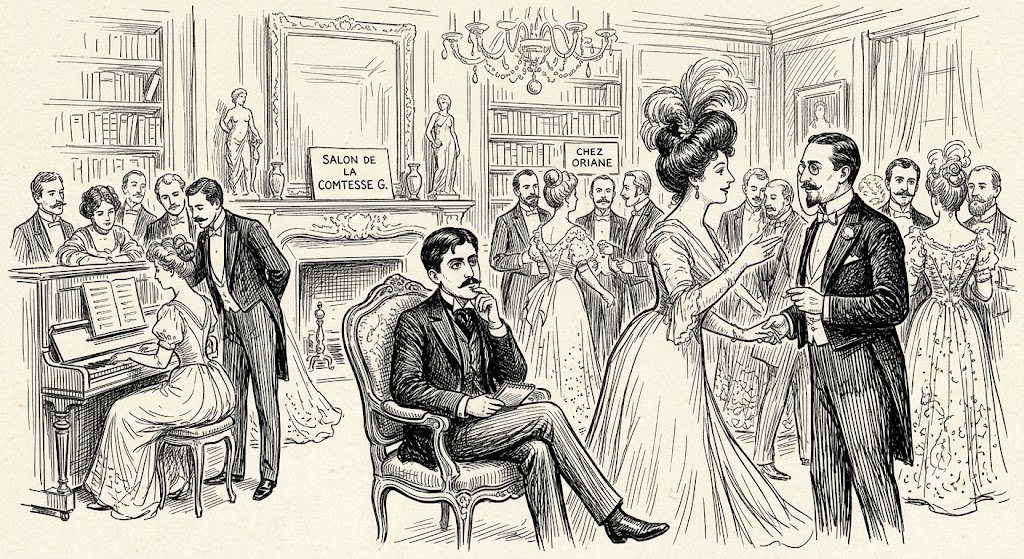
The Salon as Arena: Proust’s Rivalries and the Women Who Managed Them
Pip: The central argument here is that homosexual literary men in Belle Époque Paris were not a community — they were competitors, and the arena was the drawing room. The question is what made these rivalries so high-stakes, and what role the women running those salons actually played.
Mara: The post frames the structural logic precisely: hostesses such as Madeleine Lemaire, the Comtesse Greffulhe, Geneviève Straus, and the Comtesse de Chevigné “adopted talented young homosexuals. They provided these men with social standing, access to elite networks, and protection from the legal and moral taboos surrounding inversion. In return, the hostesses demanded absolute loyalty, wit, and conversational entertainment.”
Pip: So the upshot is that tolerance had a price tag, and the currency was performance. When multiple men were competing for the same patroness, the salon stopped being a sanctuary and started being a tournament bracket.
Mara: The most literal example of that tournament is the 1897 duel between Proust and the decadent critic Jean Lorrain. Lorrain had reviewed Proust’s debut book by attacking not just the prose but Proust’s romantic relationship with Lucien Daudet — a public accusation in the shadow of the Oscar Wilde trial.
Pip: In the homophobic climate of the 1890s, that was less a book review and more a detonation.
Mara: Proust challenged Lorrain to a duel. On February fifth, in the forest of Meudon, two shots were fired, both missed, and honor was declared satisfied. The post notes the paradox directly: two homosexual men dueling over a public accusation of homosexuality to maintain standing in high society.
Mara: The Lorrain clash was sudden. The rivalry with Count Robert de Montesquiou lasted decades. Proust spent years as Montesquiou’s deferential errand boy — absorbing mockery of his bourgeois origins and Jewish ancestry — while quietly studying the Count’s grandiosity and secret encounters with working-class men.
Pip: Patience as a long game. Montesquiou thought he was collecting a disciple; Proust was collecting material.
Mara: The reversal came through Baron de Charlus in La Recherche — Montesquiou immortalized not as a tragic lord but, as the post puts it, as a pathologized case study. Proust defeated his former mentor not with a pistol, but through literary immortalization.
Mara: Then there is the generational angle: Jean Cocteau, young and dazzling, began displacing Proust in the affections of the very hostesses — including the Comtesse de Chevigné — who had anchored Proust’s social world. Proust responded not with a duel but by embedding those dynamics into La Recherche, capturing the cycle where established figures are supplanted by younger rivals in the fickle affections of salon hostesses.
Pip: The post also steps back to profile the hostesses themselves — Straus and Lemaire in particular — as informal ministers of culture, political strategists during the Dreyfus Affair, and career-makers whose endorsement functioned like accreditation. The salon was the shadow institution behind every visible one.
Mara: Which reframes the whole thing. These weren’t just social gatherings where rivalries happened to break out. The structure of patronage produced the rivalry. The hostesses didn’t merely witness the combats de coqs — they created the conditions for them.
Pip: From dueling pistols to literary caricature — the weapons changed, but the arena stayed the same.
Mara: What stays with me is how the post insists these rivalries were fought over tangible stakes — social survival, artistic legacy, and the patronage of powerful women — not just ego.
Pip: Marginalized groups navigating power through the only institutions available to them. That dynamic didn’t end in 1914. More from osoparavos.com next time.
______________________________
Leave a Reply