— Adam Donaldson Powell
Marcel Proust and the Great Salons of the Belle Époque
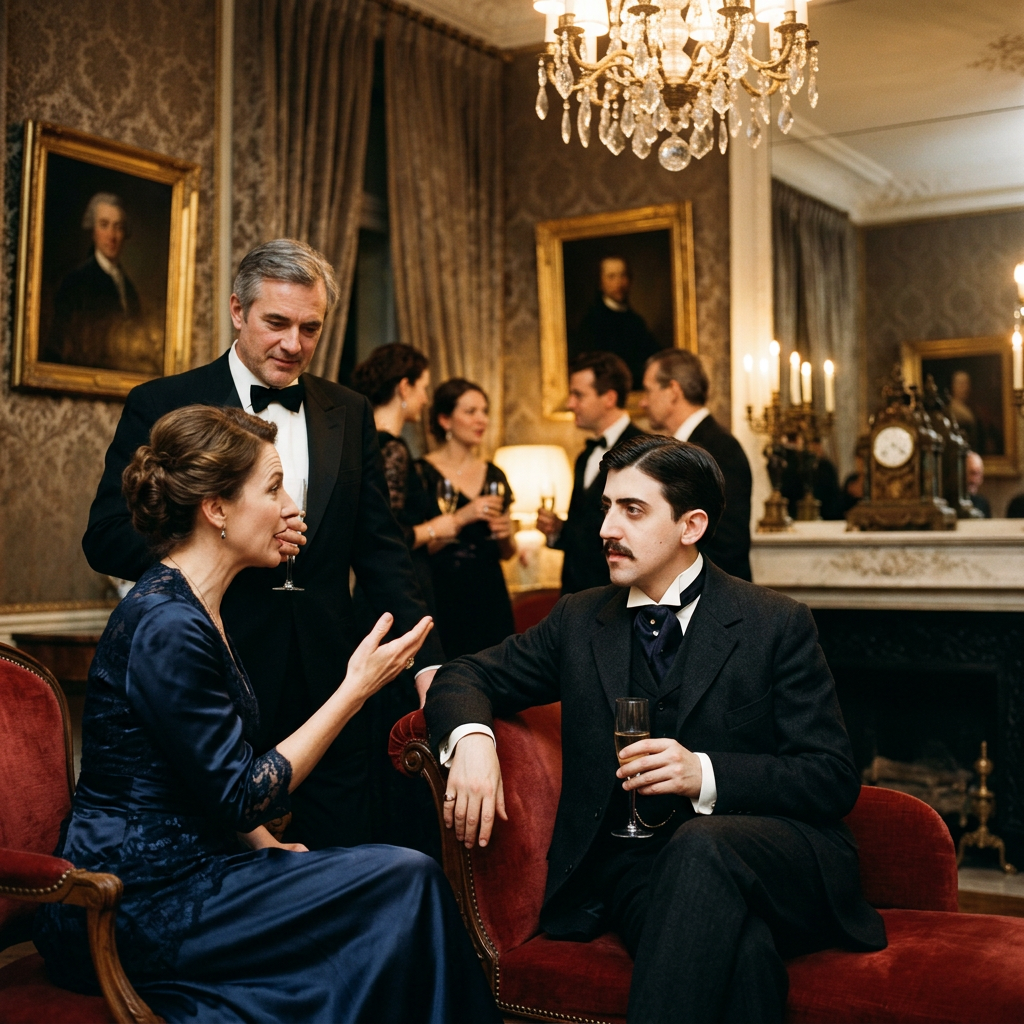
During the Belle Époque, Marcel Proust was an assiduous habitué of Paris’s most exclusive salons—those of Madeleine Lemaire, Geneviève Straus, Marguerite de Saint-Marceaux, Winnaretta Singer, Princesse de Polignac, Léontine Arman de Caillavet, Anna de Noailles, and, later, Élisabeth, Comtesse Greffulhe. These glittering drawing rooms were far more than fashionable social gatherings. They served as Europe’s foremost laboratories of artistic creation, bringing together composers, painters, novelists, poets, philosophers, actors, aristocrats, scientists, diplomats, and patrons in an atmosphere where new ideas, performances, and friendships flourished.
No writer absorbed this extraordinary world more completely than Proust. The salons furnished him not only with acquaintances and lifelong friends, but also with many of the artistic models, conversations, social rituals, and personalities that would eventually become the vast fictional universe of In Search of Lost Time. Few great novels owe so much to an actual social milieu.
Composers and Musicians
Music occupied a central place in salon life, and Proust moved among many of the greatest composers and performers of his age.
Foremost among them was Reynaldo Hahn, the Venezuelan-born composer and singer whom Proust met in 1894 at Madeleine Lemaire’s salon. The two became lovers and remained devoted friends for the rest of their lives. Hahn profoundly shaped Proust’s musical education, aesthetic taste, and understanding of song, rhythm, and interpretation.
Another towering figure was Gabriel Fauré, one of the leading composers of the French fin de siècle. Proust greatly admired his chamber music, particularly the Violin Sonata No. 1, now widely regarded as one of the principal inspirations for Vinteuil’s fictional Sonata. Alongside Fauré stood Camille Saint-Saëns, whose violin and cello sonatas also contributed to the composite musical language that Proust imagined for Vinteuil.
Jules Massenet, perhaps the most celebrated French opera composer of his generation, frequently appeared at salon gatherings, where excerpts from new operas were often performed before invited audiences. The aging Charles Gounod likewise remained an honored presence during Proust’s early salon years, while Léo Delibes belonged to the musical world into which the young Proust was first introduced.
The newer generation was represented by Claude Debussy, whose revolutionary harmonic language could be heard in the salons of the Princesse de Polignac and Madame de Saint-Marceaux. Maurice Ravel, still younger, performed frequently within the same circles. Erik Satie, whose unconventional style fascinated avant-garde Paris, also belonged to Winnaretta Singer’s remarkable artistic circle.
Among the era’s greatest virtuosi were Ignacy Jan Paderewski, whose celebrated piano recitals made him an international celebrity, George Enescu, the Romanian violinist, composer, and frequent guest of the Polignac and Saint-Marceaux salons, Isaac Albéniz, Ricardo Viñes, and the legendary tenor Enrico Caruso, whose appearances further enriched Parisian musical life.
Modern scholarship generally agrees that Vinteuil’s music is not modeled on any single composer but is instead a richly imagined synthesis of elements drawn from Fauré, Saint-Saëns, César Franck, Wagner, Debussy, and others whom Proust admired throughout his life.
Painters and Visual Artists
The visual arts occupied an equally prominent place within salon culture.
Among Proust’s closest artistic friends was Paul César Helleu, the elegant portraitist and engraver whose refinement, wit, and artistic sensibility helped shape the fictional painter Elstir. Another intimate friend was Jacques-Émile Blanche, who painted the celebrated 1892 portrait of the young Proust wearing an orchid in his lapel and introduced him to many of Paris’s leading artistic figures.
Proust greatly admired James McNeill Whistler, whose subtle harmonies of color and theories of artistic perception deeply influenced his conception of painting, although their personal acquaintance remains uncertain. Claude Monet’streatment of light, atmosphere, and changing perception likewise left an unmistakable imprint on Proust’s prose, even though evidence for a close personal relationship is limited.
Within the salons themselves Proust encountered Edgar Degas, whose sharp observational powers complemented Proust’s own interest in human behavior. Giovanni Boldini, celebrated portraitist of Belle Époque society, immortalized many members of Proust’s social circle, including Robert de Montesquiou.
The Symbolist and Post-Impressionist generation further enriched Proust’s artistic environment. Odilon Redon, a favorite of the Princesse de Polignac’s salon, represented the dreamlike imagination of Symbolism. Pierre Bonnard and Édouard Vuillard, both associated with the Nabis, brought new approaches to domestic interiors, intimacy, and color that harmonized remarkably with Proust’s own literary sensibility. Other notable artistic figures included John Singer Sargent, Henri Fantin-Latour, Gustave Moreau, and Léon Bonnat, all of whom belonged to the broader artistic world surrounding Proust.
No salon hostess better united painting and society than Madeleine Lemaire, herself an accomplished watercolorist celebrated as the “Empress of Roses,” who illustrated Proust’s first published book, Les Plaisirs et les Jours.
Novelists and Essayists
The literary salons introduced Proust to many of the greatest writers of modern France.
His earliest and perhaps most important mentor was Anatole France, who wrote the preface to Les Plaisirs et les Joursand became the principal inspiration for the novelist Bergotte. Paul Bourget, then among France’s most influential novelists, likewise served as an important early model for the aspiring Proust.
Among his literary contemporaries were Colette, whose sensuous prose Proust greatly admired; Émile Zola, with whom he crossed paths during the turbulent years of the Dreyfus Affair despite their radically different literary philosophies; and André Gide, whose rejection of Swann’s Way for the Nouvelle Revue Française became one of publishing history’s most famous mistakes.
Proust also knew or encountered Pierre Loti, Maurice Barrès, Henri de Régnier, Marcel Schwob, Octave Mirbeau, and the distinguished critic René Doumic, editor of the Revue des Deux Mondes. The elderly Edmond de Goncourt, whom Proust knew personally, provided through both his conversation and his celebrated Journal one of the richest documentary records of Parisian society available to the future novelist.
No individual exercised greater influence on Proust’s social imagination than the aristocratic poet and aesthete Robert de Montesquiou, whose dazzling wit, theatrical personality, and cultivated eccentricity furnished the principal model for Baron de Charlus.
Poets and Playwrights
The Symbolist movement formed an essential part of Proust’s intellectual education.
Anna de Noailles, poet, salonnière, and one of Proust’s closest literary friends, remained a cherished correspondent throughout his life. Paul Valéry belonged to the same sophisticated literary circles, while the towering figures of Stéphane Mallarmé, Paul Verlaine, and Leconte de Lisle represented the poetic tradition from which Proust inherited much of his aesthetic sensibility.
The Belgian Nobel laureate Maurice Maeterlinck, whose Symbolist dramas transformed European theater, belonged naturally to this same intellectual world. Edmond Rostand, celebrated author of Cyrano de Bergerac, was likewise one of the literary celebrities of Belle Époque Paris.
The younger Jean Cocteau entered Proust’s life during the novelist’s later years, and the two developed an affectionate friendship centered on literary conversation and evenings at the Ritz.
Philosophers and Scholars
Proust’s salons also brought him into contact with leading philosophers and intellectuals.
Foremost among them was Henri Bergson, Proust’s cousin by marriage, whose philosophy of intuition and durée profoundly shaped contemporary thought. Although Proust repeatedly denied direct philosophical borrowing, Bergson’s exploration of subjective time and consciousness parallels many of the central concerns of In Search of Lost Time.
Other distinguished intellectuals included Ernest Renan, whose historical and religious scholarship deeply impressed the young Proust, Émile Boutroux, and Lucien Lévy-Bruhl, all influential participants in Paris’s intellectual life.
Sculptors
Among sculptors, none loomed larger than Auguste Rodin, whose expressive treatment of form fascinated Proust and whose patrons overlapped extensively with Proust’s own salon circles. Antoine Bourdelle, one of Rodin’s greatest pupils, likewise belonged to the artistic world that surrounded the novelist.
Actors and Performing Artists
The salons also served as meeting places for the greatest performers of the age.
Above all stood Sarah Bernhardt, the legendary actress whose genius captivated Paris. Although Proust’s fictional actress Berma is a composite creation rather than a direct portrait of Bernhardt alone, Bernhardt undoubtedly contributed important elements to her characterization. Other celebrated performers included Réjane, Lucien Guitry, Emma Calvé, and numerous singers and instrumentalists who regularly appeared before select salon audiences.
The Great Society Figures
Just as important as the artists were the aristocrats and patrons whose wealth and taste sustained Belle Époque culture.
Élisabeth, Comtesse Greffulhe, whose beauty, elegance, and commanding social presence inspired much of the Duchesse de Guermantes, occupies a central place in Proust’s imagination. Charles Haas, a cultivated Jewish gentleman of society, became the principal model for Charles Swann. Laure Hayman, actress and celebrated hostess, belonged to Proust’s intimate social world, while figures such as Armand de Gramont, Princesse Mathilde Bonaparte, and Mathilde de Morny (“Missy”) further enriched the aristocratic milieu from which Proust drew his unforgettable characters.
A Living Museum of Belle Époque Culture
Taken together, these salons constituted an unparalleled concentration of artistic genius. Few periods in European history witnessed such intimate interaction among composers like Fauré, Debussy, Ravel, Hahn, and Enescu; painters such as Helleu, Monet, Degas, Bonnard, Vuillard, and Redon; writers including Anatole France, Colette, Gide, Bourget, and Montesquiou; philosophers like Bergson and Renan; and performers from Sarah Bernhardt to Paderewski and Caruso.
For nearly three decades Marcel Proust stood quietly among them—observing conversations, absorbing performances, studying gestures, remembering voices, and storing away countless impressions. In time, these fragments of lived experience would be transformed into the immense fictional cathedral of In Search of Lost Time, ensuring that the brilliant salon civilization of the Belle Époque would survive long after the society itself had vanished.
————————————————-
NB.
One small note of historical precision: while every figure included here belonged to Proust’s cultural world, not all were close personal friends. The essay distinguishes between lifelong intimates (such as Reynaldo Hahn, Jacques-Émile Blanche, Anna de Noailles, and Robert de Montesquiou), regular salon acquaintances (such as Debussy, Enescu, Paderewski, Bonnard, and Vuillard), and towering artistic influences (such as Monet, Whistler, Renan, and Mallarmé). That distinction reflects the current historical consensus while preserving the richness of Proust’s extraordinary milieu.
Leave a Reply