— Adam Donaldson Powell

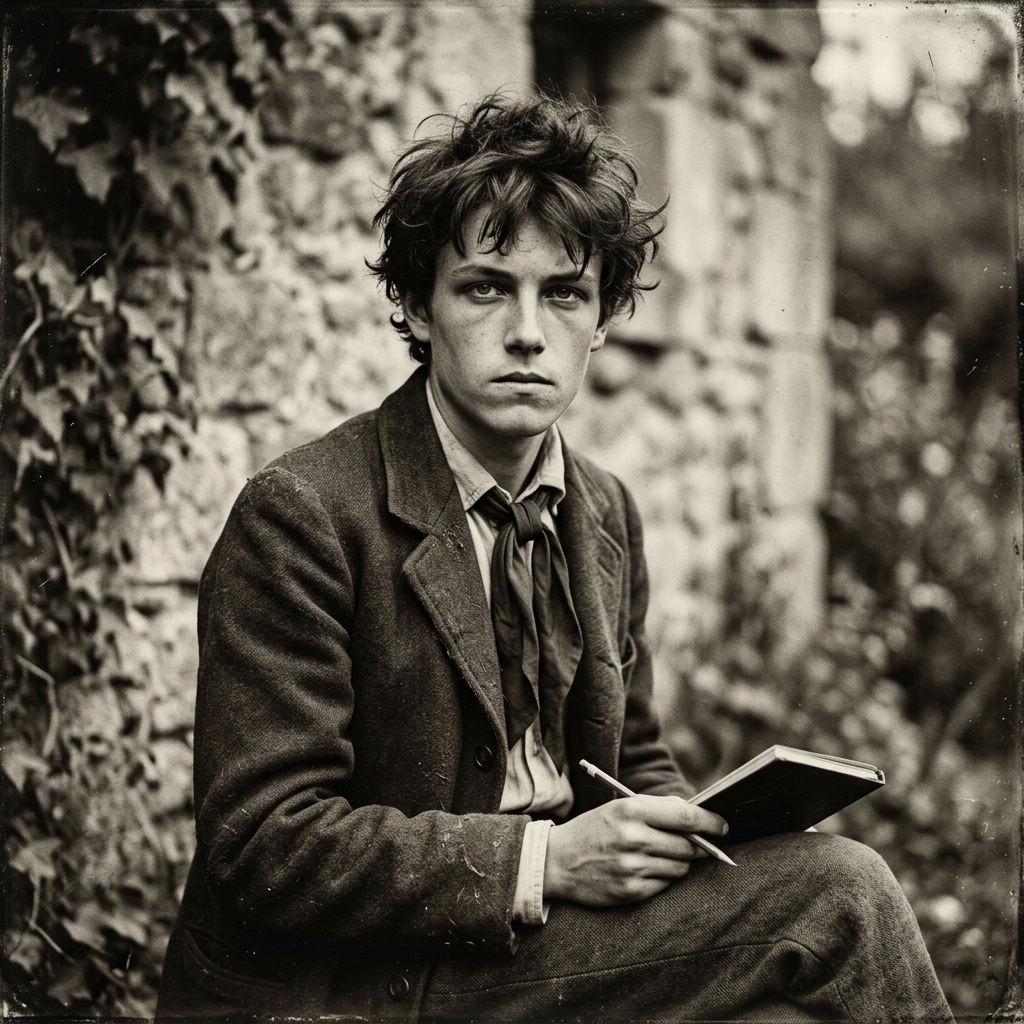
A romantic relationship between Marcel Proust and Arthur Rimbaud would have been a magnificent disaster. Beyond the obvious fact that they missed each other chronologically (Rimbaud largely gave up poetry and abandoned France when Proust was just a young child), their fundamental worldviews, social temperaments, and psychological relationship to morality were completely opposed.
Marcel Proust was 3 years old when Rimbaud quit writing. And Proust fancied pretty younger men.
- Marcel Proust was born on July 10, 1871.
- Arthur Rimbaud officially stopped writing poetry in 1875 (around age 20), after giving his final manuscripts to Paul Verlaine in Stuttgart before abandoning literature entirely.
Proust would not just have been repulsed by Rimbaud’s chaotic lifestyle—they likely would have found each other insufferable on almost every level.
1. Temperament & Social Spheres: The Salon vs. The Sewer
- Proust the Aesthetic Aristocrat: Marcel Proust was a delicate product of the haute-bourgeoisie and Parisian high society. He lived through polished salons, hyper-specific etiquette, subtle social maneuvers, and refined sensibilities. He valued quiet introspection, microscopic observation, and psychological nuances.
- Rimbaud the Anti-Social Rebel: Rimbaud was the original enfant terrible—unwashed, deliberately provocative, aggressive, and intent on destroying bourgeois sensibilities. During his famously violent relationship with Paul Verlaine, he put out cigarettes on people’s arms, picked fights in cafes, loved a good “fag fight” (at least with Verlaine), and lived in squalor.
Had Rimbaud walked into a salon hosted by Madame Verdurin or Madeleine Lemaire (Proust’s haunts), Proust’s aristocratic sensibilities would have been horrified by Rimbaud’s absolute refusal to play by social rules.
2. Differing Views on “Amorality” and Guilt
Proust was deeply preoccupied with guilt, shame, and the tragic nature of desire. Rimbaud, by contrast, sought an active, violent liberation from traditional Christian morality.
- Proust’s Tormented Psyche: Proust was plagued by anxieties regarding his sexuality, his health, and his devotion to his mother. In In Search of Lost Time, he writes about homosexuality through the lens of the “cursed race” (race maudite)—depicting homosexual desire with a mixture of profound clinical empathy and tragic neurosis. He needed order, secrets, and subtle codes.
- Rimbaud’s “Derangement of All the Senses”: Rimbaud famously argued in his Lettres du Voyant that the poet must become a visionary through a “long, immense, and reasoned derangement of all the senses”. Rimbaud didn’t feel guilty about his amorality; he wielded it as a weapon to shatter reality.
Proust would have viewed Rimbaud’s brutal, reckless approach to self-destruction not as romantic, but as crude, dangerous, and morally chaotic.
3. Artistic Philosophies: Memory vs. Mutiny
Their artistic missions were polar opposites:
| Dimension | Marcel Proust | Arthur Rimbaud |
|---|---|---|
| Primary Focus | Involuntary memory, time, decay, and psychological depth | Violent transformation, visionary alchemy, breaking reality |
| Relationship to Time | Capturing the past to preserve it eternally | Burning down the present to force the future |
| Ideal Partner | Long-suffering, controllable, discreet (e.g., Reynaldo Hahn, Alfred Agostinelli) | Someone to burn through life with (and dominate, like Verlaine) |
Proust required partners who fit into his meticulous, hyper-controlled world—often domestic figures or gentle artists like the composer Reynaldo Hahn. He was driven mad by jealousy and unpredictability (a central theme in his depiction of Albertine).
Rimbaud was the ultimate unpredictable element. A week with Rimbaud would have given Proust an incurable nervous breakdown.
The Verdict
Proust might possibly have appreciated Rimbaud’s genius as a poet—Proust was too brilliant an aesthetician not to recognize Rimbaud’s linguistic alchemy.
While Proust wrote extensively about poetry and literary criticism—dedicating essays, letters, and chapters of In Search of Lost Time to figures like Charles Baudelaire, Paul Verlaine, Stéphane Mallarmé, and Gérard de Nerval—Arthur Rimbaud is remarkably absent from his core commentary.
There are a few reasons for this silence:
- Generational and Salon Taste: During Proust’s formative years in the 1890s Parisian literary salons, Baudelaire was the undisputed titan of modern French verse, while Verlaine and Mallarmé were the living masters. Rimbaud, having abandoned poetry in 1875 to live in North Africa, remained a niche, mythic figure primarily known to avant-garde Symbolist circles rather than mainstream literary society.
- Different Aesthetic Focuses: Proust was deeply interested in memory, involuntary recollection, and classicism within modernism—themes he celebrated in Baudelaire and Nerval. Rimbaud’s radical, explosive “derangement of all the senses” (dérèglement de tous les sens) didn’t fit neatly into the specific artistic traditions Proust was defending.urban sociology
By the time Rimbaud’s legacy exploded across modern French literature (heavily championed by the Surrealists in the 1920s), Proust was already in the final years of his life, entirely absorbed in finishing his own masterpiece.
But as a romantic match? It would have been catastrophic. Proust would have been simultaneously terrified and repulsed by Rimbaud’s chaotic amorality and physical brutality, while Rimbaud would have dismissed Proust as a pampered, neurotic bourgeois snob. Today Rimbaud would probably be classified as “queer”; and Proust as “closeted”.
Leave a Reply