Pip: Oscar Wilde, Marcel Proust, and the eternal question of whether brilliance is a shield or a target — osoparavos.com has thoughts.
Mara: Adam Donaldson Powell has been writing about both men this week — how they saw each other, and what Wilde’s life and trial actually cost him. Let’s start with the encounter between Proust and Wilde, and what Proust made of it.
Wilde And Proust
Pip: These two occupied the same literary world but operated on opposite principles — one performed everything, the other concealed everything. Proust’s view of Wilde was never simple admiration.
Mara: The post frames it as three distinct lenses, and Proust’s own words capture the tension precisely. In a letter to Jean Cocteau, he wrote: “Je déteste Wilde (ou plutôt je ne le connais pas).” — “I hate Wilde, or rather, I do not know him.”
Pip: That parenthetical does a lot of work. The hatred is real, but so is the distance — Proust distrusted Wilde’s theatricality while quietly absorbing his aesthetic insights, including Wilde’s reading of Balzac.
Mara: And Wilde’s legal catastrophe hit Proust personally. The post argues it reinforced Proust’s conviction that discretion and coded language were survival tools — the opposite lesson from the one Wilde lived by. That contrast sets up everything in the next segment.
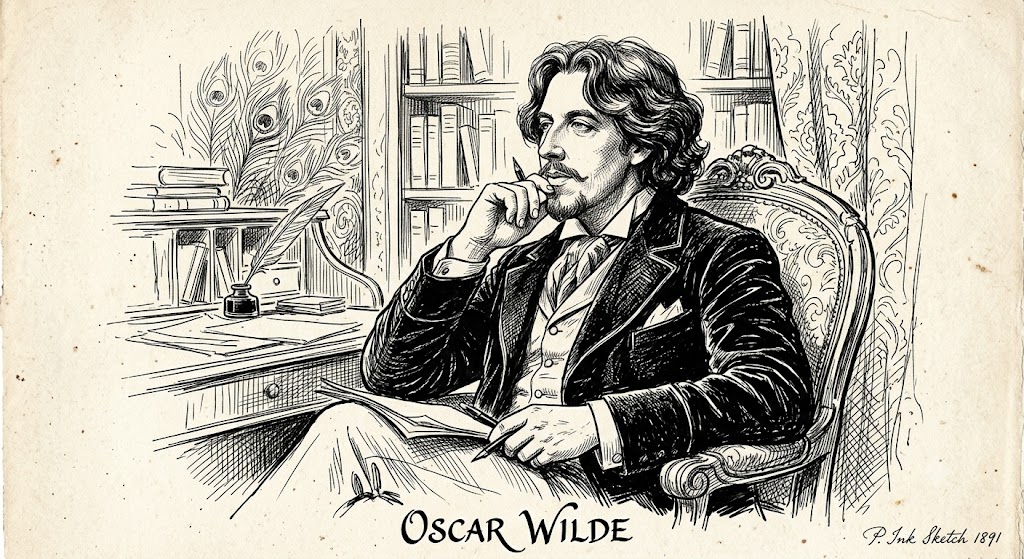
Oscar Wilde: Wit, Trial, and What Survived
Pip: The post titled “Oscar Wilde: The Martyr of Wit” asks a pointed question — not whether Victorian society wronged Wilde, which it clearly did, but why a man of his intelligence kept choosing performance when survival demanded silence.
Mara: The essay holds both truths at once, and this line from De Profundis cuts to the center of it: “I must say to myself that I ruined myself, and that nobody great or small can be ruined except by his own hand.”
Pip: What that means in practice is that Wilde isn’t letting society off the hook — the persecution was real and brutal — but he’s also refusing to cast himself as purely passive. That’s a harder, more honest accounting.
Mara: The courtroom sections show exactly how the mechanism worked. Carson cross-examined Wilde about a young servant, asking whether Wilde had kissed him. Wilde denied it, but added that the boy was “a particularly plain boy” and “unfortunately extremely ugly.” The post notes that wasn’t a confession — but it was an aesthetic judgment where a legal denial was needed.
Pip: He answered like an artist in a room that had stopped caring about art. The wit that made London applaud him became, in that moment, evidence against him.
Mara: The essay traces the full arc — from the libel suit Wilde brought against Queensberry, which his friends begged him to abandon, through conviction and two years’ hard labor, to his exile in Paris under the name Sebastian Melmoth. Even there, near the end, the instinct held. Looking at his hotel room, he reportedly said: “My wallpaper and I are fighting a duel to the death. One or other of us has got to go.”
Pip: Joke, confession, and tragedy in one sentence. The man was constitutionally unable to let a moment pass without shaping it.
Mara: The post’s conclusion is that he wasn’t destroyed by enemies alone, or by himself alone — he was destroyed by the force that made him extraordinary. His inability to stop being brilliant carried a price the drawing room never charged him, but the courtroom did. There’s also a companion documentary post simply titled “Oscar Wilde” that points to film for anyone who wants the story in full.
Pip: And the Proust connection closes the loop — where Wilde exposed himself to the world, Proust absorbed it and hid behind literature. Two strategies, one era, very different outcomes.
Mara: The through-line across both pieces is the cost of visibility — what it meant to be seen, and how much it mattered who was doing the looking.
Pip: Proust survived by making the world his subject. Wilde survived by becoming one. Next time, we’ll see what else osoparavos.com has been turning over.
______________________________
Leave a Reply