— Adam Donaldson Powell & ChatGPT
French and Italian Artists and Writers Associated with Pederasty 🏳️🌈
Throughout European history, attitudes toward same-sex relationships and age differences varied considerably depending on period, location, religion, and legal system. The modern concept of pederasty generally refers to erotic or romantic relationships between an adult man and an adolescent boy. Historically, however, the term has been used in different ways, ranging from the classical Greek educational ideal (typically involving adolescent youths) to modern discussions of adult attraction to teenage boys.
Among prominent French and Italian artists and writers, several either openly described attraction to adolescent males, defended pederastic relationships in print, maintained documented relationships with teenage boys, or became the subject of legal accusations or scholarly debate. In many Renaissance cases, however, surviving evidence is fragmentary, and historians disagree about the nature of particular relationships.
French Writers and Artists
André Gide (1869–1951)
André Gide remains the clearest modern French example of an internationally renowned author who openly defended pederasty.
Awarded the Nobel Prize in Literature in 1947, Gide challenged prevailing European attitudes toward homosexuality throughout his career.
Defense of Pederasty
His most controversial work, Corydon (1924), presents a series of philosophical dialogues arguing that homosexuality is a natural expression of human sexuality. Gide also praises historical forms of male love in ancient Greece and discusses pederasty as a legitimate cultural institution rather than a moral or medical disorder.
Unlike many writers who concealed their sexuality, Gide explicitly distinguished his attraction to adolescent boys from relationships between adult men.
Personal Life
In his autobiography Si le grain ne meurt (If It Die…), Gide described his sexual experiences with adolescent boys during travels in Algeria and Tunisia. His journals and correspondence likewise acknowledge that he preferred teenage boys over adult partners. These admissions have made him one of the few major twentieth-century writers to publicly defend and acknowledge pederastic relationships.
Paul Verlaine (1844–1896) and Arthur Rimbaud (1854–1891)
The relationship between Symbolist poets Paul Verlaine and Arthur Rimbaud remains one of the most famous literary partnerships in French history.
When they met in 1871, Verlaine was twenty-seven years old, while Rimbaud was sixteen. Their relationship rapidly became both artistic and romantic.
The pair traveled together through France, Belgium, and England, producing some of the most influential poetry of the nineteenth century while living in turbulent circumstances marked by alcoholism, domestic conflict, and financial instability.
Their relationship ended dramatically in Brussels in 1873 when Verlaine shot Rimbaud in the wrist during an argument. Verlaine was convicted of assault and served nearly two years in prison.
Although their relationship involved an adult and an older adolescent, historians generally describe it as a homosexual relationship rather than an example of ideological or systematic pederasty.
Henry de Montherlant (1895–1972)
Henry de Montherlant, novelist, playwright, and member of the Académie Française, repeatedly explored erotic fascination with adolescent boys in both his fiction and his private life.
His novel Les Garçons (The Boys) portrays emotional and sexual tensions within Catholic boarding schools and reflects themes that recur throughout his work.
Biographers, drawing upon diaries, correspondence, and testimony from acquaintances, conclude that Montherlant maintained relationships with numerous teenage boys over several decades. His attraction to adolescent males has become a central subject in scholarship on his life and writings.
Roger Peyrefitte (1907–2000)
Roger Peyrefitte was among the most outspoken French novelists on homosexuality and pederastic themes.
His novels—including Les Amitiés particulières (Special Friendships)—depicted emotionally intense relationships between schoolboys and criticized the repression of homosexuality within elite Catholic education.
Peyrefitte also defended age-structured male relationships in essays and interviews, making him one of the twentieth century’s most explicit literary advocates of pederastic ideals after Gide.
Italian Artists and Writers
Leonardo da Vinci (1452–1519)
Leonardo’s sexuality has long been debated by historians.
In 1476, when Leonardo was twenty-four, he and three other men were anonymously accused of sodomy involving Jacopo Saltarelli, a seventeen-year-old male prostitute. Because witnesses failed to appear, the charges were dismissed without conviction, as happened in many anonymous Florentine accusations.
Leonardo never married and left no evidence of relationships with women.
His closest lifelong companion was Gian Giacomo Caprotti, known as Salaì, who entered Leonardo’s household at about age ten in 1490. Salaì remained with Leonardo for more than twenty-five years as an apprentice, assistant, model, and heir to part of his estate.
Some historians have suggested that their relationship became sexual after Salaì reached adolescence, citing Leonardo’s affection, drawings with erotic themes, and the intimacy reflected in contemporary accounts. Others argue that the available evidence is insufficient to establish a sexual relationship with certainty.
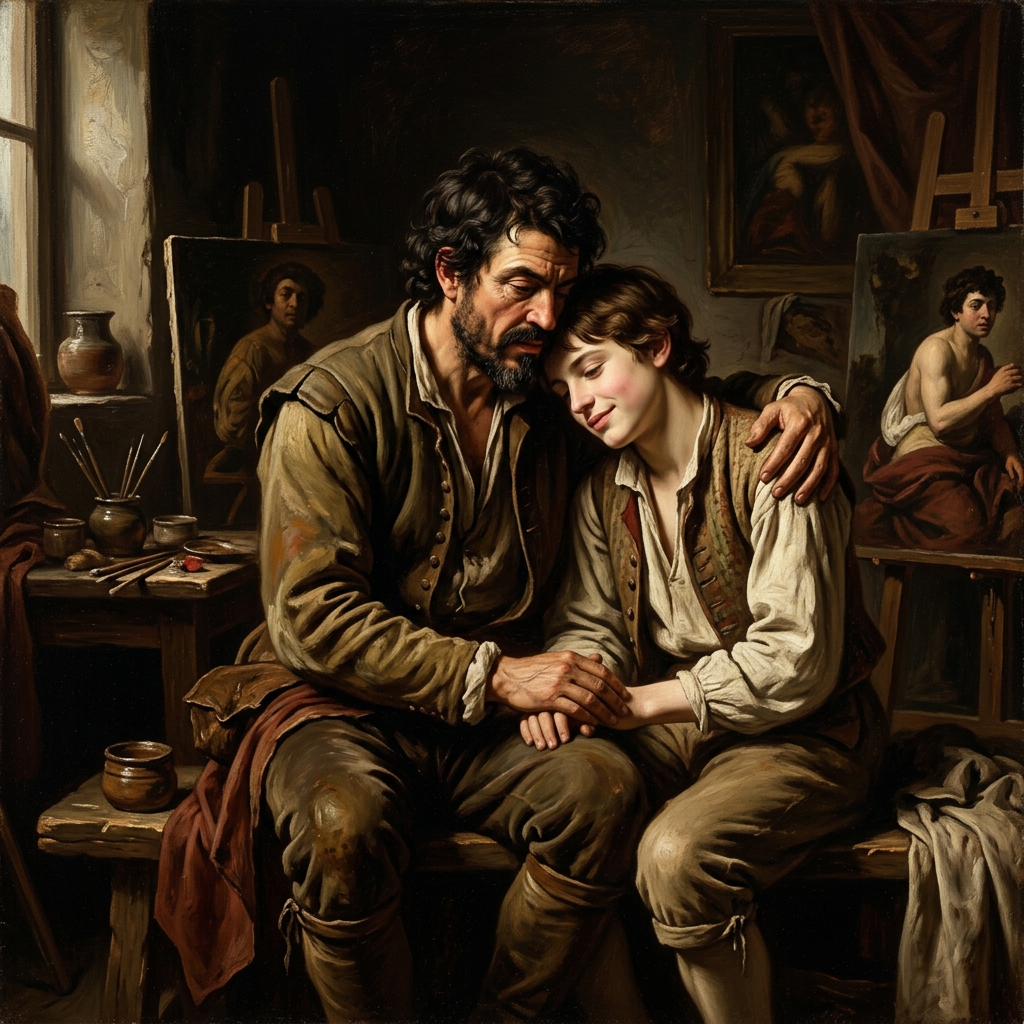
Caravaggio (1571–1610)
Caravaggio frequently painted idealized adolescent and young adult male figures whose sensuality has attracted scholarly attention.
Many of his early Roman works—including Boy with a Basket of Fruit, The Musicians, and Amor Vincit Omnia—feature attractive young male models in poses that contemporaries regarded as erotic.
His most frequently identified model was Francesco Boneri (Cecco del Caravaggio), who probably entered his household as a young assistant and later became an accomplished painter in his own right.
Although many art historians believe Caravaggio probably had sexual relationships with men, no surviving document conclusively proves that he maintained pederastic relationships. Earlier biographies sometimes described Cecco as his lover, but modern scholarship generally treats this as plausible rather than established fact.
Benvenuto Cellini (1500–1571)
Benvenuto Cellini, the celebrated Florentine goldsmith and sculptor, left one of the Renaissance’s most revealing autobiographies.
Court records show that he faced multiple prosecutions for sodomy during his lifetime.
One of the best documented occurred in 1557, when he was convicted in Florence after accusations involving Fernando di Montepulciano, a young apprentice. Cellini was fined, though enforcement of sodomy laws in Renaissance Florence varied considerably, and repeat offenders often received relatively light punishments.
His autobiography also contains numerous references to attractive young male assistants and apprentices, making him one of the Renaissance artists whose same-sex relationships are most extensively documented.
Pier Paolo Pasolini (1922–1975)
Pier Paolo Pasolini was one of Italy’s most influential twentieth-century writers, filmmakers, and intellectuals.
Unlike many earlier figures, Pasolini was openly homosexual and frequently acknowledged his attraction to adolescent and young working-class men, particularly the ragazzi di vita (“boys of life”) who inhabited the poorer districts of Rome.
His novels Ragazzi di vita (1955) and Una vita violenta (1959) portray marginalized teenage boys and young men with unusual realism and sympathy.
Throughout his life he faced repeated police investigations and prosecutions, although many charges were dismissed or politically motivated. His encounters with young men remained a major source of public controversy until his murder in 1975.
Most scholars distinguish Pasolini’s attraction to older adolescents and young adults from clinical definitions of pedophilia, though his sexuality continues to generate ethical and historical debate.
Historical Context
Modern readers should be cautious about applying contemporary categories to earlier periods. During the Renaissance, “youth” often referred to males in their mid- to late teens, legal ages varied widely, and prosecutions for sodomy focused primarily on same-sex acts rather than age differences. Consequently, evidence that someone was accused of sodomy does not necessarily indicate pederasty.
Likewise, historical documentation varies greatly. Figures such as André Gide explicitly described and defended relationships with adolescent boys in their own writings. By contrast, cases involving Leonardo da Vinci or Caravaggio rely largely on legal records, workshop relationships, artistic evidence, and later biographical interpretation rather than unequivocal proof of sexual relationships with minors. Historians therefore distinguish between self-admitted conduct, contemporary accusations, documented relationships, and speculative interpretations when evaluating these figures.
____________________________
The term pederast (pédéraste in French) was associated with Marcel Proust, but whether he fits the modern definition depends heavily on historical context, language, and how his sexuality differed from contemporaries like André Gide.
1. The 19th-Century French Term vs. Modern Usage
In 19th- and early 20th-century France, the word pédéraste was frequently used as a blanket term or medical label for any homosexual man, regardless of age preference.
- In his youth, Proust wrote a poem at age 17 titled “Pédérastie” (dedicated to his schoolmate Daniel Halévy) as an early attempt to articulate his emerging attraction to other men.
- In the slang and medical literature of fin-de-siècle Paris, Proust and other gay men were often referred to by peers or critics using the term pédéraste, alongside terms like inverti (“invert”).
2. Proust’s Actual Relationships and Preferences
Under the modern definition of pederasty (a relationship between an adult man and an adolescent boy), Proust was not a pederast.
His romantic and sexual relationships were almost exclusively with young adult men—peers, artists, and working-class adult men in his social orbit:
- Reynaldo Hahn: The famous composer with whom Proust had a deep romantic relationship in his twenties.
- Alfred Agostinelli: Proust’s secretary and chauffeur, who served as the primary real-life inspiration for the character Albertine in In Search of Lost Time.
- Albert Le Cuziat: Proust frequented and helped fund a private bathhouse run by Le Cuziat, which catered to adult male clientele in wartime Paris.
3. Contrast with André Gide
The distinction becomes clearest when comparing Proust to his contemporary, the author André Gide:
- Gide explicitly defended pederasty in the classical Greek sense (attraction to adolescent youths) in works like Corydon.
- Proust rejected Gide’s defense of pederasty. Proust preferred to depict male homosexuality in In Search of Lost Time through the lens of adult “inversion” (exemplified by characters like the Baron de Charlus) rather than ancient Greek pederasty.
Summary: While contemporary 19th-century French society labeled gay men generally as pédérastes, Proust’s actual desires and adult relationships were focused on adult men, not adolescent boys.
_____________________________
Jean Genet.
Whether Genet was considered a “pederast” depends on whether you look at the 19th/early-20th-century French linguistic usage or the modern definition of the term.
1. Linguistic Usage in 20th-Century France
In Genet’s lifetime, the French word pédéraste (often shortened to pédé) was used as a generic, blanket term—and slating insult—for any homosexual man, regardless of the age of his partners. In this broad, historical French sense, Genet was routinely labeled a pédéraste by French society, the press, and legal authorities simply because he was openly gay.
2. Genet’s Real-Life Relationships
Under the strict, modern definition of pederasty (an adult man’s sexual attraction to adolescent boys), Genet was not a pederast.
Genet’s romantic and sexual relationships were with adult men, typically from marginal or hyper-masculine subcultures:
- Sailors, criminals, and prisoners: His real-life encounters with sailors in ports like Brest directly inspired Querelle.
- Lucien Sénémaud: A 21-year-old former convict and painter who was one of Genet’s major loves.
- Abdallah Bentaga: An Algerian acrobat and high-wire artist in his twenties who had a long, intense relationship with Genet in the 1950s.
3. The Eroticization of Power and Age Gaps
While Genet did not pursue underage boys, power differentials were central to his sexuality and literary work.
Some modern scholars, such as queer theorist Kadji Amin, argue that Genet’s work operates around a “pederastic structure”—meaning his erotic imagination relied heavily on dynamics of:
- Dominance and submission: Master/servant, guard/prisoner, officer/sailor.
- Age and experience gaps: Pairing older, established men with younger, tougher, or lower-class adult partners.
- Hyper-masculinity vs. vulnerability: As seen in Querelle, where sailors and criminals navigate desire through violence, betrayal, and submission.
Summary: Genet was called a pédéraste in mid-20th-century France because it was the standard French term for gay men. However, his actual adult partners and romantic relationships were with grown men, defined by complex dynamics of power, class, and masculinity rather than pederasty
______________________________
Jean Cocteau was considered a pederast, both through 20th-century French linguistic usage and in a sense that comes closer to the classical definition than either Marcel Proust or Jean Genet.
1. French Colloquial Usage
As with Proust and Genet, mid-20th-century French culture used the term pédéraste (or the slang pédé) as a broad label and derogatory catch-all for any gay or bisexual man. Cocteau—who lived openly and flamboyantly in Parisian artistic circles—was routinely tagged with this label by the press, critics, and the public.
2. The Relationship with Raymond Radiguet
Unlike Proust or Genet, whose romantic partners were adults, Cocteau’s most infamous relationship involved a genuine age gap with an adolescent:
- Raymond Radiguet: In 1918, a 29-year-old Cocteau met the literary prodigy Raymond Radiguet when Radiguet was just 15 years old.
- Cocteau became Radiguet’s mentor, promoter, and companion, whisking him away on trips and keeping him out of post-WWI military service.
- While Cocteau and some contemporaries claimed their bond was strictly platonic or intellectual mentoring, many in Parisian society viewed it as an erotic relationship with a teenager. When Radiguet died abruptly of typhoid fever at age 20 in 1923, Cocteau was devastated and spiraled into severe opium addiction.
3. Later Adult Relationships
His later high-profile relationships were with grown men, though often marked by significant age differences:
- Jean Marais: Cocteau met the actor when Marais was 24 and Cocteau was 48. They became one of France’s most famous artistic power couples and were often dubbed the “first modern gay couple”.
- Édouard Dermit: Later in life, Cocteau fell in love with Dermit (an adult painter/actor), whom he eventually legally adopted to make him his heir.
4. Homoerotic Themes of Youth in His Art
Cocteau’s work consistently revisited themes of male adolescence, schoolboy fascination, and youthful beauty:
- His novel Les Enfants Terribles (1929) centers on the intense, insulated world of adolescents and schoolyard obsessions.
- His anonymous homoerotic novel Le Livre Blanc (1928) directly explores schoolboy crushes (inspired by his childhood friend Dargelos) and the awakening of male-male desire.
Summary: Cocteau was labeled a pédéraste by French society due to his open homosexuality. However, his early romantic mentorship of 15-year-old Raymond Radiguet and his artistic fixation on adolescent male beauty gave the label a literal weight that did not apply to figures like Proust or Genet.
Leave a Reply