The art of autofiction
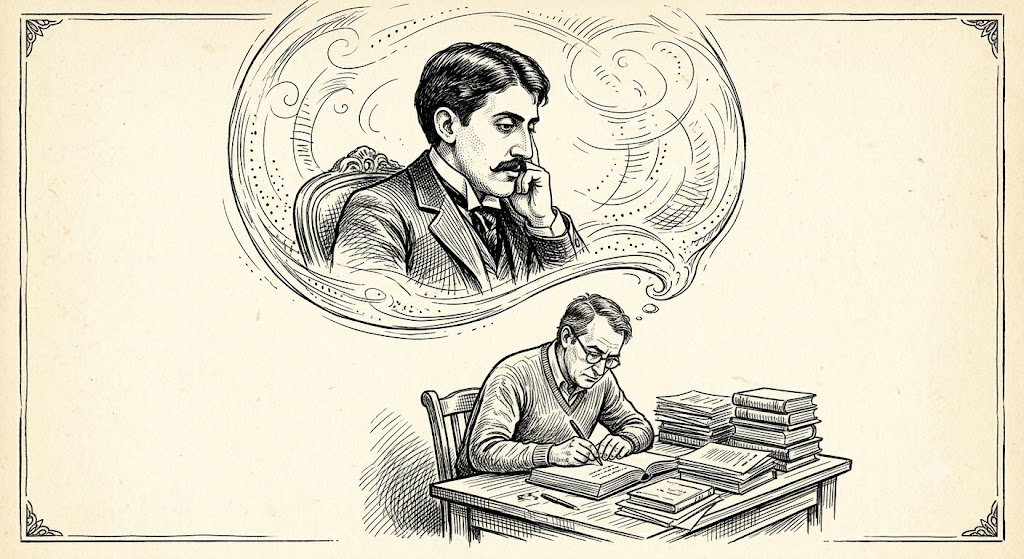
Marcel Proust’s In Search of Lost Time (À la recherche du temps perdu) stands as the quintessential autobiographical novel—or what modern critics call autofiction—where the boundary between the author’s real life and a fictionalized narrative persona is deliberately blurred.
— Marcel Proust, pioneer of modern autofiction. Kilde: Museum TV
Several famous authors across different eras and movements have used their own lives as raw material for fictionalized masterpieces:
1. Karl Ove Knausgård – My Struggle (Min Kamp)
- The Parallel to Proust: Knausgård is frequently hailed as the modern Norwegian Proust. His six-volume epic spans thousands of pages detailing the mundane, intimate, and painful details of his upbringing, his father’s alcoholism, marriage, and artistic ambition.
- How it fictionalizes: Though Knausgård uses real names and accurate historical events, the work relies on constructed dialogue, literary pacing, and subjective memory reconstruction.
2. James Joyce – A Portrait of the Artist as a Young Man
- The Parallel: Stephen Dedalus acts as Joyce’s clear alter ego. The book charts Stephen’s intellectual, religious, and artistic awakening in late 19th-century Ireland—mirroring Joyce’s own departure from Catholicism and decision to leave Dublin for exile in Europe.
- How it fictionalizes: Joyce translates real family members, teachers, and classmates into fictional archetypes to critique Irish society and Catholic dogma.
3. Sylvia Plath – The Bell Jar
- The Parallel: Esther Greenwood’s descent into severe clinical depression, her internship at a New York fashion magazine, and her subsequent hospitalization closely mirror Plath’s real experiences in the summer of 1953.
- How it fictionalizes: Plath changed names, condensed timelines, and used satirical prose to distance herself slightly from the traumatic events, publishing the novel originally under the pseudonym Victoria Lucas.
4. Jack Kerouac – On the Road & The Subterraneans
- The Parallel: Virtually all of Kerouac’s novels form a multi-volume autobiographical chronicle (which he called the “Duluoz Legend”). His protagonist Sal Paradise in On the Road is Kerouac himself, traveling across America with Dean Moriarty (real-life friend Neal Cassady).
- How it fictionalizes: Kerouac romanticized the Beat Generation’s travels, changing names to avoid libel suits while turning real-life figures into countercultural legends.
5. Charles Dickens – David Copperfield
- The Parallel: Dickens called this his “favourite child” because it closely paralleled his own childhood trauma—specifically being forced to work in a blacking factory when his father was sent to debtors’ prison.
- How it fictionalizes: Wrapped in Victorian storytelling conventions, Dickens introduced colorful secondary characters like Mr. Micawber (a caricature of his real father) to cushion the emotional realities of his early life.
6. Philip Roth – Operation Shylock & The Counterlife
- The Parallel: Roth took fictionalized autobiography to a meta-level by creating an alter ego named “Nathan Zuckerman” in several novels, and eventually writing a novel where the main character is named Philip Roth dealing with an impostor using his name in Israel.
- How it fictionalizes: Roth played post-modern games with his audience, constantly provoking readers to guess where the “real” Roth ended and the fictional narrative began.
Key Autofiction Traditions
| Author | Major Work | Fictional Alter Ego / Device |
| Colette | Claudine series | Claudine (a lightly veiled version of her teenage and young adult years) |
| Thomas Wolfe | Look Homeward, Angel | Eugene Gant (chronicling his youth in North Carolina) |
| Maya Angelou | I Know Why the Caged Bird Sings | Autobiographical fiction using narrative techniques to explore memory and trauma |
| W.G. Sebald | The Emigrants / Austerlitz | An unnamed narrator traveling Europe blending real photos, biography, and fiction |
_____________________________
The term autofiction—a blend of “autobiography” and “fiction”—refers to a genre of literature that deliberately blurs the boundaries between real life and invented narrative. The author uses their real identity, personal history, and authentic memories as the foundation of the story, but employs the stylistic freedom, narrative pacing, and imaginative techniques of fiction.
1. Origins of the Term
Coined in 1977 by French writer and literary critic Serge Doubrovsky, the word first appeared on the back cover of his novel Fils (Sons or Threads).
Doubrovsky created the term partly as a response to structuralist theorist Philippe Lejeune’s influential concept of the “Autobiographical Pact.” Lejeune argued that autobiography relies on a strict contract of truth between author and reader. Doubrovsky countered by proposing a hybrid genre:
“Autobiography? No, that is a privilege reserved for the important people of this world… Fiction, of events and facts strictly real; if you like, autofiction.” — Serge Doubrovsky
While authors like Marcel Proust, Colette, and James Joyce had practiced this form of writing for decades, Doubrovsky gave it a name, formally establishing it as a self-aware literary category.
2. Definition & Core Difference
Unlike a standard autobiography (which claims to tell historical truth) or a roman à clef (a “novel with a key,” where real people are hidden behind pseudonyms), autofiction explicitly uses the author’s real name for the protagonist while openly acknowledging that the narrative contains fictional elements.
| Genre | Protagonist Name | Fact vs. Fiction | Primary Goal |
| Autobiography | Author’s real name | Claims strict factual accuracy | Record historical personal truth |
| Roman à Clef | Fictional pseudonym | Real events disguised as fiction | Protect real identities while telling a real story |
| Autofiction | Author’s real name | Openly mixes real events with invented ones | Explore subjective truth, memory, and selfhood |
3. Key Features of Autofiction
The Identity Paradox
The main character shares the author’s real name, background, and biography. However, the author refuses to guarantee that every event happened exactly as written, destabilizing the reader’s expectation of absolute truth.
Reconstructed Memory over Historical Fact
Autofiction treats memory as inherently unreliable. Rather than trying to report facts accurately, autofiction focuses on the emotional and subjective truth of how an event felt, often filling gaps in memory with constructed dialogue or imagined scenarios.
Meta-Literary Awareness
Autofiction frequently turns inward. Authors often write about the very act of writing the book, examining their own motivations, ethics, and the process of turning real people into literary characters.
Mundane Detail and Hyper-Realism
Modern autofiction (such as Karl Ove Knausgård’s My Struggle or Rachel Cusk’s Outline trilogy) often lingers on the unpolished details of daily existence—cooking meals, routine conversations, inner anxieties—to create an intense sense of immediacy.
Key Figures in Autofiction
- Foundational Figures: Serge Doubrovsky, Marguerite Duras (The Lover), Annie Ernaux (The Years—2022 Nobel Laureate).
- Contemporary Pioneers: Karl Ove Knausgård, Rachel Cusk, Sheila Heti, Ben Lerner, and Édouard Louis.
_____________________________
Because autofiction intentionally uses real identities while blurring the line between fact and fiction, it routinely sparks intense ethical and legal debates. When authors write about their lived experiences, their narratives inevitably involve family members, romantic partners, and friends who never asked to become characters in a published book.
Smolny Beyond Borders
1. The Question of Consent and “Narrative Colonization”
The most prominent critique of autofiction is that the author exercises unilateral power over another person’s private life.
- Collateral Exposure: An author’s spouse, child, or sibling is frequently exposed to public scrutiny simply by association. While the author chooses public exposure for their career, the people around them often do not.
- The Imbalance of Power: Critics argue that writers essentially “colonize” the private memories and trauma of others. The person written about rarely gets an equal platform or right of reply.
PEER REVIEW JOURNAL - Notable Example: When Karl Ove Knausgård published My Struggle, describing intimate family dynamics and his father’s descent into alcoholism, several family members publicly condemned the books and threatened legal action, feeling deeply betrayed.
PEER REVIEW JOURNAL
2. Distortion of Reality and Misrepresentation
Because autofiction explicitly allows the author to invent or exaggerate details for narrative effect, it creates a unique trap for the people depicted:
- The “Fact or Fiction” Ambiguity: Readers often assume every unflattering detail is true because the main character shares the author’s real name. If an author invents a negative trait or event for dramatic pacing, real-life figures suffer the real-world fallout.
- Rebuttal Resistance: If a real-life subject objects to a depiction, the author can retreat behind the defense of aesthetic freedom (“It’s just a novel, it’s art!”). Yet, if the book is praised for its raw truth, the author reaps the rewards of non-fiction authenticity.
3. Legal Consequences: Privacy vs. Free Speech
Autofiction regularly tests the limits of privacy laws, libel, and defamation:
- Invasion of Privacy: Even if a story is 100% true, publishing highly personal facts—such as medical history, sexual encounters, or private conversations—can constitute an illegal invasion of privacy.
Writer’s Digest - Defamation & Libel: If an author alters real events in a way that damages a living person’s reputation, that individual may sue for libel. However, authors often bypass this by subtly changing minor details (e.g., hair color or profession) while leaving the person clearly recognizable to friends and neighbors.
- “Answering Back” Literature: The ethical friction has become so intense that it has spawned counter-novels. For instance, after Norwegian writer Helga Flatland wrote an autofictional novel about family grief, her sister wrote her own novel to publicly challenge her sibling’s version of events.
4. The Shift Toward “Vampiric” Voyeurism
Critics like William H. Gass and various contemporary scholars argue that modern autofiction can devolve into literary voyeurism. Instead of doing the hard imaginative work of fiction, authors are accused of sacrificing the privacy of their loved ones for commercial shock value and personal celebrity.
The Defense: Aesthetic Necessity and Freedom
Defenders of the genre—and autofiction writers themselves—arguing from a tradition represented by authors like Annie Ernaux, counter with several key principles:
- The Inevitability of Shared Life: A writer cannot tell their own story without including the people in it. Requiring total consent would effectively ban writers from exploring family dynamics, trauma, or relationships.
- Emotional vs. Documented Truth: The goal is not character assassination, but an honest pursuit of subjective human experience.
- Subverting Power: In many cases, autofiction gives voice to marginalized individuals exposing abuse or power imbalances inflicted by figures who held power over them.
Leave a Reply