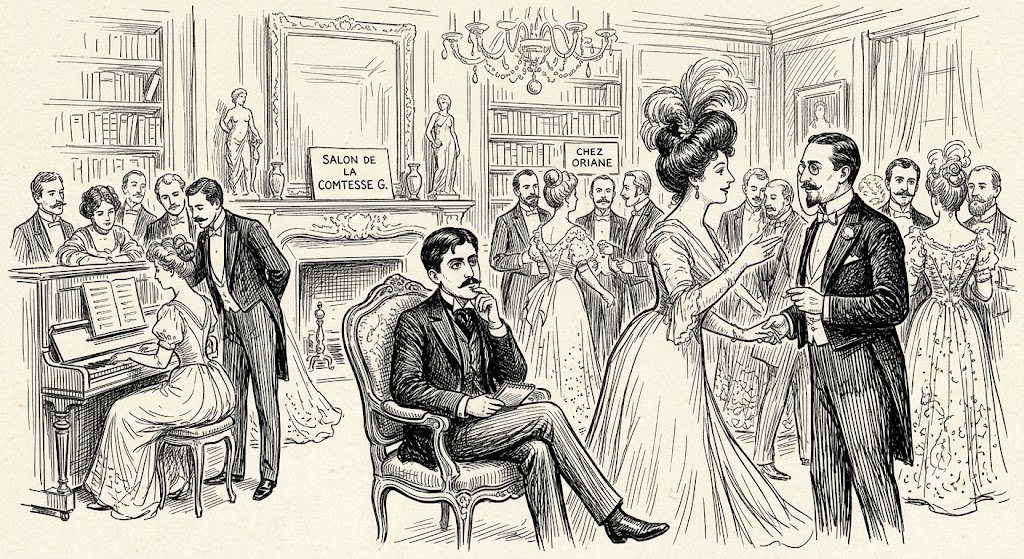
Marcel Proust’s lavish 1899 dinner parties—where Count Robert de Montesquiou regaled Paris society with poetry readings—provide a fascinating window into Proust’s rise in Le Tout-Paris.
1. How Did He Pay for It?
Proust did not pay out of his own pocket; his parents footed the bill. At 28 years old, Marcel held no paying position and lived at home.
- The Family Fortune: His father, Dr. Adrien Proust, was a world-renowned physician, epidemiologist, and professor of medicine whose work on international quarantine (cordon sanitaire) earned him substantial wealth and status. His mother, Jeanne Weil Proust, came from an extraordinarily wealthy German-Jewish banking and porcelain family.Simple Wikipedia+ 1
- The Venue: Rather than renting out a restaurant (though he later favored the Ritz and Larue’s), Proust hosted these large formal dinners in his parents’ grand apartment at 45 Rue de Courcelles near Parc Monceau. The venue provided fine china, a full kitchen staff, and an opulent setting without restaurant hire fees.Ville de Paris
- Allowances & Expenses: His parents granted him a generous allowance, underwrote his tailor bills, and funded the food, champagne, and floral arrangements required to entertain high-society guests.
2. Were His Parents That Indulgent?
Yes, but with mixed feelings.
- Jeanne Weil Proust (His Mother): Jeanne adored Marcel deeply and indulged his fragile health, aesthetic sensitivities, and social ambitions. While she occasionally fretted over his chronic lack of career momentum, she took pride in his intellectual sharp-mindedness and was content to let him host aristocratic tastemakers at their home.Simple Wikipedia
- Dr. Adrien Proust (His Father): Dr. Proust was a practical, hardworking man of science who was initially dismayed that his elder son wouldn’t pursue law, diplomacy, or medicine. However, by 1899, he had largely conceded to Marcel’s delicate constitution (asthma) and literary pursuits. He accepted the dinners as part of Marcel’s role as a man of letters and social commentary.Simple Wikipedia
3. Attendee Reactions & Diaries: What Did People Say?
Count Robert de Montesquiou—the primary model for Baron de Charlus in In Search of Lost Time—and other aristocratic guests left a trail of observations in letters, memoirs, and diaries:
Blogger.com
Montesquiou’s Perspective
Montesquiou relished being the center of attention and having his verses performed before an audience. However, in his private letters and later memoirs (Les Pas effacés), he treated Proust with a mix of condescension and affection:
- He viewed Marcel as an overly eager, hyper-polite acolyte who had to be “trained” in high-society etiquette.
- Montesquiou loved the homage but was quick to throw temper tantrums if he felt the guest list wasn’t exclusive enough or if someone wasn’t listening intently during his recitations.
Society Guests & Friends
- Reactions to Proust’s Hospitality: Friends like composer Reynaldo Hahn and writer Lucien Daudet noted Proust’s almost suffocating attentiveness as a host. Proust would obsessively check if guests were cold, force second helpings on them, and lavish hyper-verbose praise on every guest.Proust Ink
- Social Snobbery vs. Genius: Contemporaries in aristocratic circles often dismissed Proust at this stage in his life as a wealthy “dilettante” or a social climber (un petit bourgeois snob). It was only much later that they realized he was quietly taking psychological and social notes on all of them for his masterpiece.
4. Proust’s Secret Weapon: Writing His Own Press
One of the most amusing details about Proust’s dinners is how they were reported in the newspapers: Proust frequently wrote the society notices himself.
Anonymous columns in newspapers like Le Gaulois, Le Figaro, and the New York Herald (Paris edition) described the dinners as “most literary and most elegant,” praising M. Marcel Proust for his “rare and precious hospitality” and Count Robert de Montesquiou for his “brilliant genius.”
When newspapers edited his submitted drafts, Proust would anxiously write letters to Montesquiou to clarify that he hadn’t approved the paper’s alterations.
Leave a Reply