Pip: Welcome to osoparavos.com, where the past is never quite past — it just keeps steeping in your teacup until someone writes a poem about it.
Mara: This episode follows Adam Donaldson Powell into the territory where philosophy and literary identity collide — specifically, what happens when a great writer insists his memory belongs to him alone.
Pip: Let’s start with Proust, Bergson, and a very firm refusal.
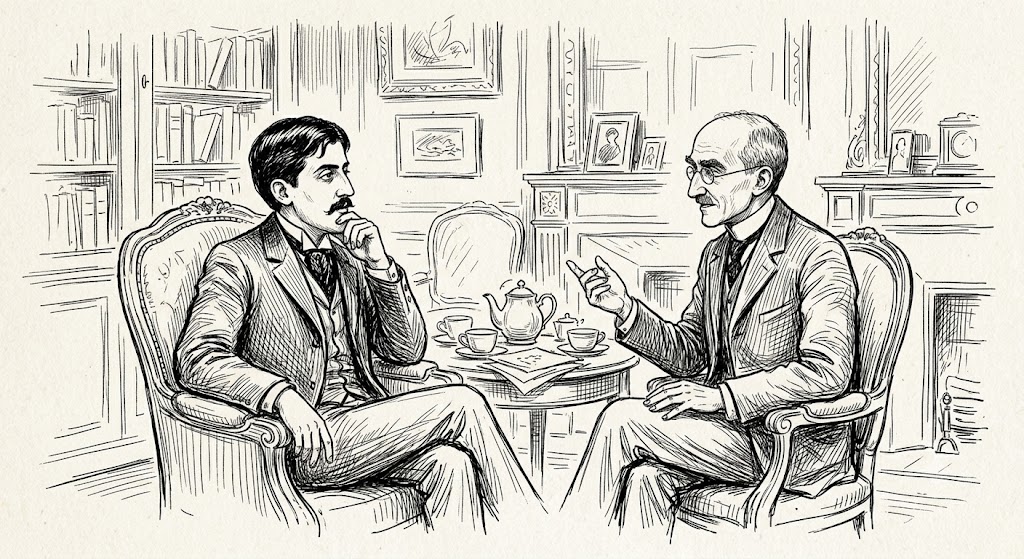
Marcel Proust Pushes Back Against Bergson
Mara: The tension here is a real historical one: critics and scholars long positioned Proust as essentially dramatizing Bergson’s philosophy of time and memory in fictional form. The poem asks whether that framing does justice to Proust’s own creative sovereignty.
Pip: The historical Proust was clear about it. In a letter addressing exactly those comparisons, he wrote: “I have enough to do without trying to turn that philosophy of M. Bergson into a novel!”
Mara: That line does a lot of work. It isn’t a dismissal of Bergson — it’s a refusal to be reduced to an illustrator of someone else’s system. Proust is claiming authorship of his own interiority.
Pip: The poem, “Ne me dictez rien!” — “Do Not Dictate to Me!” — runs with that refusal and gives it a formal shape. Classical Alexandrines, twelve syllables per line, the meter of Valéry and Rostand. The form itself is a statement: this is serious literary work, not a philosophical footnote.
Mara: And the poem’s voice is unmistakably Proust’s own register. Lines like “my steeples of Martinville and my lost kisses” pull directly from the novel’s texture — the specific, sensory, irreplaceable details that no doctrine can substitute for.
Pip: There’s something almost funny about using one of French poetry’s most rule-bound meters to argue against being ruled. The Alexandrine as a vehicle for “leave me alone.”
Mara: The poem also acknowledges Bergson honestly — “Matter and Memory has tinted our era, I know it, I feel it in the depths of my mind” — before insisting the memory that matters is personal, not philosophical. The cup of warm tea against a dogma put in print is the crux of it.
Pip: Influence admitted, ownership asserted.
Mara: That’s the whole argument, really. The poem earns its title.
Pip: Memory as personal territory, time as something you recover rather than theorize — these ideas don’t age out.
Mara: Next time we’ll see where else on osoparavos.com that thread leads.
_____________________________
Leave a Reply