Pip: Welcome to osoparavos.com, where the questions are ancient and the bibliography is long — today we’re sitting with Marcel Proust, desire, and the uncomfortable distance between a writer’s private life and their published genius.
Mara: Adam Donaldson Powell reviews William C. Carter’s Proust in Love, a study that traces how Proust’s emotional and romantic experiences fed the psychological architecture of In Search of Lost Time. Let’s start with what Carter actually argues about love, suffering, and literary creation.
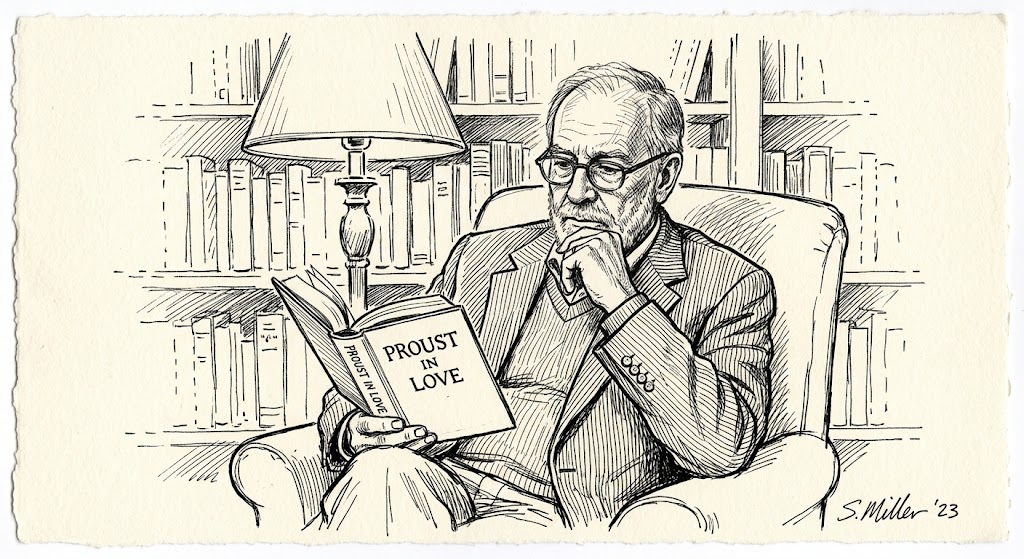
Proust in Love
Pip: The central tension here is one that biographical criticism always has to answer for: can knowing what a writer felt in private actually deepen what we read on the page, or does it just make us voyeurs with footnotes?
Mara: Carter’s answer is careful. The review frames it this way: “Proust transformed experience through memory, observation, imagination, and artistic construction. His fictional characters are not simply portraits of real individuals, nor can every episode in the novel be explained by reference to his private life.”
Pip: So the book is not a decoder ring. Carter is not saying Albertine equals a real person — he’s saying Proust’s anxious, secretive emotional life gave him the raw material to understand jealousy from the inside.
Mara: That’s exactly the distinction the review draws. Proust lived in a society where homosexuality carried real social risk, and he had to manage the gap between private desire and public respectability. Carter explores those contradictions with, as the review puts it, “considerable sensitivity.”
Pip: And that pressure — the concealment, the fear of exposure — shows up directly in the fiction. Swann’s obsession with Odette, the narrator’s grip on Albertine: love in Proust is rarely tender. It’s surveillance.
Mara: The review calls it “a form of psychological imprisonment.” The beloved is never entirely knowable, and the attempt to understand or control another person intensifies the lover’s suffering. Carter reads Baron de Charlus through the same lens — private desire in collision with public identity.
Pip: The review does flag a real limitation: readers who come for Proust’s prose style or his philosophy of time may feel the biographical focus is too narrow. Biography can flatten what fiction deliberately keeps open.
Mara: Right — and the review is honest about that risk. But it concludes that Carter’s achievement is illuminating possible connections “without entirely eliminating the mystery of literary creation.” The book is also published bilingually here, with a full French-language version of the review alongside the English.
Pip: Which feels appropriate, given the subject.
Mara: Proust’s questions — why we love people who remain strangers, whether memory preserves or distorts what we’ve lost — don’t really belong to one language anyway.
Pip: Those questions have a way of outlasting the biography, the criticism, and probably the podcast.
Mara: More from osoparavos.com next time — the territory keeps expanding.
Leave a Reply