Here are reviews and analytical overviews of three pivotal works—Celeste Albaret’s memoir Monsieur Proust, William C. Carter’s biography Proust in Love, and Marcel Proust’s early unfinished novel Jean Santeuil—focusing on what each book reveals about Proust’s life and how they deepen our understanding of his masterpiece, In Search of Lost Time (À la recherche du temps perdu).
1. Monsieur Proust by Céleste Albaret
Review
Céleste Albaret was Marcel Proust’s devoted housekeeper, secretary, and confidante during the final eight years of his life (1914–1922)—the crucial period when he was revising, expanding, and finishing In Search of Lost Time. Dictated to journalist Georges Belmont half a century after Proust’s death, this memoir provides an extraordinarily intimate, day-to-day portrait of the author in his cork-lined bedroom on the Boulevard Haussmann.
Albaret’s tone is fierce, affectionate, and protective. She captures Proust’s eccentric nocturnal routine, his meticulous diet of coffee and croissants, his agonizing battles with asthma, and the intense creative fervor of his final years.
Importance for Insight into Proust
- The Living Process of Creation: Albaret demystifies the image of Proust as an effete dilettante. Instead, she reveals a dedicated worker who treated writing as a physical battle against time and illness.
- The Master of Observation: She recounts how Proust would return late at night from aristocratic salons and re-enact conversations, dissecting every gesture, tone, and hypocrisy for Albaret. It illustrates how Proust used conversations with his inner circle as a testing ground for his characters.
Understanding In Search of Lost Time
- The Model for Françoise: Céleste herself (along with her husband Odilon) directly inspired aspects of the Narrator’s loyal, formidable servant Françoise and the character Célestin. Reading her account reveals how Proust transformed real-life domestic loyalty into art.
- The Physical Architecture of the Book: Albaret explains how the famous paperoles—the long strips of paper pasted onto draft pages—were physically created and managed. Her memoir shows how the expansion of In Search of Lost Time was driven by the changing world around Proust, particularly World War I.
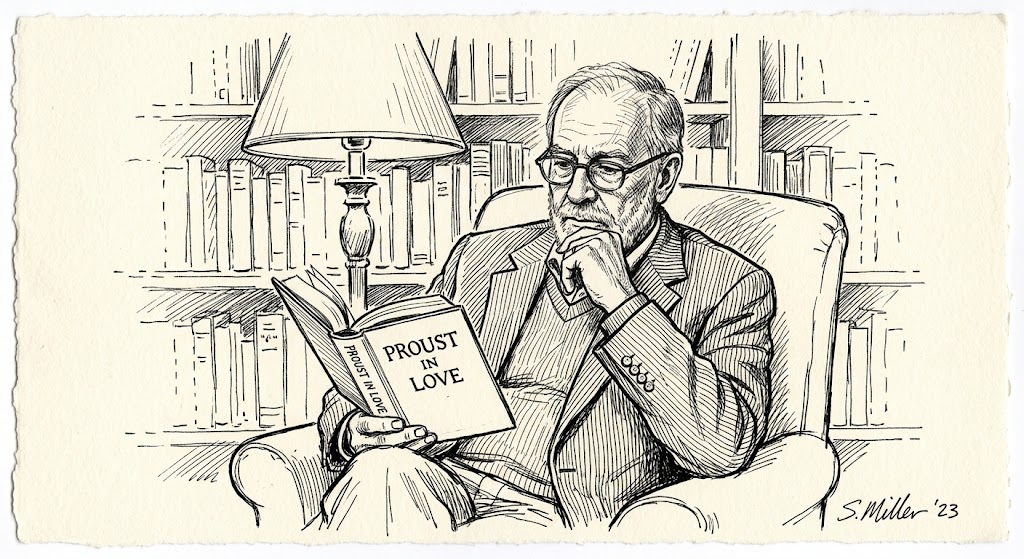
2. Proust in Love by William C. Carter
Review
William C. Carter, one of the world’s leading Proust scholars, focuses his lens on the central drive of Proust’s life and work: his desire for love, intimacy, and romantic obsession. Proust in Love traces Proust’s personal relationships from his schoolboy crushes to his complex, often tragic romantic entanglements with figures like Reynaldo Hahn, Lucien Daudet, and his chauffeur Alfred Agostinelli.
Carter writes with psychological acuity and historical rigor, navigating 19th- and early 20th-century social attitudes toward homosexuality while demonstrating how Proust’s personal heartbreak informed his philosophy of passion.
Importance for Insight into Proust
- Understanding Proust’s Homosexuality: The book provides crucial context on how Proust navigated his sexuality in a society where homosexuality was heavily stigmatized, clarifying the tension between his private life and his public persona.
- The Mechanism of Obsession: Carter shows that Proust’s own romantic life was defined by jealousy, possessiveness, and idealization—patterns that Proust meticulously documented in his personal correspondence before codifying them in his fiction.
Understanding In Search of Lost Time
- The Real-Life Albertine: Carter’s detailed account of Proust’s relationship with Alfred Agostinelli—his chauffeur and secretary who died in a plane crash—is essential for understanding the psychological core of The Captive (La Prisonnière) and l The Fugitive (Albertine disparue). Agostinelli’s life and death served as the primary blueprint for the character of Albertine.
- The Theory of Jealousy and Transposition: The book illuminates Proust’s fundamental belief that love is inherently one-sided and fueled by anxiety. It also helps readers understand Proust’s “transposition of sexes”—how he transformed male objects of desire into female characters in the novel, shedding light on the artistic choices behind the Narrator’s relationships.
3. Jean Santeuil by Marcel Proust
Review
Written between 1895 and 1899 but abandoned and only published posthumously in 1952, Jean Santeuil is Proust’s early, unfinished autobiographical novel. It tells the story of a sensitive young man from a wealthy bourgeois family coming of age, navigating high society, discovering art, and enduring the pains of love.
While Jean Santeuil lacks the seamless structure, philosophical depth, and sentence architecture of In Search of Lost Time, it is a vibrant, lyrical draft that reads like a treasury of raw Proustian material.
Importance for Insight into Proust
- The Young Artist’s Apprenticeship: Jean Santeuil reveals Proust testing his voice. It shows an ambitious young writer trying to master traditional third-person narrative storytelling before realizing he needed an entirely new, subjective first-person framework.
- Biographical Raw Material: Because Proust did not distance himself as far from his real life in this early work, Jean Santeuil gives direct glimpses into his childhood in Illiers (the basis for Combray), his relationship with his parents, and his early experiences with the Dreyfus Affair.
Understanding In Search of Lost Time
- The Blueprint for In Search of Lost Time: Reading Jean Santeuil allows you to see the prototype of In Search of Lost Time. Early versions of key characters (such as Swann, Saint-Loup, and the Duchess of Guermantes) and places appear here in embryo form.
- The Evolution of Involuntary Memory: In Jean Santeuil, Proust describes moments of sensory recollection (such as the smell of a room or sunlight on water), but he has not yet developed the philosophical framework of “involuntary memory” that becomes the emotional and structural engine of In Search of Lost Time (most famously embodied by the Madeleine episode).
Summary Comparison Matrix
| Book | Type | Primary Value to the Reader | Key Connection to In Search of Lost Time |
|---|---|---|---|
| Monsieur Proust | Memoir / Primary Source | Reveals Proust’s daily writing habits, personality, and final years | Explains the real-life domestic inspiration for Françoise and the creation of the paperoles |
| Proust in Love | Critical Biography | Explores Proust’s emotional life, sexuality, and romantic psychology | Unpacks the real-life origins of Albertine (Alfred Agostinelli) and Proust’s theory of romantic jealousy |
| Jean Santeuil | Posthumous Early Novel | Shows Proust’s stylistic development and early thematic experiments | Serves as the “first draft” of In Search of Lost Time, highlighting the evolution of involuntary memory |
Recommendation: If you are reading In Search of Lost Time for the first time, keep
Proust in Lovenearby to better understand the biographical roots of Swann and the Narrator’s passions. ReadJean Santeuilafter completing the Search to appreciate the artistic transformation Proust underwent, and readMonsieurProust to experience the extraordinary dedication required to finish one of literature’s greatest achievements.
— Adam Donaldson Powell + AI
Leave a Reply