a chat between adam donaldson powell and chatgpt
Peeking inside Marcel Proust’s closet 🏳️🌈
Quite a few people in Proust’s immediate social world probably knew that he was a homosexual, or at least strongly suspected, that he was attracted to men, even though Proust himself was extremely guarded and never publicly identified himself as homosexual.
The important distinction is between “people knew Proust had relationships/desires involving men” and “Proust openly acknowledged being gay.” The former is well supported; the latter is not.
His family
Proust’s family situation was complicated. His mother, Jeanne, was exceptionally close to him, and his brother Robert was a doctor and was certainly aware of Marcel’s unusually intense friendships with men. But there is no clear evidence that Marcel ever sat down with his family and explicitly told them, “I am homosexual.” Proust was remarkably careful about maintaining a heterosexual public appearance.
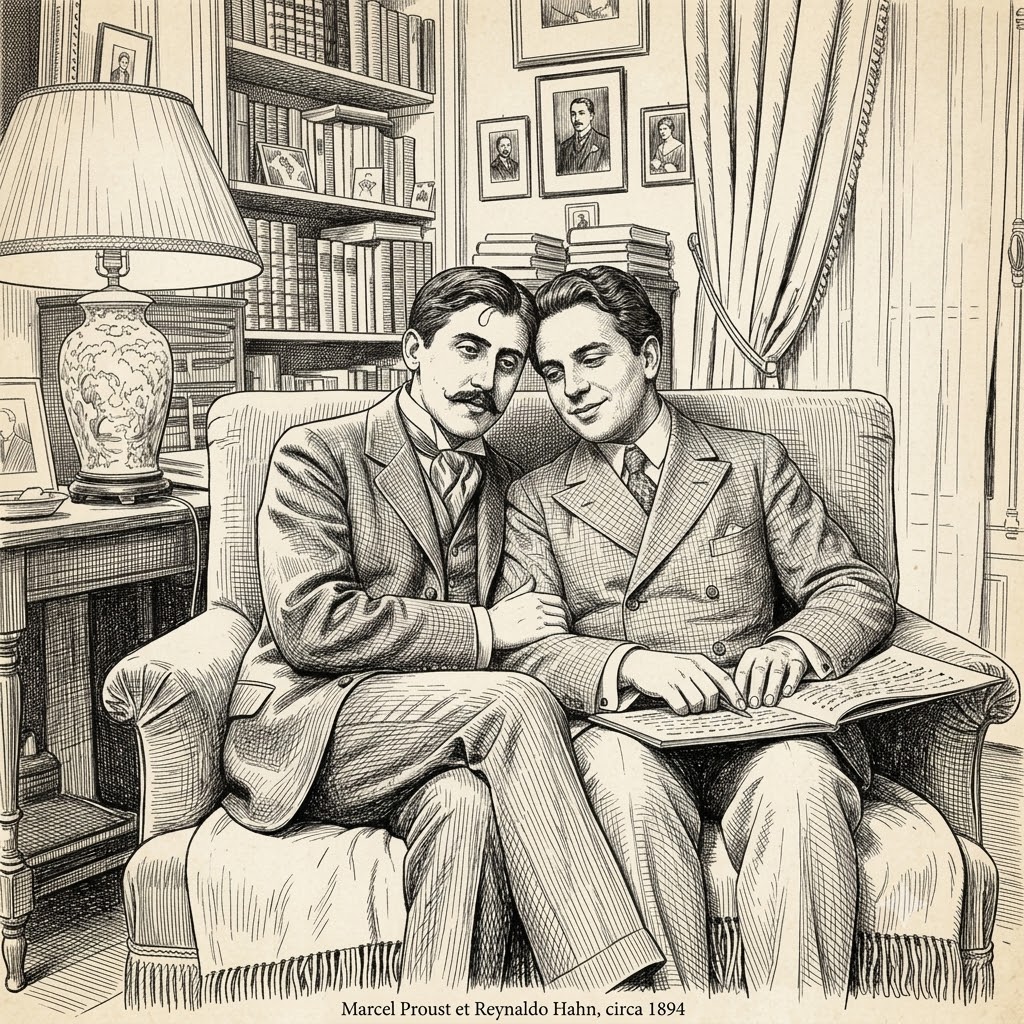
Indeed, his correspondence and behavior show that he sometimes went to considerable lengths to preserve ambiguity. His relationship with Reynaldo Hahn, for example, was known within his circle, but could be described publicly as an exceptionally intimate friendship. Proust also maintained friendships and flirtations with women, which made the boundaries still less obvious to outsiders.
The salons were a different matter
Here the answer is much more clearly yes.
Proust’s Parisian salon world was unusually sophisticated about homosexuality. He moved among writers, artists and aristocrats in circles where male homosexual relationships were hardly an unknown phenomenon. One of his important early connections was Robert de Montesquiou, whose homosexuality was itself a matter of considerable awareness in Parisian society. Proust’s acquaintance with him gave Proust access to aristocratic circles.
And there were concrete incidents that made Proust’s own sexuality difficult for insiders to overlook. In 1897, Jean Lorrain publicly insinuated that Proust’s relationship with the young writer Lucien Daudet was sexual. Proust responded by challenging Lorrain to a duel. The duel itself therefore became a rather extraordinary piece of evidence for people in their social world: Proust was publicly denying the implication, but the fact that he reacted so violently to it naturally kept the subject alive.
There is also later evidence from people who knew Proust personally. André Gide, who initially misunderstood Proust’s sexuality, eventually became convinced of it; Proust’s Swedish valet Ernest Forssgren also left testimony concerning Proust’s homosexual life. Forssgren’s memoirs were published much later, in an edition edited by Proust scholar William Carter.
And Proust’s involvement with the homosexual underworld was not merely a biographical reconstruction made decades later. In 1918, he was among the men identified by police during a raid on Albert Le Cuziat’s male brothel. Proust’s friend Paul Morand also made teasing references to Proust’s visits to male prostitutes.
But there was an important social convention at work
It would be misleading to imagine Proust’s contemporaries thinking in exactly the same categories that we would use today.
Proust lived in a society in which homosexuality could be simultaneously an open secret and something that was never explicitly said. Among sophisticated Parisian circles, people could know perfectly well that a man had male lovers while maintaining a polite fiction that he was simply an eccentric bachelor with unusually intense friendships.
This is particularly relevant to Proust because he himself was extraordinarily interested in the psychology of the closet. Sodome et Gomorrhe is essentially an extended examination of a society in which everyone notices things that nobody quite says aloud. Modern scholarship also emphasizes that same-sex desire in Proust’s work is closely associated with questions of social inclusion, exclusion and concealment.
| Group | What they probably knew |
| Mother / immediate family | Probably suspected or understood something, but explicit acknowledgment is difficult to establish |
| Very close male friends | Some almost certainly knew; others probably suspected |
| Parisian literary salons | Knowledge/suspicion was considerably more widespread |
| People acquainted with Hahn, Daudet, etc. | Very difficult to imagine they were unaware of the implications |
| General public | Proust successfully maintained considerable ambiguity during his lifetime |
One especially interesting point is that Proust’s homosexuality was not simply “a secret that everyone was fooled by.” It was more like a secret whose existence was widely recognized by people who knew him, while Proust retained the ability to deny the explicit proposition when necessary. His 1897 duel with Lorrain is perhaps the clearest illustration of that paradox.
And there is a fascinating further question here: what did Proust’s mother Jeanne actually understand about his relationships with men? The evidence on her is much more ambiguous—and much more interesting—than the simple claim that “his family knew.”
Surviving correspondence makes the picture considerably more nuanced—and, especially with Jeanne Proust, more interesting than the simple statement that “his mother knew.”
Jeanne Proust: probably aware of the intimacy, but not necessarily of its sexual nature
The surviving correspondence between Marcel and his mother is enormous, and scholars have specifically studied it. One striking feature is that Marcel does not write to Jeanne about his romantic life in anything like the way he writes to his lovers. The published correspondence with Jeanne contains little or no direct discussion of his emotional/sexual relationships.
That is significant because Jeanne was anything but an inattentive mother. She was intensely involved in Marcel’s daily life and concerned about his movements, health, friendships, sleeping habits, and social activities.
There’s a wonderful example from 1895, when Marcel was staying at Dieppe with Reynaldo Hahn. Jeanne wrote asking him, essentially, what time he went to bed and what time he got up. Colm Tóibín, discussing the letter, points out how characteristic this was of her extraordinary attentiveness to her son’s daily existence.
And Hahn wasn’t an obscure acquaintance. Marcel and Reynaldo had become extraordinarily close after meeting in 1894. William Carter describes their relationship as a reciprocated love: they became virtually inseparable, and Proust dedicated The Death of Baldassare Silvande to Hahn in 1895.
So Jeanne certainly knew Hahn was extraordinarily important to Marcel.
The harder question is whether she understood that this was a sexual/romantic relationship.
Here the evidence becomes tantalizingly inconclusive. A detailed study of Proust’s correspondence observes that when Marcel was with Hahn, he used extraordinarily affectionate language to Hahn—“my beloved child,” “my dear little one,” etc.—but that none of this emotional/romantic material appears in his letters to Jeanne. The scholar explicitly asks whether Jeanne knew about her son’s passions and concludes that the surviving letters don’t allow us to establish it.
That’s probably the safest conclusion:
Jeanne knew that Hahn was extremely important to Marcel; we cannot demonstrate that she knew they were lovers.
And there’s a fascinating possibility that Jeanne simply understood more than Marcel ever explicitly told her.
But Jeanne wasn’t necessarily scandalized by his relationships with women either
There’s another useful complication. Some biographical evidence suggests that Jeanne could facilitate Marcel’s relationships with women.
One account describes her accommodating a young actress, Louisa de Mornand, who would sometimes visit Marcel late at night: when Jeanne knew she was coming, she would apparently retire early so that the two could be alone.
This is interesting because it shows Jeanne participating in the management of Marcel’s romantic/private life. It doesn’t establish that she thought he was heterosexual; it does show that she was willing to treat his intimate relationships discreetly rather than interrogate them.
And it may have given Marcel a useful socially acceptable cover.
Robert Proust is a different case
I’d be more confident that Robert knew or suspected something about Marcel’s relationships with men, although again I don’t think we have a surviving “Marcel told Robert he was homosexual” moment.
Robert and Marcel were very close, and Robert was embedded in the same family and social world. More importantly, Robert lived long enough to see Marcel’s adult relationships and knew many of the same people.
The brothers’ relationship also gives us a nice contrast with Jeanne. Marcel could be extremely explicit about practical matters with Robert, but he generally maintained a degree of discretion about sexuality.
There is evidence that Reynaldo Hahn and Robert knew each other independently, including during the First World War. Proust’s letters refer to Hahn being in the Argonne and Robert being in the same general region.
That doesn’t prove Robert knew Hahn had been Marcel’s lover. But by adulthood, Robert was operating within a network in which Hahn, Lucien Daudet, and Marcel’s other male attachments were not mysterious strangers.
So I’d characterize Robert as:
very likely aware or suspicious; not demonstrably told in explicit terms.
Reynaldo Hahn is the really revealing case
Here the evidence is much stronger.
Proust met Hahn in 1894, when Proust was 22 and Hahn 19, at Madeleine Lemaire’s salon. Their relationship rapidly became an intense love affair. Carter’s account explicitly describes Hahn as Proust’s reciprocating lover.
And their letters are remarkably different from Proust’s correspondence with his family.
Proust uses intimate pet names with Hahn and writes to him in a language that is unmistakably emotionally charged. Hahn’s own correspondence confirms the intimacy. Some of the letters were preserved in Hahn’s family papers, and they are sufficiently revealing that when they were put on display before a 2018 auction, one report highlighted Proust’s instruction to Hahn to destroy one of his letters immediately—a pretty good indication of the degree of secrecy Proust expected.
That gives us an important distinction:
Proust wasn’t necessarily hiding his sexuality from Hahn’s or his own intimate circle. He was hiding it from the public.
That’s a much more accurate description of his situation.
And then there is Lucien Daudet
This is where the “everyone knew nothing” interpretation becomes almost impossible to sustain.
In 1897, Proust became involved with Lucien Daudet, the young son of the novelist Alphonse Daudet. Jean Lorrain publicly insinuated that the relationship was sexual. Proust responded by challenging Lorrain to a duel.
The duel is extraordinarily revealing because Proust did not respond by calmly saying, “This is false.” Instead, he treated the insinuation as a sufficiently serious insult to warrant a potentially lethal confrontation. The incident consequently made the subject more visible among his acquaintances. Proust’s later biographers treat it as an important episode in the history of his efforts to conceal his homosexuality.
And Hahn himself apparently became jealous of Daudet. Carter’s biography describes Hahn as being alienated partly by Proust’s involvement with the very young Daudet.
So within the Hahn–Daudet–Proust circle, the romantic/sexual reality was hardly theoretical.
What the family dynamic probably looked like
The evidence suggests something more subtle than either:
“Everyone knew Marcel was gay”
or
“Nobody knew.”
It was probably something like this:
Jeanne:
Marcel has extraordinarily intense relationships with certain people, particularly Hahn. I know he is emotionally involved with them. I don’t ask questions that would force him to say something he doesn’t want to say.
Robert:
He probably understood substantially more than Jeanne, simply because he was his brother and a physician living within the same social world.
Hahn:
He knew exactly what their relationship was.
Close male friends/lovers:
They knew.
The salon world:
Many people knew or suspected, and gossip circulated.
The wider public:
Proust could maintain plausible deniability.
That last distinction is crucial. Proust wasn’t living in a world in which homosexuality was invisible. He was living in a world where socially sophisticated people could know something perfectly well without forcing it into explicit language.
And Proust became extraordinarily good at exploiting that gap.
One final irony
This makes the relationship between Proust’s life and In Search of Lost Time especially fascinating. His fictional narrator spends enormous amounts of time trying to determine what other people know about sexuality—who has noticed, who is pretending not to notice, who is gossiping, who is concealing, who is genuinely ignorant.
That wasn’t merely an abstract sociological interest. Proust himself was living inside precisely that system.
His letters show him performing different versions of himself for different audiences: the devoted son to Jeanne, the brother to Robert, the lover to Hahn, the literary man to his salon acquaintances. The extraordinary thing is that these weren’t necessarily contradictory performances. They were different layers of a single life.
Proust’s letters to Hahn are openly affectionate and sometimes unmistakably intimate, whereas the letters to his mother are much more carefully coded.
There is one caveat: I don’t want to manufacture a “Jeanne letter” that isn’t actually preserved. The Hahn correspondence is unusually well documented online; the maternal correspondence is much less available in full text. So the comparison below uses representative passages and distinguishes what the documents actually establish.
1. Proust to Hahn: the language of a lover
In September 1894, shortly after their relationship began, Proust wrote to Hahn:
“Je vous aime, bien cher ami.”
Literally, “I love you, my dear friend.” He was also trying to persuade Hahn to come and stay with him, offering him a room “next to mine.”
That is already striking—but the letters become much more explicit.
In January 1895:
“Mon enfant bien aimé”
“My beloved child”
Proust invites Hahn to come to breakfast, talks about poems he has written for him, and says that one is always inspired when speaking about what one loves.
And in another 1895 letter, Proust writes:
“le petit Maître qui vient de se réveiller à côté de moi…”
—“the little Master who has just woken up beside me.”
He then worries about having to spend eight or fifteen days apart from Hahn and immediately adds, essentially, don’t let’s start that yet.
The cumulative effect is considerably more revealing than any individual phrase. These aren’t merely letters between two literary friends.
2. And Proust sometimes explicitly asks for secrecy
This is perhaps more important for your original question.
In another 1895 letter Proust is frantically searching for Hahn’s lost papers and ends with:
“Mais je vous en prie, à Colonne, pas un mot, pas un geste… parfaitement.”
“Please, at Colonne, not a word, not a gesture…”
The surrounding circumstances involve their private dealings and the social setting around them.
So Proust could be extraordinarily intimate in private correspondence while simultaneously being acutely conscious of what could be said or done in public.
That’s exactly the social mechanism I was describing before.
3. Compare that with Jeanne
What’s striking about the surviving correspondence with Jeanne is not that Marcel says “I’m heterosexual” or anything of the sort. Rather, he simply doesn’t speak to her in the language he uses with Hahn.
And yet Jeanne was intimately involved in his daily movements.
There’s a revealing letter to Hahn from 1895 in which Proust explains that his father had stayed awake until 12:30 because Marcel was ill, while:
“Maman qui m’avait aussi attendu…”
—“Mother, who had also waited for me…”
gave him orange-blossom tea.
This gives us a glimpse of the household: Jeanne was paying extremely close attention to Marcel’s movements and relationships with people around him.
But notice what Proust does not tell her. He can write to Hahn:
“Mon enfant bien aimé”
and
“Je vous aime”
while the family correspondence remains concerned with practical matters—where he is, when he is coming home, his health, social arrangements, etc.
That difference is unlikely to be accidental.
4. The really extraordinary thing: Maria Hahn
There’s another letter that gives us an almost perfect demonstration of Proust’s ability to speak differently to different members of the same family.
In August 1895, while staying at Dieppe with Reynaldo, Proust writes to Maria Hahn, Reynaldo’s sister.
He calls her, among other things, his “sister,” his confidante, and an exceptionally important person in his emotional life.
But then comes this extraordinary sentence:
“…tout ce que vous faites vibrer…”
and, after a torrent of elaborate praise, he describes Reynaldo as his:
“voile d’espérance dans les ténèbres de ma vie”
—“veil of hope in the darkness of my life.”
And he explicitly says that his thoughts and impressions at Dieppe are shared with Maria and Reynaldo.
So Proust wasn’t simply hiding Hahn from everyone. Hahn’s family knew that Proust and Reynaldo were exceptionally close.
What they may not have been expected to acknowledge was the precise sexual nature of that closeness.
5. Then look at what happens when Hahn and Proust quarrel
The letters become almost unmistakably those of lovers.
In 1896 Proust complains bitterly that Hahn has chosen to remain for dinner rather than return with him:
“vous aviez facilement sacrifié… le désir de me faire plaisir…”
“You had easily sacrificed… the desire to please me…”
He describes Hahn’s behavior as “méchanceté”—cruelty—and talks about the emotional injury Hahn has caused him.
A few weeks later, Proust writes about forgiveness in astonishingly intimate terms:
“Jamais vous ne trouverez un confesseur plus tendre, plus compréhensif…”
“You will never find a more tender, more understanding confessor…”
and then reverses the roles, saying that if Hahn had not asked him for silence, Hahn’s heart would be the confessional and Proust the sinner, because Proust is just as weak—or weaker.
At this point, the relationship is very difficult to understand as merely a conventional fin-de-siècle male friendship.
So what might Jeanne have inferred?
This is where we have to be careful.
There is no surviving piece of evidence saying, “Jeanne Proust knew Marcel was homosexual.”
But imagine what Jeanne actually observed:
- Reynaldo Hahn was extraordinarily important to Marcel.
- Marcel spent extensive amounts of time with him.
- Marcel could become intensely distressed about Hahn.
- Hahn was repeatedly present in Marcel’s social and domestic arrangements.
- Marcel corresponded with Hahn in language that, privately, was that of a lover.
- Hahn was known to the family.
- Marcel nevertheless never used that intimate language with his mother.
That makes “Jeanne knew nothing” a difficult hypothesis.
But “Jeanne knew Marcel was homosexual” goes beyond the evidence.
The most defensible formulation is:
Jeanne almost certainly knew that Reynaldo Hahn occupied an exceptional emotional position in Marcel’s life. Whether she consciously understood that Hahn was his lover is something the surviving evidence cannot establish.
And I think that distinction is important because it fits the social world Proust actually inhabited.
One especially revealing detail
Proust’s letters to Hahn are preserved in a dedicated corpus of correspondence, and the online edition makes the chronological progression unusually easy to see. You can actually watch the relationship change: the affectionate “cher ami” of 1894 becomes “mon enfant bien aimé,” then “mon petit Reynaldo,” and eventually a relationship characterized by jealousy, quarrels, reconciliation, separation and emotional dependence.
That makes me slightly revise my earlier wording. I would now say that Proust’s closest circle probably contained people who knew, people who strongly suspected, and people who deliberately chose not to articulate what they knew. Jeanne belongs most plausibly in that third, uncertain category rather than either extreme.
The Lucien Daudet episode is probably the clearest piece of evidence that Proust’s homosexuality was an “open secret” in parts of his social world. But it is important to reconstruct exactly what happened, because the famous duel is sometimes presented too simply.
1. Proust met Daudet through the same social network that included Hahn
Proust met Lucien Daudet around 1895, through Reynaldo Hahn and the Daudet family. Lucien was the son of the famous novelist Alphonse Daudet and was only about Proust’s age. Proust became very close to him.
This is important in relation to your original question because Lucien wasn’t some secret acquaintance whom Proust could easily conceal from his family and friends. The Daudets were part of the same literary-social world as Proust, Hahn, Madeleine Lemaire and others.
Proust also continued corresponding with Lucien after the most intense phase of their relationship. In August 1897, for example, while Marcel was at the spa at Oranienhof with his mother, he wrote to Lucien asking him for reading recommendations.
So this wasn’t a brief encounter that disappeared.
2. And Hahn knew what was happening
This is one of the most revealing pieces of evidence.
By 1896, Hahn was jealous of Lucien Daudet.
The surviving Hahn-Proust correspondence makes the triangle quite visible. In one letter, Hahn tells Proust that he probably won’t go to Hamlet but adds:
“Mais n’abandonnez pas pour cela Lucien Daudet.”
In other words:
“But don’t abandon Lucien Daudet because of that.”
Hahn then apologizes for having reproached Marcel about something and tells him that life is too short not to enjoy things that give pleasure. The editor’s note cautiously suggests that the “thing” Hahn is referring to may itself be Lucien Daudet.
That is extraordinarily useful evidence.
It means that by 1896, at least one person extremely close to Proust—his former lover—was not merely suspecting something about Marcel and Lucien.
Hahn was jealous of Lucien.
William Carter’s biography makes the same point: Proust’s interest in Daudet aroused Hahn’s jealousy, and Proust did little to discourage the impression that he preferred spending time with Daudet.
So, whatever Jeanne knew, Reynaldo Hahn knew.
3. Then Jean Lorrain made the relationship public
This is the explosive part.
Jean Lorrain, a journalist, novelist and notorious gossip, reviewed Proust’s Les Plaisirs et les Jours and made an insinuation about Proust and Lucien Daudet.
The important thing is that Lorrain didn’t necessarily write a straightforward sentence saying “Proust is homosexual.”
He could insinuate.
And in the social world Proust inhabited, insinuation was enough.
A contemporary account describes Lorrain as having “sous-entendu une liaison sentimentale” between Proust and Daudet—i.e. he implied a sentimental/romantic liaison.
Other biographical accounts describe the episode more explicitly as Lorrain publicly alluding to Proust’s homosexuality. William Carter treats the incident as a moment when Proust’s homosexuality was alluded to in print.
And notice the name he chose to put next to Proust’s:
Lucien Daudet.
That was not random. People who knew their social circle would know who Lucien was.
4. Proust’s reaction was extraordinary
Proust challenged Lorrain to a duel.
It took place in February 1897 in the Bois de Meudon. Proust’s seconds were the painter Jean Béraud and the fencing master Gustave de Borda. Two shots were exchanged and neither man was wounded.
Proust was apparently proud of the episode for the rest of his life.
But here’s the fascinating point:
The duel didn’t actually settle the truth of Lorrain’s insinuation.
It settled the question of honor.
That distinction was crucial in nineteenth-century society.
Proust could effectively say:
You have insulted me by saying this publicly.
without having to say:
The thing you implied is factually false.
And that is exactly the sort of ambiguity that allowed a homosexual man to preserve a respectable public identity.
5. Why did Proust react so violently if the insinuation was true?
This is where modern readers can easily misunderstand the situation.
A duel doesn’t prove that Proust was heterosexual, nor does it prove that he was trying to conceal a completely imaginary accusation.
In Proust’s circumstances, the real danger was public exposure.
He could have had male lovers while still being furious that a journalist had transformed private knowledge into a public accusation.
William Carter’s biography explicitly places the duel in the context of Proust’s fear of public exposure as a homosexual.
So the apparent contradiction—
“Why would a gay man duel someone who said he was gay?”
—largely disappears once you understand the social distinction between private knowledge and public declaration.
6. And Proust’s family was close to the Daudets
This is where the question of Jeanne becomes particularly interesting.
Proust’s relationship with the Daudets wasn’t happening in some completely separate compartment of his life.
He had social contact with the family, and the Daudets themselves belonged to the literary milieu in which his mother moved.
There’s even a surviving piece of Proust’s correspondence from 1895 describing a dinner at the Daudets’ home. The editors of the Hahn correspondence identify it with a dinner also recorded by Edmond de Goncourt.
So imagine Jeanne’s position.
She didn’t necessarily need Marcel to say:
“Lucien Daudet is my lover.”
She could observe:
- Marcel spending time with Lucien;
- Marcel’s unusual emotional attachment to him;
- Hahn’s involvement and jealousy;
- the literary gossip surrounding the young men;
- and finally a public insinuation serious enough to produce a duel.
It would be surprising if she had never noticed anything.
But again, we shouldn’t turn that probability into a documented fact.
7. The most revealing evidence may actually come from
after
the scandal
Here’s something I find particularly interesting.
The relationship with Lucien didn’t simply vanish after Lorrain’s insinuation.
In 1897, while Marcel and Jeanne were together at Oranienhof, Marcel wrote to Lucien asking for advice about books. He wanted recommendations about British and Russian writers and asks questions about Dostoevsky, Boswell and Dickens.
Think about that for a moment.
The public scandal hadn’t made Lucien socially radioactive to Marcel.
Nor did Proust’s mother apparently forbid or prevent the contact.
That doesn’t tell us what Jeanne thought, but it is evidence against the idea that the Daudet relationship was some completely hidden affair conducted without her awareness.
8. And Hahn’s jealousy gives us the missing context
There’s a really elegant chronology here:
1894:
Proust falls in love with Reynaldo Hahn.
1895:
Proust becomes acquainted with the Daudet family and increasingly close to Lucien.
1896:
Hahn is jealous of Lucien. The correspondence makes the triangle visible.
1896/97:
Jean Lorrain turns the private gossip into a public literary insinuation.
1897:
Proust challenges Lorrain and they duel.
1897 onward:
Proust continues communicating with Lucien.
That sequence makes it extremely difficult to maintain that Proust’s male relationships were invisible to his intimate circle.
9. But there is an even more interesting possibility
I think the evidence suggests that Proust’s real secret wasn’t simply “I am attracted to men.”
The deeper secret was:
“I want to be allowed to have a private homosexual life without forcing my family and respectable social acquaintances to acknowledge it explicitly.”
That distinction is enormously important.
Proust didn’t live in a modern closet in which nobody knew.
He lived in a system of mutually maintained discretion.
People could know.
They could gossip.
They could tease him.
A lover could be jealous.
A journalist could make an insinuation.
And yet everyone could continue behaving as though nothing explicit had been established.
That is very close to the social world Proust later anatomizes in Sodome et Gomorrhe.
And there is one delicious detail about the duel
Proust subsequently told stories about the duel himself. He apparently regarded it as one of the memorable adventures of his youth. In later correspondence, he even comments on how long it would take for the affair to be forgotten—“at least ten years—or else a war.”
In other words, the duel itself became part of Proust’s social mythology.
So the attempt to suppress the homosexual insinuation paradoxically made the relationship with Lucien more memorable to the people around him.
And that is why I would now put the answer to your original question rather strongly:
By the late 1890s, people in Proust’s intimate literary circle almost certainly did not regard his attraction to men as an unimaginable possibility. Some knew; some suspected; some gossiped; and some—probably including people in his family—may have chosen not to put the knowledge into words.
What we cannot responsibly say is that Jeanne or Robert explicitly acknowledged to Marcel, or to each other, “Marcel is homosexual.” The documentary evidence doesn’t get us that far.
The Gide episode is particularly revealing because, unlike Jeanne or Robert, Gide was himself a homosexual writer who was quite prepared to discuss homosexuality openly. And yet even Gide initially failed to understand Proust.
There are really two separate Gide–Proust episodes: Gide’s disastrous rejection of Swann in 1913–14, and their much more intimate conversations about homosexuality several years later.
1. In 1913, Gide didn’t recognize what he was looking at
When Proust submitted Du côté de chez Swann to the Nouvelle Revue Française, Gide was involved in the decision to reject it.
Gide later explained his mistake in a famous letter to Proust in January 1914. He said that he had constructed an image of Proust from their earlier encounters in society:
“For me, you had remained the man who frequented the houses of Mme X or Y…”
and, crucially, he had thought of Proust as a snob, a society dilettante rather than as a major novelist.
This is important for our discussion because Gide wasn’t rejecting Proust because he had discovered that Proust was homosexual. The surviving evidence points to a quite different reason: Gide simply hadn’t read the manuscript attentively enough and had prejudged Proust as a fashionable society writer.
Gide’s own apology is remarkably candid. He called the rejection:
“the most serious mistake ever made by the NRF”
and said he was ashamed because he bore much of the responsibility.
So, initially, even another homosexual intellectual who knew Proust socially had not penetrated Proust’s public persona.
That’s quite significant.
2. Then Gide actually read
Swann
And his perception of Proust changed dramatically.
Proust’s reply to Gide in January 1914 is fascinating because Proust is almost overwhelmed by the fact that Gide has finally understood the book.
He writes that if the words of a book are not entirely mute, they are like a kind of spectral analysis revealing the internal composition of another person. He says, in effect, that Gide’s understanding of the book gives him a pleasure greater than the pleasure he would have received from being published by the NRF.
That is important because Proust’s preferred method of self-revelation was through fiction rather than confession.
He could tell the truth.
But he wanted the reader to discover it.
3. Then comes the really extraordinary conversation
Several years later, Gide came to Proust’s apartment with a manuscript of Corydon, his controversial work defending male homosexuality.
Proust was fascinated by it.
Gide was also intensely interested in Proust’s own sexuality, and the two men eventually had a long conversation about it.
According to Gide’s diary, Proust told him something extraordinarily direct:
that he had exclusively desired men and had loved women only “spiritually.”
This is one of the most important pieces of evidence concerning Proust’s own understanding of his sexuality. Benjamin Taylor’s reconstruction of the episode notes that Gide recorded this confession in his diary within hours of the conversation.
If that recollection is accurate—and it is generally treated by biographers as significant—then this is much stronger evidence than anything we have for Jeanne or Robert.
Proust was explicitly telling another man: I have desired men throughout my life.
4. But notice what Proust
didn’t
say
He apparently did not say:
“I am a homosexual.”
That terminology and identity category carried implications Proust was uncomfortable with.
Instead, he described his desire.
That’s a very Proustian distinction.
He could say, essentially:
This is what I have desired.
without necessarily accepting:
This is what I am.
And this helps explain something that can otherwise be confusing about Proust.
He was simultaneously:
- extraordinarily knowledgeable about homosexuality;
- deeply interested in his own homosexual desire;
- willing to discuss it privately with trusted people;
- unwilling to make a public declaration of homosexual identity.
Those aren’t contradictions in his historical context.
5. Gide wanted something different
This is where Gide and Proust diverged quite sharply.
Gide was increasingly interested in defending homosexuality openly, intellectually and morally.
Corydon was part of that project. Gide wanted to challenge the idea that homosexual desire was inherently pathological or shameful.
Proust’s approach was much darker and more ambivalent.
He was fascinated by:
- secrecy;
- jealousy;
- blackmail;
- social surveillance;
- gossip;
- betrayal;
- coded language;
- the fear of discovery.
And this is precisely why Gide was not entirely satisfied with Proust’s treatment of homosexuality in the novel.
Gide wanted homosexuality to be something that could be openly acknowledged and positively defended.
Proust was interested in the psychological and social consequences of living in a society where homosexual desire had to be concealed.
Those are very different literary projects.
6. This explains Proust’s famous “I” principle
Proust apparently told Gide something along the lines of:
“One can say anything so long as one does not say ‘I’.”
The formulation appears in discussions of their conversations about sexuality and writing.
That sentence is extraordinarily revealing.
Proust’s solution was:
Tell the truth—but put it into the mouths of fictional characters.
Don’t say:
I am homosexual.
Instead create Charlus.
Don’t say:
I am attracted to men.
Create an entire fictional society in which homosexual desire is examined from dozens of perspectives.
Don’t say:
I am afraid of being discovered.
Create characters who spend thousands of pages worrying about exactly that.
This allowed Proust to write with an extraordinary degree of psychological honesty while retaining deniability about autobiography.
7. And Gide eventually understood the trick
This is where Gide’s initial mistake becomes almost ironic.
In 1913 he looked at Proust and saw:
a fashionable Parisian society figure.
Then he read Swann and discovered:
a writer who had transformed that society into an enormous psychological machine.
And when he subsequently talked to Proust about homosexuality, he discovered that the supposedly detached author was himself deeply implicated in the subject.
Gide’s later response to Proust’s work was therefore complicated. He admired Proust enormously but objected to aspects of Proust’s representation of homosexual men. Benjamin Taylor notes, for example, that Gide reacted strongly to the treatment of homosexuality in Sodome et Gomorrhe.
Gide wanted homosexual men to be able to say:
This is who we are.
Proust was more interested in:
What happens to people when they have to hide what they are?
8. And this brings us back to Jeanne
This actually changes how I’d interpret the evidence about Proust’s mother.
Gide was much closer to Proust’s sexual world than Jeanne was, and Proust still waited years before giving him a relatively explicit account of his desires.
That suggests that Proust’s secrecy wasn’t necessarily about deceiving people individually.
It was about controlling the circumstances in which the truth became explicit.
With Hahn, he could be a lover.
With Lucien Daudet, he could pursue an intimate relationship.
With close friends, he could allow considerable knowledge.
With Gide, eventually, he could explicitly discuss his desires.
But with his mother?
He could simply not say it.
And that distinction matters enormously.
9. The most revealing contrast
We can now put the four relationships next to each other:
| What Proust appears to have allowed them to know | |
| Reynaldo Hahn | The relationship itself; Hahn was his lover |
| Lucien Daudet | The relationship/intimacy; their connection became subject to gossip |
| André Gide | Eventually, an explicit account of Proust’s male desire |
| Jeanne Proust | His intense attachments and social life, but no surviving explicit confession |
That makes me think the most defensible answer is actually more nuanced than “his family knew.”
Proust’s homosexuality wasn’t a secret in the ordinary sense.
It was a layered secret.
Some people knew the whole story.
Some knew pieces of it.
Some suspected.
Some probably preferred not to know.
And Proust himself controlled which layer each person was permitted to enter.
That is almost exactly the structure he gives homosexuality in In Search of Lost Time.
One last, fascinating point
Gide’s conversation with Proust also helps explain why Proust’s homosexuality became much more openly documented after his death.
While Proust was alive, he controlled the boundary between the fictional “I” and the biographical Marcel.
After his death, Gide published their correspondence and wrote about their conversations. The boundary could no longer be policed by Proust himself. The result was that the homosexuality which Proust had discussed privately became part of the public biographical record.
And that gives us a rather beautiful paradox:
Proust spent his life saying that a writer could reveal everything without saying “I”; Gide eventually supplied the “I” after Proust was gone.
The narrator of In Search of Lost Time is not simply “Proust,” but neither is he an innocent heterosexual mask. Proust deliberately constructed a narrator whose sexuality is much more ambiguous than his own known sexual life.
That ambiguity is essential to how the novel works.
1. Proust goes out of his way not to make the narrator simply himself
The narrator is called “Marcel” only very occasionally, and much of the time he is simply “I.”
That sounds autobiographical, but Proust repeatedly warned against identifying the author with that “I.”
The famous formulation is essentially that the real self of the writer is different from the social person who goes by his name.
And Proust’s narrator does things Proust himself did not do—or at least not in the same way.
Most obviously, the narrator has extensive heterosexual relationships:
- he becomes obsessed with Gilberte;
- he has a long and destructive relationship with Albertine;
- he is sexually interested in women;
- he visits women in brothels;
- he experiences jealousy over women.
So if we ask:
“Is the narrator a straightforward fictionalized Proust?”
the answer is clearly no.
2. But then comes the extraordinary thing: homosexuality is everywhere
The narrator’s world is saturated with male homosexuality.
The most important example is Baron de Charlus.
Charlus is unmistakably homosexual. Proust doesn’t merely hint at it; he eventually makes it explicit.
And the narrator becomes an obsessive observer of Charlus’s behavior.
He watches:
- his gestures;
- his voice;
- his mannerisms;
- his relationships with younger men;
- his attempts to conceal his sexuality;
- the gossip surrounding him;
- the way other people interpret him.
This isn’t simply a subplot.
It’s one of the great epistemological problems of the novel:
How do you know what another person desires?
And the answer Proust repeatedly gives is:
You don’t.
You infer.
You observe.
You interpret signs.
You gossip.
And you can be completely wrong.
That problem applies to homosexuality—but ultimately it applies to every human relationship in the novel.
3. The narrator becomes obsessed with Albertine—but Albertine may be attracted to women
This is where Proust does something extraordinarily clever.
The narrator’s most intense heterosexual relationship is with Albertine.
But he becomes convinced that Albertine may have sexual relationships with women.
So the narrator himself becomes the person occupying the position that Proust occupied socially:
He is heterosexual on the surface, but obsessed with discovering the hidden sexuality of someone he loves.
And that obsession produces jealousy.
He wants to know:
- whom Albertine has kissed;
- whom she has slept with;
- whether she has been with women;
- what happened in the past;
- what she might be doing when he’s not present.
In other words, the heterosexual narrator experiences the psychology of the closet from the outside.
That’s one reason it is dangerous to read the novel simply as Proust’s autobiography.
Proust is taking his own psychological material and redistributing it among different characters and sexual configurations.
4. But there’s something even more interesting about the narrator
The narrator is fascinated by homosexual men without ever quite locating himself outside the phenomenon.
Consider his observations of Charlus.
He doesn’t merely say:
“Charlus is homosexual.”
He becomes fascinated by the entire social mechanism surrounding homosexuality.
He observes how homosexual people recognize one another.
How they use coded language.
How they hide.
How they gossip.
How they are blackmailed.
How they form networks.
How heterosexual society interprets them.
And, most importantly:
how desire changes what people see.
That is very close to Proust’s own experience.
5. There is an extraordinary passage in
Sodome et Gomorrhe
Proust describes homosexuality using the famous metaphor of the “race maudite”—the “accursed race.”
The narrator observes homosexual people as though they constituted a hidden population living alongside heterosexual society.
Modern readers understandably find the language uncomfortable.
But we need to be careful about interpreting it as simply Proust’s own attitude.
The novel is deliberately unstable about who is speaking.
Sometimes the narrator seems sympathetic.
Sometimes fascinated.
Sometimes judgmental.
Sometimes almost ethnographic.
And sometimes the language sounds like the hostile language of contemporary society.
That instability is part of the point.
Proust is showing us what it feels like to live in a society where homosexuality is simultaneously:
visible, invisible, condemned, eroticized, mocked, feared and desired.
6. And Proust does something brilliant with Charlus
Charlus is probably the clearest example.
When we first encounter him, his homosexuality isn’t immediately obvious.
He presents himself as an aristocratic heterosexual man.
Gradually, the narrator notices things.
Then comes the famous scene in which the narrator sees Charlus meeting Jupien.
The narrator watches them from a distance.
The scene is constructed almost like a scientific experiment.
Two men who have never met appear to recognize something in one another almost instantaneously.
Proust describes this recognition as if they belong to a hidden biological or social order.
And the narrator realizes:
there is an entire world around me that I don’t fully understand.
That is precisely the moment when homosexuality becomes not merely a character trait but a way of thinking about society.
7. The narrator is therefore both inside and outside homosexuality
This is the paradox.
If you read the narrator as simply heterosexual, you miss an enormous amount.
If you read him as simply homosexual, you also miss an enormous amount.
He’s something more complicated:
Proust has taken his own homosexual experience and distributed its emotional logic across the narrator, Charlus, Albertine, Saint-Loup and others.
The narrator experiences:
- concealment;
- jealousy;
- suspicion;
- sexual surveillance;
- fear of betrayal;
- obsessive interpretation;
- the impossibility of knowing another person’s desire.
Those are not exclusively homosexual experiences.
But Proust had personally experienced them through homosexual desire, and he turns them into the general psychology of love.
8. Albertine is especially revealing
There is an astonishing reversal here.
The narrator becomes convinced that Albertine has lesbian experiences.
He therefore becomes the suspicious partner.
He wants to know whether she is telling the truth.
He interprets tiny gestures as evidence.
He searches for inconsistencies.
He tries to reconstruct her past.
He even effectively imprisons her because he cannot tolerate the uncertainty.
Now think about the historical Proust.
Proust himself had lived in a world in which people might ask:
Who are his male friends?
Why is he so close to Hahn?
What was his relationship with Daudet?
Why did he react so violently to Lorrain?
But Proust transforms the situation:
the homosexual man becomes the heterosexual jealous lover investigating a woman’s possible homosexuality.
It’s almost as though Proust has inverted his own position.
9. And that’s why “Is the narrator gay?” isn’t quite the right question
A better question is:
What aspects of Proust’s sexual experience did he give to the narrator?
The answer is: many of the psychological ones, but not necessarily the same sexual identity.
The narrator inherits Proust’s:
- obsessive capacity for love;
- jealousy;
- sensitivity to social nuances;
- fear of abandonment;
- habit of interpreting tiny details;
- fascination with hidden sexuality;
- experience of desire as something that produces suffering;
- conviction that we can never fully know another person.
But Proust deliberately gives him a sexual biography that isn’t identical to his own.
10. There is also a wonderful biographical reason for this
Proust needed the narrator to be able to move through both heterosexual and homosexual social worlds.
If he had made the narrator openly homosexual from the beginning, the entire structure of the novel would have changed.
The narrator would have entered Charlus’s world already knowing its codes.
Instead, he enters it as an observer.
He gradually discovers:
There is another society hidden inside the society I thought I knew.
And that discovery becomes one of the central intellectual revelations of the book.
11. Proust’s homosexuality is therefore simultaneously hidden and everywhere
This is perhaps the most fascinating relationship between the biography and the novel.
In his life:
Proust:
“I don’t publicly declare myself.”
In the novel:
The narrator:
“I observe a hidden sexual world that everyone pretends not to see.”
In his life:
Hahn:
knows.
Daudet:
knows.
Gide:
eventually knows.
Friends:
suspect or know.
Society:
gossips.
In the novel:
Charlus:
hides.
Jupien:
recognizes.
The narrator:
observes.
Society:
gossips.
The parallel is almost uncanny.
12. And then Proust gives us one final twist
Near the end of the novel, the narrator discovers that Saint-Loup, one of the characters he has thought of as thoroughly heterosexual, is himself involved with men.
This is extraordinarily important.
Saint-Loup is handsome, masculine, aristocratic, athletic and apparently heterosexual.
And then the narrator discovers another side of him.
The effect is:
You thought you knew this person. You didn’t.
That is essentially Proust’s fundamental thesis about human beings.
And it goes far beyond sexuality.
Everyone has an invisible life.
So was Proust hiding himself in the narrator?
Yes—but not by simply disguising himself as a heterosexual man.
He did something much more sophisticated.
He took pieces of his own life and divided them among the characters.
Charlus receives Proust’s homosexual experience.
The narrator receives Proust’s jealousy and obsessive introspection.
Albertine receives elements of Proust’s experiences with women and of the mysteriousness of female sexuality.
Saint-Loup receives aspects of Proust’s social world and the revelation of hidden desire.
And the narrator receives Proust’s deepest conviction:
that the person we think we know is never the whole person.
That is why I think the most revealing way to read In Search of Lost Time isn’t as a disguised autobiography but as a gigantic redistribution of Proust’s own experience among fictional people.
And this connects directly back to your original question about Jeanne. Proust’s great achievement was to make his homosexuality publicly visible in the novel while remaining personally deniable. Someone who knew his life could recognize it everywhere; someone who knew only the narrator could never quite prove anything.
That is remarkably close to the social strategy Proust seems to have used in life itself.
Leave a Reply