Pip: Osoparavos.com this week takes us somewhere the GPS cannot follow — into the interior country of obsession, where the person you’re looking for keeps dissolving just before you reach them.
Mara: Adam Donaldson Powell is working in that territory today — grief, desire, and the particular cruelty of a mind that won’t release what it cannot hold. Let’s start with the dream that won’t let go.
L’emprise du rêve — The Dream’s Grip
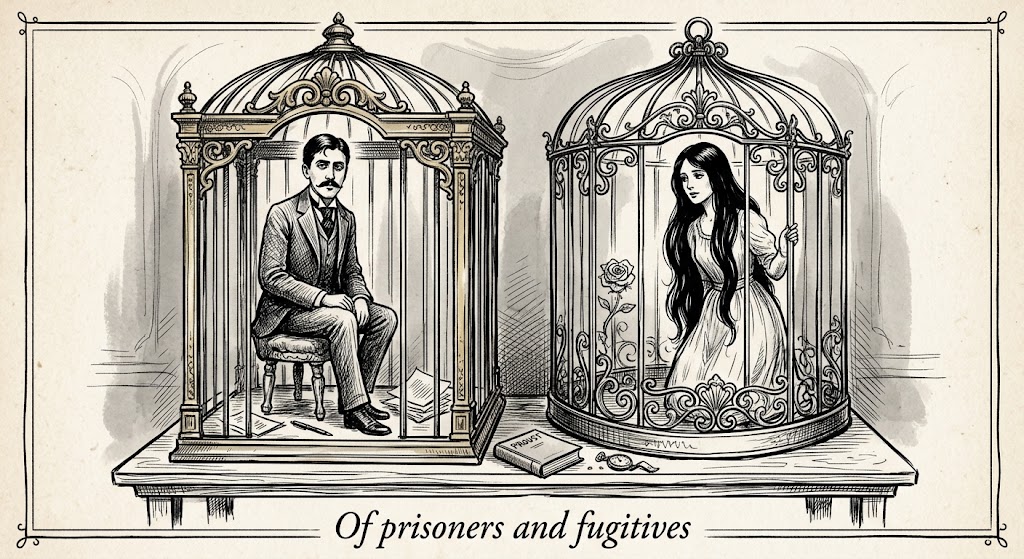
Mara: This piece is about a very specific kind of haunting — not supernatural, but psychological. Marcel sees Albertine everywhere: in parks, in cafés, in the back seats of passing taxis. The question the story keeps pressing is whether he’s searching for her or confirming that she’s permanently out of reach.
Pip: The story builds to a dream sequence where he finally catches her — and that’s when it turns. She lets him take her wrist, and then she speaks. The line she delivers is the spine of the whole piece: “J’ai échappé à ton emprise, mais tu n’échapperas jamais à la mienne avant ta mort.”
Mara: Which is to say: she has freed herself from his control, but he will never free himself from hers. Not while he lives. That’s the asymmetry the entire story has been constructing — his obsession was always the cage, and she’s the one who walked out of it.
Pip: What makes the earlier sections earn that line is the accumulation. It’s not one sighting — it’s the park, the café mirrors, the bookshop labyrinth, the taxi windows. Each time he closes in, there’s an empty chair, a vanished silhouette, a glass left behind. The city becomes a machine for producing her absence.
Mara: And then in the dream, presence is worse than absence. He feels the warmth of her skin, the resistance of her body — and she looks at him with a coldness he’d never seen in life. The story describes it precisely: not tenderness, but “cette expression presque imperceptible de quelqu’un qui vient de comprendre la faiblesse de son adversaire.” She reads his weakness in the very grip that was meant to hold her.
Pip: He wakes clutching his own wrist. And in the silence, he hears a dress moving away down the corridor. The haunting doesn’t end with the dream — it just changes address.
Mara: That final image does something quiet and devastating. The physical sensation outlasts the vision. His body believes what his mind cannot resolve.
Pip: Possession running in both directions, and only one of them voluntary — that’s the real subject here, and it doesn’t close tidily.
Mara: Grief that behaves like desire, desire that behaves like a trap — the story leaves those categories deliberately tangled.
Pip: Next time, we’ll see where else on the site that knot gets pulled. Don’t go anywhere.
Leave a Reply