Pip: Welcome to osoparavos.com, where the reading list is long, the sentences are longer, and someone has apparently been thinking very hard about what happens to your brain when you finish a seven-volume French novel.
Mara: That someone is Adam Donaldson Powell, and the territory today runs from Proust’s novel and what it does to readers, through the long history of how artists get made, and into neuroscience’s stranger edges — what the brain becomes when life interrupts it.
Pip: A natural trio. Let’s start with Proust.
—
Reading Proust: Process, Memory, and the Self
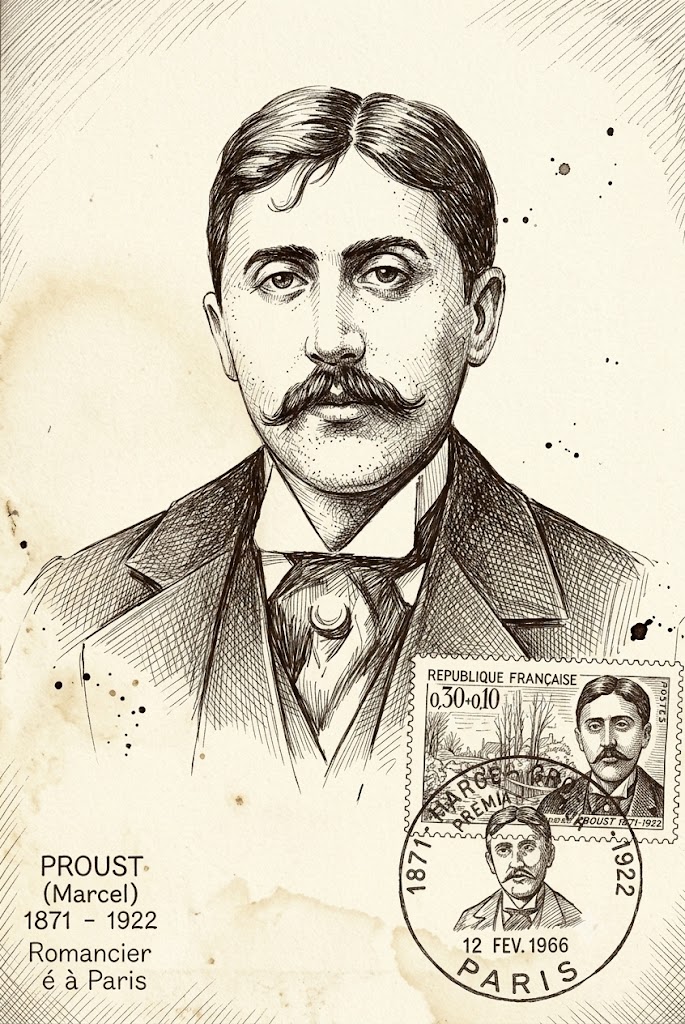
Mara: The central question here is whether finishing In Search of Lost Time is an achievement or an experience — and whether those two things are the same.
Pip: The post draws that line sharply: “The former is a process, an encounter, sometimes an ordeal, and occasionally a revelation. The latter is a statement of completion.”
Mara: And the stakes of that distinction are real. If you treat the novel as a monument to be conquered, you miss what it’s actually doing — which is teaching you to read differently, to tolerate uncertainty, to sit with what you haven’t yet understood.
Pip: There’s a certain irony the post doesn’t let go of: a novel so precise about social vanity can itself become a social credential. Announcing you’ve read all seven volumes is, as it notes, a way of declaring cultural distinction.
Mara: Right, and the post asks readers to examine their own motives honestly. Most are mixed — genuine curiosity alongside the appeal of belonging to the company of those who’ve done it.
Pip: Before the Masterpiece takes that further by reading Jean Santeuil, Proust’s abandoned early novel, as a record of an artist who had the material but hadn’t found the form. The impressions are there; the unifying principle isn’t.
Mara: The post on the Proust hangover names the aftermath: finishing the novel can feel like losing a close friend, because readers spend months inside the narrator’s consciousness. It recommends a reading sequence — Tadié’s biography first, then the novel, then William C. Carter’s Proust in Love — as a way of processing the exit.
Pip: And the literary analysis of Time Regained takes the ending seriously as both a philosophical triumph and a dramatic problem. The verdict: “conceptually magnificent but dramatically imperfect.”
Mara: The circular structure — the narrator discovers the conditions under which he can begin the very book we’ve been reading — is described as one of the most audacious moves in modern literature. The execution, shaped partly by posthumous editing, is another matter.
Pip: The LGBTQ reception piece, written in Portuguese and examining Brazil, Argentina, Europe, and the United States, adds another angle: how different communities have made Proust’s treatment of desire, secrecy, and social performance into a resource for thinking about their own experiences.
Mara: That piece is careful to distinguish cultural influence from documented readership, and critical recognition from uncritical celebration. Proust can be important to queer readers precisely because his representations are contradictory — revealing and limited at once.
Pip: So reading Proust is less a destination than a set of questions you keep carrying. Which is, presumably, the point.
Mara: That tension between what we learn and what we carry — between training and vision — runs into the next question too.
—
How Artists Get Made
Mara: The question here is whether artistic formation follows a single path — and whether formal training leads to originality or away from it.
Pip: The post answers that directly: “Knowing art history is valuable not because every artist must follow established traditions, but because understanding those traditions allows artists to make more deliberate choices about what they want to change, retain, reject, or reinvent.”
Mara: So the upshot is that historical knowledge expands vocabulary rather than constraining it. Picasso’s Cubism wasn’t ignorance of convention — it was a precise transformation of it.
Pip: The companion piece on art galleries frames the institutional side: who decides what gets shown, preserved, and called significant. Galleries have always reflected the values of whoever controls them — church, crown, academy, market.
Mara: And both posts land in the same place: neither formal training nor self-teaching guarantees originality or recognition. What matters is whether the artist can make deliberate choices — and whether the institutions around them create space to do so.
Pip: The brain, it turns out, has its own views on that.
—
The Mind After the Impossible
Mara: The central claim here is that the brain is not a static machine — and that neurological disruption can alter the balance between systems in ways that change perception, motivation, and creative expression.
Pip: The post puts it plainly: “A disruption may produce losses, but it may also reveal capacities that were not previously evident.”
Mara: What this means in practice is that acquired savant syndrome — cases like Jason Padgett’s geometric perception after a head injury, or Derek Amato’s musical improvisation after a diving accident — may involve changes in attention and pattern detection as much as the emergence of entirely new abilities. The post is careful not to overstate what case studies can establish.
Pip: The careful skepticism is actually the most interesting part. The post takes the experiences seriously while refusing to let extraordinary claims outrun the evidence — including on xenoglossy, the alleged spontaneous acquisition of a foreign language, for which it finds no robust scientific support.
Mara: The section on inner voices and experiences of presence follows the same logic. The brain constructs models of the world and monitors the source of its own thoughts. When those processes are altered, a thought may seem involuntary, a mental image may acquire perceptual intensity, a voice may feel like someone else’s.
Pip: And then the mind reaches for a figure to make sense of it — Jesus, Lazarus, the phoenix, Osiris, Chiron. The post reads these not as proof of supernatural contact but as the brain’s way of organizing an experience that exceeds its ordinary categories.
Mara: The closing argument is measured: “We do not need to transform every extraordinary event into a miracle to recognize its importance. Nor do we need to reduce every spiritual experience to an abnormality in order to study its neurological mechanisms.”
Pip: Curiosity, rigor, and compassion as a package deal. Proust would probably have written forty pages about that sentence.
Mara: And then questioned whether he understood it correctly the first time.
—
Pip: Memory that rewrites itself, institutions that shape who gets seen, brains that reorganize after the impossible — all of it circles the same question: how does a person make meaning from experience that exceeds their existing categories?
Mara: Next time, we’ll see what else is on the site. The search continues.
Leave a Reply