
Pip: Osoparavos.com — where the past is never quite past, and the city always has a second life running underneath the official one.
Mara: Today we’re in the work of Adam Donaldson Powell, and the territory is queer Paris at the turn of the twentieth century — desire navigated in code, identity lived in the margins, and the hidden geography of a city that belonged to some people only after dark.
Pip: Let’s start with the prose itself — and what it means to write a world that couldn’t write itself.
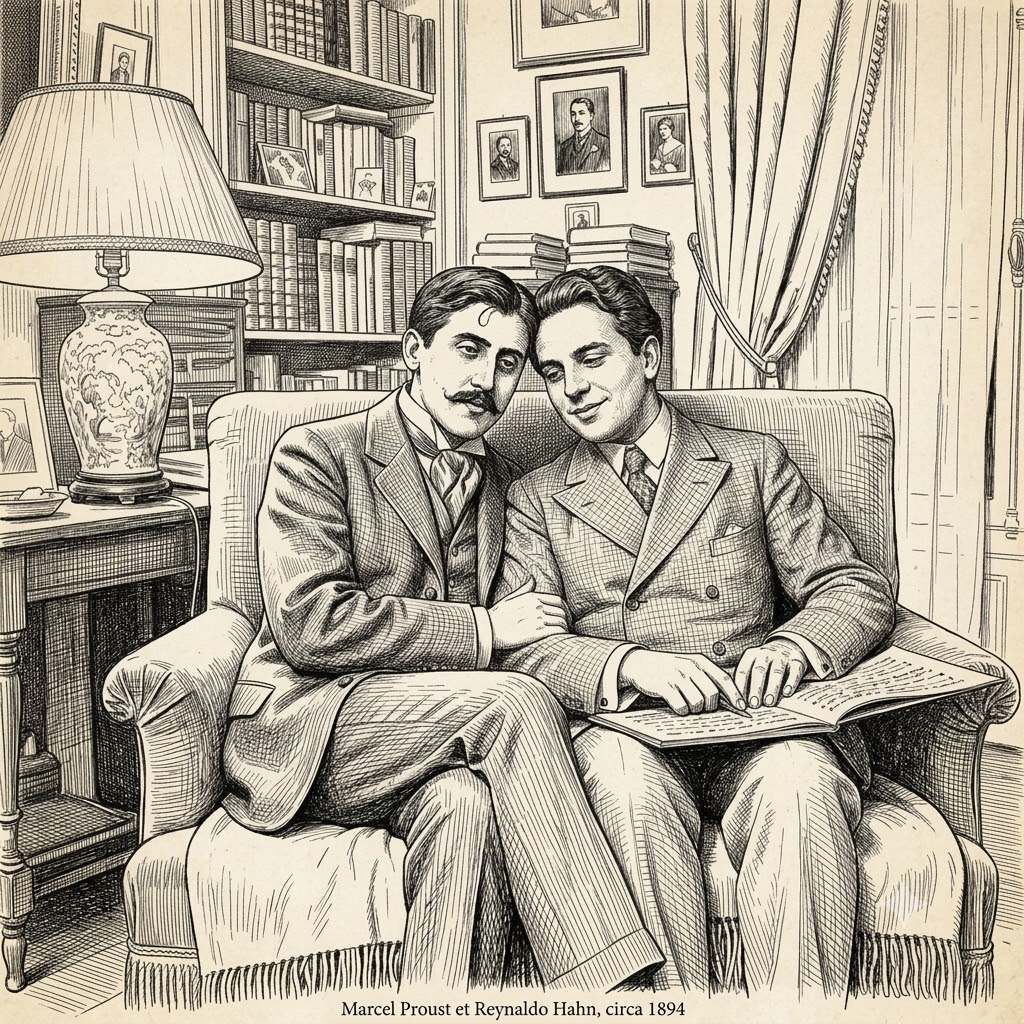
Entre Nous et Eux — Queer Paris in the Shadows
Mara: The piece frames its whole world in the opening line — there was us, and there was them, and between the two, an entire universe that went unspoken, unwritten, lived mostly when the city closed its eyes.
Pip: That’s the tension the whole piece holds: a community with a complete interior life, and no sanctioned language for any of it.
Mara: The prose delivers that interior life in precise detail. Here’s the passage at the center of it: “C’était notre alphabet, notre argot silencieux, notre langue à l’envers. Le verlan avant le mot, le secret avant la parole.” Our alphabet, our silent slang, our language in reverse — the secret before the word.
Pip: So the form mirrors the content. Verlan — French back-slang — becomes the metaphor for an entire coded existence, where meaning travels sideways because it cannot travel straight.
Mara: And the piece is meticulous about the mechanics of that code. The way a man holds his cane, crosses his legs, lingers in front of a shop window without looking at anything. A wrist exposed, a nape offered, a smile addressed only to you.
Pip: A whole semiotics of survival, running parallel to the city’s official one.
Mara: The danger is equally specific. A police officer’s face under his cap, the laughter of a bourgeois who recognizes another bourgeois too clearly, the brutality of a gang in a lightless street. And then morning — described as “ce matin terrible,” that terrible morning when lovers became strangers again.
Pip: The cruelest enforcement wasn’t legal. It was daylight.
Mara: What the piece finally insists on, though, is that this wasn’t only suffering. There were bursts of laughter, nights of celebration, friendships that outlasted love affairs. And the closing image earns its weight: “nous n’étions pas leurs ombres. Nous étions leurs secrets.”
Pip: We were not their shadows. We were their secrets. That’s a different kind of claim entirely — not erasure, but possession.
Mara: The subtitle places this in Paris around 1905, and the verlan form is part of the argument — language itself bent to accommodate lives that official culture refused to name.
Pip: A city inside the city, built from desire and necessity, in the gaps between the hours that belonged to everyone else.
Mara: What stays with me is that phrase — a secret Paris, made in the interstices of its nights.
Pip: Cities have always had that second layer. Next time, more of what lives underneath.

Leave a Reply